HRV in Plain English: Beat-to-Beat Variation Explained
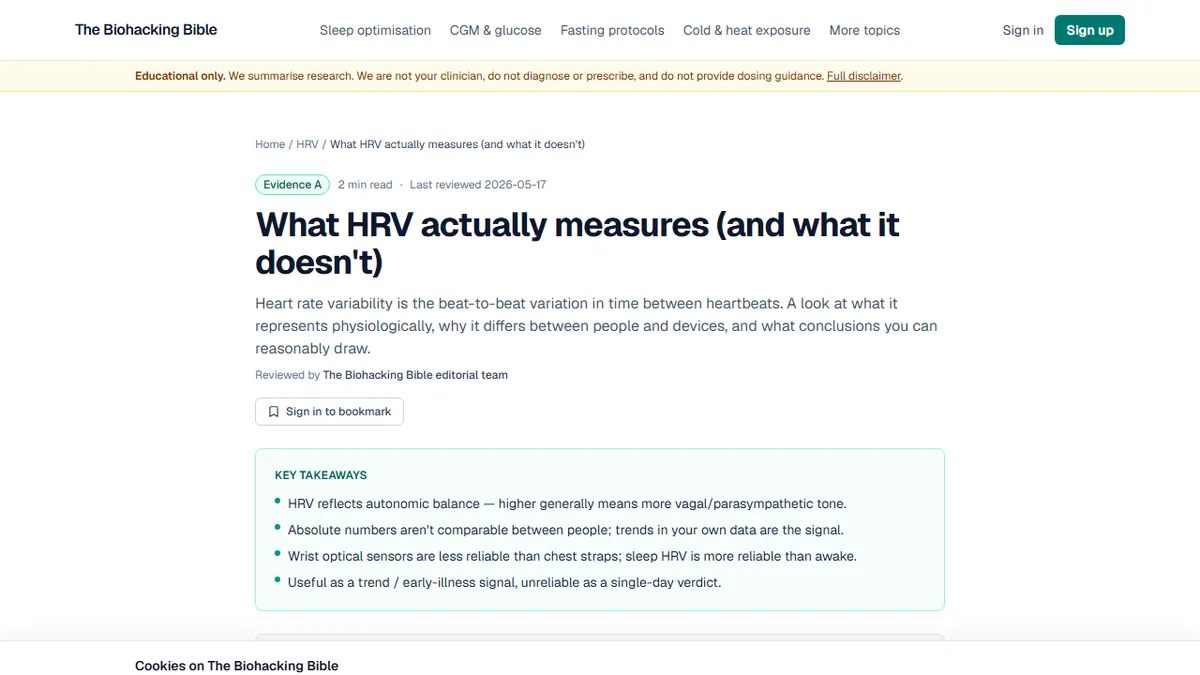
Your heart does not beat with the mechanical regularity of a metronome. Even at a resting heart rate of sixty beats per minute, the actual interval between consecutive heartbeats varies, sometimes by tens of milliseconds. That variation is not a sign of irregularity or malfunction; it is a feature of a healthy, adaptable cardiovascular system.
Heart rate variability is simply the quantification of that variation. Understanding what heart rate variability actually represents physiologically requires some basic autonomic nervous system context. The heart is under continuous competing influence from two branches of the autonomic nervous system: the sympathetic branch, which accelerates the heart and reduces beat-to-beat variation, and the parasympathetic branch, which slows the heart and increases variation. Higher HRV, broadly speaking, reflects greater parasympathetic influence, a state associated with rest, recovery, and cardiovascular adaptability.
This is why HRV has attracted interest as a health and performance metric. It is a window into the balance between the two autonomic branches, and that balance is influenced by sleep quality, training load, illness, alcohol, stress, and a range of other factors that matter for health and recovery.
RMSSD vs SDNN: Which Metric Your Device Uses and Why It Matters
Most consumer wearables report HRV as a single number, but behind that number sits one of two calculation methods, and the methods measure related but distinct things.
The practical difference between RMSSD and SDNN metrics is important for interpreting your readings. RMSSD (Root Mean Square of Successive Differences) captures short-term beat-to-beat variation and primarily reflects parasympathetic activity. It is the metric most consumer devices use, including Oura and Whoop, because it is relatively robust to measurement artefacts and less influenced by respiratory patterns during the measurement window.
SDNN (Standard Deviation of all Normal-to-Normal intervals) captures both short and long-term variation across an entire recording and reflects overall autonomic variability. It is the metric more commonly used in clinical settings (Holter monitors, formal cardiac assessments) because it captures a broader picture of autonomic function over hours. A clinical SDNN reading and a consumer device's overnight RMSSD are not directly comparable, even when both are described as "HRV."
This distinction matters when you are reading general claims about HRV and health outcomes. Much of the cardiovascular risk literature uses long-recording SDNN. Much of the sports recovery research uses RMSSD. They overlap conceptually but are not interchangeable numbers.
What High HRV Predicts (And What It Doesn't)
Higher HRV is consistently associated with better cardiovascular outcomes, lower all-cause mortality, and better athletic performance in the epidemiology literature. This makes it a genuinely interesting health signal. But the associational nature of most HRV research means the prediction is probabilistic and population-level, not individual and prescriptive.
A high overnight RMSSD does not guarantee you are healthy or well-recovered. A low reading does not mean you are sick or overtrained. HRV reflects the current state of your autonomic nervous system, which is influenced by dozens of overlapping factors. Several of those factors (notably alcohol, caffeine timing, and ambient temperature) can produce substantial acute changes in HRV that do not reflect anything meaningful about your underlying health trajectory.
The most useful thing HRV offers individual users is not a single reading, but a baseline and the ability to detect meaningful deviations from it.
Why Your HRV Varies Day to Day
A reading that looks dramatically different from the previous day often triggers anxiety in new HRV users. Understanding the major sources of variation reduces that anxiety and improves the quality of your self-interpretation.
Alcohol is the most powerful acute HRV suppressor most people will encounter. Even two to three drinks can produce next-morning RMSSD readings that are twenty to forty percent below baseline in sensitive individuals. Late exercise, particularly high-intensity training within three hours of sleep, has a similar effect. Poor sleep quality, regardless of cause, reduces next-morning HRV.
Temperature is an often-overlooked factor. A warmer sleeping environment, or even a warmer room during the measurement window, can lower HRV independently of recovery status. If you wake up noticeably warmer than usual and see a low HRV reading, temperature may be the more relevant variable.
How to Interpret Trends vs Single Readings
This is the most practically important principle in consumer HRV use. A single overnight reading is noisy. A seven-day rolling average, or better, a thirty-day baseline, provides a reference point against which individual nights become interpretable.
Most consumer apps build some version of this into their interface: Oura uses a monthly baseline, Whoop uses a rolling sixty-day window. The devices are trying to answer the question "how does today's reading compare to your personal normal?" rather than "is this number objectively high or low?" The second question is largely unanswerable without knowing your individual normal, because HRV baselines vary enormously between individuals.
A healthy 25-year-old athlete and a healthy 55-year-old non-exerciser will have very different absolute RMSSD values, both of which are appropriate for their physiology.
Three Common Mistakes When Reading HRV Data
Comparing your number to other people's. HRV declines with age, varies with sex, and differs substantially between aerobic athletes and sedentary individuals. The only meaningful comparison is your own baseline.
Reacting to single readings. One low overnight score does not warrant cancelling training or overhauling your sleep protocol. A persistent trend below your baseline for five or more consecutive days is worth paying attention to.
Using HRV to diagnose health conditions. Consumer HRV devices are wellness tools, not medical devices. They are not validated for diagnosing cardiovascular conditions, autonomic dysfunction, or any specific pathology. If you have genuine concerns about your heart rhythm or autonomic function, those warrant a clinical assessment with validated equipment.
This article is for educational purposes only and does not constitute medical advice.