On this page
What the KIHD Cohort Is and Why It Matters
The Kuopio Ischaemic Heart Disease Risk Factor Study, known as KIHD, is one of the most cited sources in longevity wellness discussions about sauna. It is a Finnish prospective cohort study that began enrolling middle-aged men in the Kuopio region in the 1980s and has followed their health outcomes for decades. Because sauna use is deeply embedded in Finnish culture, the study captured detailed sauna habits alongside comprehensive cardiovascular and mortality tracking, a combination rarely available to researchers elsewhere.
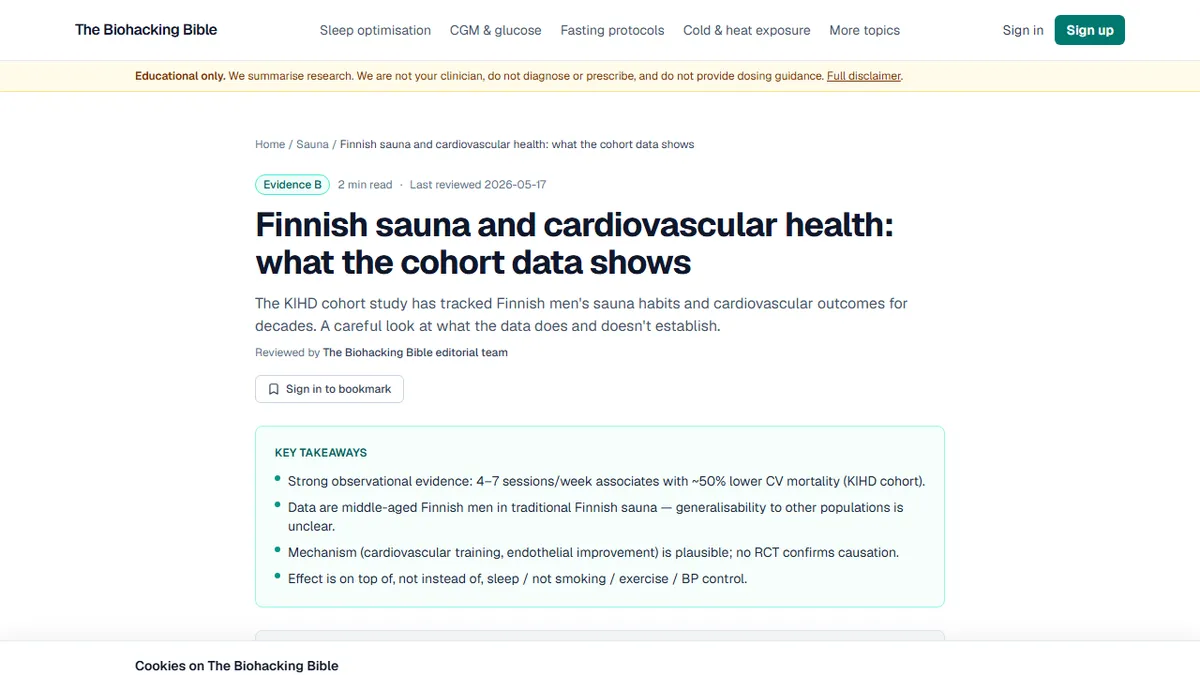
The KIHD data attracted international attention when analyses published in the 2010s found that men who used the sauna four to seven times per week had markedly lower rates of fatal cardiovascular events than men who used it once per week. The association was strong, consistent across several outcome categories, and plausible given sauna's known cardiovascular effects.
Decades of KIHD cohort data on sauna and cardiovascular outcomes does represent a genuinely compelling body of evidence. But the kind of evidence (observational, in a specific population, following people over many years) comes with constraints that often get lost when the findings travel from academic journals into wellness content.
Cardiovascular Findings: Association vs Causation
The central cardiovascular finding is that frequent sauna users in the KIHD cohort had lower rates of sudden cardiac death, fatal coronary heart disease events, and all-cause mortality. The dose-response relationship, with benefits increasing at higher sauna frequency, is one of the more persuasive features of the data.
What the study cannot establish is whether sauna use caused these reduced rates. Randomised controlled trials, which are the standard for establishing causation, are extremely difficult to conduct on something like sauna use. You cannot blind participants to whether they are using a sauna, and multi-decade randomised trials in large populations are not feasible. The KIHD data is associational, and association is not causation.
Regular sauna users in Finland may differ from infrequent users in ways that the analysis did not fully capture: they may have lower baseline cardiovascular risk, better socioeconomic status, more social connection (saunas in Finland are often shared social spaces), greater physical activity levels, or healthier overall lifestyles. Confounding is a genuine limitation, and the study authors have generally been careful to acknowledge it even when wellness media summaries have not.
Frequency and Duration: What Dose Shows Up in the Data
The KIHD analyses examined sauna sessions lasting fifteen to thirty minutes at temperatures of approximately 79–100 degrees Celsius. The cardiovascular benefits were most pronounced in the highest-frequency group (four to seven sessions per week) compared with those using sauna just once weekly.
This dose-response is often cited to recommend very frequent sauna use. A more cautious reading notes that the differences between sauna frequency groups in the KIHD cohort may partly reflect differences in lifestyle, health, and socioeconomic factors rather than a simple cause-and-effect relationship between session frequency and health outcomes.
For practical purposes, the data is most credibly interpreted as suggesting that regular sauna use, perhaps two to four times per week and in conditions similar to those in the study, is associated with cardiovascular health in the population studied.
What the Evidence Cannot Tell Us: Confounders, Lifestyle, and More
There are several important limitations that careful readers should carry into any discussion of sauna research.
The KIHD cohort is exclusively middle-aged Finnish men. Finland has among the highest sauna densities in the world, sauna culture there differs from anywhere else, and the study population's genetics, diet, and baseline activity levels differ from most other populations. Whether the cardiovascular associations generalise to women, to people of different ethnicities, or to populations with different baseline habits is not established by this data alone.
The thermal conditions of traditional Finnish saunas — high dry heat, typically above 80 degrees Celsius — are also not consistently reproduced in commercial wellness saunas in other countries, many of which operate at lower temperatures and use different humidity profiles.
Infrared vs Traditional: Does the Research Transfer?
This is a question that genuinely matters given how many commercially available sauna options are infrared rather than traditional. Whether infrared sauna evidence matches traditional sauna research is a question the evidence does not clearly resolve in infrared's favour.
Infrared saunas heat the body differently — using radiant heat absorbed by the body rather than convective heat from hot air — and operate at lower ambient temperatures, typically 45–65 degrees Celsius. Whether the physiological effects are equivalent to traditional sauna at 80–100 degrees Celsius for the same duration is not established by the KIHD data, which studied traditional saunas exclusively. There are smaller trials on infrared saunas, but they do not yet provide the same depth or duration of evidence as the Finnish cohort literature.
Safety: Who Should Be Cautious or Avoid Sauna Altogether
Sauna is generally safe for healthy adults. The major contraindications are poorly controlled cardiovascular conditions, recent heart attack or stroke, certain arrhythmias, and severe hypotension. Alcohol and sauna is an established safety concern — the combination appears in Finnish mortality data as a notable risk factor, and the impaired thermoregulation and cardiovascular load associated with drinking before or during sauna use are not trivial.
Pregnant women are advised to avoid sauna due to concerns about elevated core body temperature in early pregnancy. People on medications that affect thermoregulation or blood pressure should seek medical advice before using sauna regularly.
A Sober Summary of What Sauna Is Actually Good For
The honest position is that regular traditional sauna use is associated with cardiovascular benefit in one well-conducted but observational study of a specific population, that the mechanism is plausible and corroborated by shorter-term physiological studies, and that sauna as a practice carries low risk for healthy adults.
It is not a proven treatment for any specific condition, the evidence does not yet establish that infrared saunas produce equivalent benefits to traditional saunas, and the dose required to achieve the associations seen in KIHD data is probably higher than casual wellness centre use provides. Approached with those constraints in mind, it is a genuinely interesting health practice with a better evidence base than most.
This article is for educational purposes only and does not constitute medical advice.