What the Small Claims Track Is — and What It Is Not
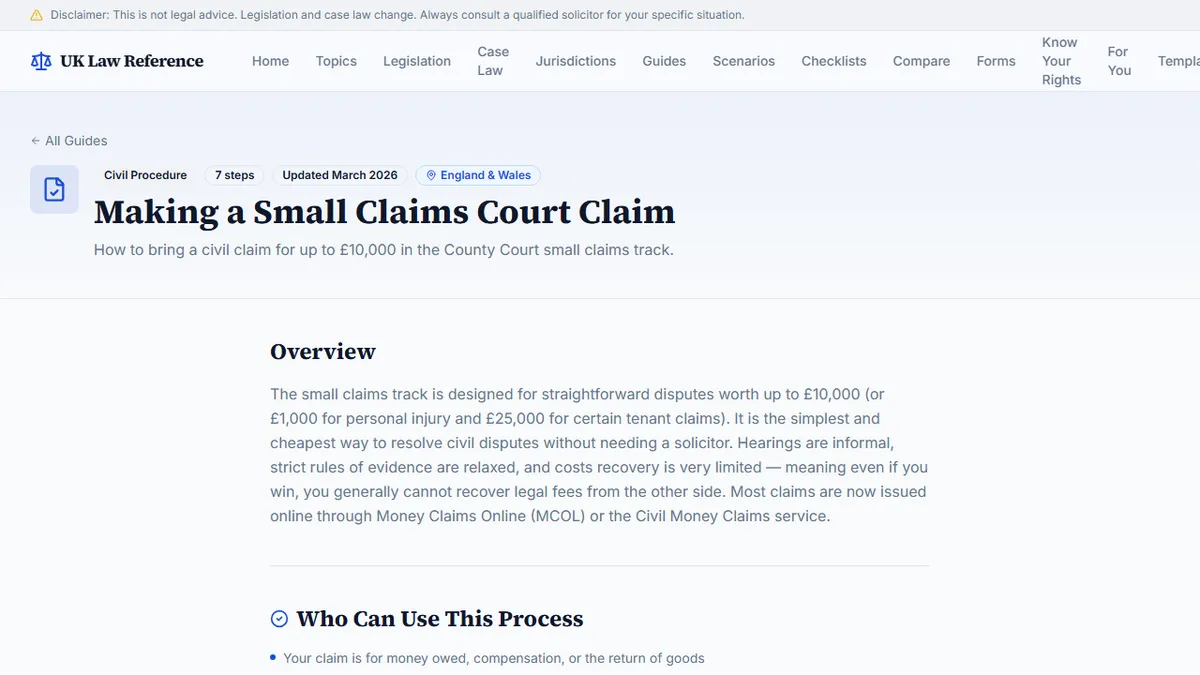
The small claims track is not a separate court. It is a case management procedure within the county court system, designed to handle lower-value disputes with a simplified approach to evidence, procedure, and costs. Cases are heard by a district judge, often in a room that looks more like a meeting space than a traditional courtroom, and the atmosphere is considerably less formal than higher-value litigation.
What makes the small claims track distinctive, and genuinely useful, is its approach to legal costs. Unlike other civil tracks, the general rule is that even if you win, you cannot recover your legal fees from the losing party. This has a double effect: it makes the process more accessible for unrepresented claimants, because hiring a solicitor becomes financially irrational when costs cannot be recovered. The procedural guide to the small claims track sets out the full county court process, but the core design principle is accessibility for people navigating it alone.
Is Your Claim Suitable? Value Limits and Subject Matter
The standard financial limit for the small claims track in England and Wales is £10,000, though personal injury claims are capped at £1,500 and housing disrepair claims at £1,000 for damages (though higher where the work itself is the remedy sought). Claims above these limits can be allocated to the small claims track by consent, but otherwise move to the fast or multi-track with correspondingly higher costs implications.
Subject matter also matters. The small claims track handles straightforward consumer disputes, unpaid debts, minor contract disputes, property damage claims, and many landlord-tenant disagreements. It is not suitable for claims requiring extensive expert evidence, complex questions of law, or where a party faces injunctive relief. If your dispute involves simply proving that money is owed and not paid, you are very likely in the right track.
Filing Online: Form N1 and the Money Claims Service
For money claims below £10,000, the Money Claim Online service (MCOL) allows you to issue proceedings without visiting a court. You complete an online form, identify the defendant and the basis of your claim, and pay the issue fee. The claim is then served on the defendant, who has fourteen days to respond. If they do not respond within that period, you can apply for judgment in default, often without attending a hearing at all.
If the defendant disputes the claim, the case is transferred to your local county court and allocated to a track. Before the hearing, the court will issue a directions order requiring both parties to exchange documents and send statements to each other. Following these directions is not optional; failing to comply can result in the court refusing to allow evidence or, in serious cases, striking out a party's case entirely.
Court Fees and How to Apply for Fee Remission
Court fees are calculated as a percentage of the claim value. For a claim of £1,000 you will pay £70; for a claim at the full £10,000 cap the fee is £455. These amounts are paid at issue and can be recovered as part of the judgment if you win. There are also potential hearing fees if the case proceeds to a contested hearing, typically in the range of £25 to £335 depending on value.
If you are on a low income or receive certain means-tested benefits, you may qualify for full or partial fee remission through the Help with Fees scheme (Form EX160). It is worth checking eligibility before filing, since the test is based on your disposable monthly income rather than capital and many working people qualify. Submitting EX160 alongside your claim form does not delay the process.
Building Your Evidence Bundle Before the Hearing
The single most important thing you can do before a small claims hearing is prepare a well-organised bundle of documents. The judge will have limited time — small claims hearings are typically listed for thirty to sixty minutes — and will form an initial impression of your case within the first few minutes based on how clearly you have presented the facts and supporting documents.
A strong bundle follows a logical order: a short covering summary of the dispute, the contract or agreement underlying the claim, correspondence showing the steps taken to resolve the matter informally, evidence of the loss or damage, and any expert report if relevant. Each document should be numbered. Use the pre-hearing preparation checklist to ensure nothing important is missing. Avoid including irrelevant material — judges notice when parties have padded their bundle and it makes finding the important documents harder.
Hearing Day: What the Judge Is Actually Looking For
District judges hearing small claims are looking for a clear, honest account supported by documentary evidence. They are not looking for legal argument, dramatic courtroom rhetoric, or an attempt to discredit the other party through speculation. The questions a judge typically asks are simple: what was agreed, what went wrong, how was loss caused, and what would make things right.
The most common error unrepresented claimants make in the hearing is responding to questions they were not asked, volunteering information that undermines their case, or becoming confrontational with the judge. When you are asked a question, answer it directly and briefly. If you do not know the answer, say so. Judges are experienced at reading credibility across hundreds of cases and are not fooled by elaboration that does not match the documents.
If You Win: Enforcing a Judgment That Gets Ignored
Winning a small claims judgment is only half the process. A defendant who refuses to pay will not be chased by the court automatically. Enforcement is the claimant's responsibility. The most common enforcement routes are a warrant of control (authorising bailiffs to seize goods), a third-party debt order (freezing money in the defendant's bank account), or an attachment of earnings order if the defendant is employed.
Before choosing an enforcement method, check that the defendant has assets or income to enforce against. Pursuing enforcement against someone who is genuinely unable to pay is expensive and unlikely to produce a return. Where there is doubt, applying for an oral examination — requiring the defendant to attend court and explain their finances — can help establish which method is likely to succeed.