Why Procedure Beats Merit in Many Tribunal Cases
Employment tribunals hear thousands of unfair dismissal cases each year, and a disquieting number of them fail not because the claimant lacked a genuine grievance, but because they made procedural errors in the days or weeks immediately following dismissal. The merits of a case (whether the employer behaved reasonably, whether there was genuine misconduct, whether process was followed) only become relevant once the claim has cleared a series of procedural gates. Miss any one of those gates and the tribunal never gets to consider whether what happened to you was unfair at all.
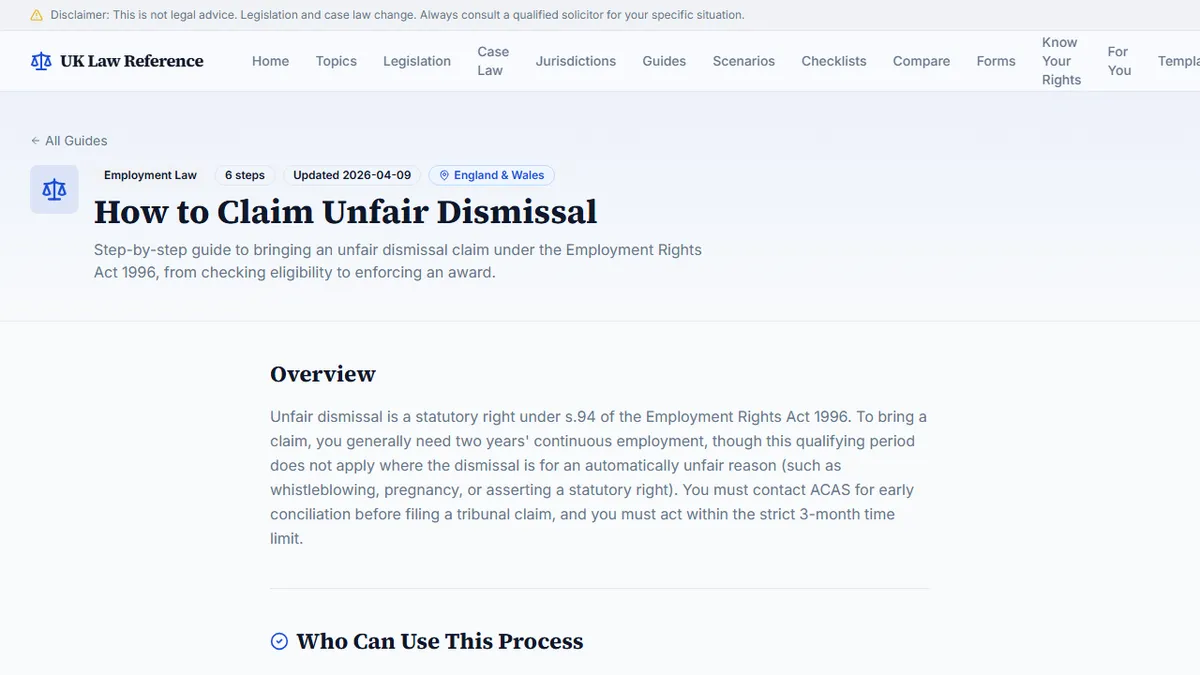
This matters because many recently dismissed employees focus entirely on gathering evidence and building their substantive argument while the procedural clock is already running against them. A step-by-step unfair dismissal claim guide will walk you through the full process, but first it is worth understanding which early mistakes are catastrophic and which can be recovered from.
Mistake 1: Missing the Three-Month Minus One Day Deadline
The primary time limit for bringing an unfair dismissal claim to an employment tribunal is three months minus one day from the effective date of termination. That date is typically the last day of employment, though it can be the date notice was given in certain circumstances. Courts interpret this deadline strictly, and tribunals have very limited discretion to extend it.
The standard for extending time is whether it was "not reasonably practicable" to file within the period — a test that is deliberately narrow. Ignorance of the law, emotional distress, or difficulty finding a solicitor will rarely satisfy it. Even claimants who were hospitalised or dealing with a family bereavement have found tribunals unwilling to grant extensions. If you have been dismissed, treating this deadline as absolute from day one is the safest approach.
Mistake 2: Skipping ACAS Early Conciliation
Before lodging a claim with the employment tribunal, claimants must first notify ACAS and allow an Early Conciliation period to run. This is not optional. A claim submitted to the tribunal without an ACAS Early Conciliation certificate will be rejected.
The good news is that the time spent in Early Conciliation effectively pauses the three-month clock, so engaging with ACAS promptly does not cost you time. The bad news is that claimants who discover the requirement at the last moment and rush through it without engaging genuinely may find the conciliation period produces no outcome — and they have wasted the goodwill that might have produced a settlement. ACAS conciliation is free and can result in a binding settlement that pays significantly more than a tribunal award in some cases. Treating it as a formality to be ticked off rather than a genuine opportunity is itself a missed chance.
Mistake 3: Resigning and Expecting the Same Protections
An employee who resigns does not, in general, have the same automatic right to claim unfair dismissal as one who was dismissed. Resignation severs the employment relationship voluntarily, and the tribunal will not treat it as a dismissal unless the claimant can establish constructive dismissal — that is, that the employer committed a serious breach of the employment contract that left resignation as the only reasonable response.
Constructive dismissal claims are substantially harder to win than straightforward unfair dismissal claims. They require the employee to demonstrate a repudiatory breach and to have resigned promptly after it. Many employees who feel driven out of a job by poor treatment resign believing this automatically entitles them to tribunal protection, when in fact they have given up the simpler claim in favour of a significantly more demanding one.
Mistake 4: Failing to Raise a Formal Grievance First
While there is no absolute legal requirement to raise a formal grievance before bringing a tribunal claim, failing to do so can have real financial consequences. If a tribunal finds that a claimant unreasonably failed to follow the ACAS Code of Practice on disciplinary and grievance procedures (which recommends raising concerns through internal channels first), it can reduce any award by up to 25 per cent.
For employees who were dismissed following a disciplinary process, engaging properly with that process (attending hearings, providing written responses, appealing decisions) is essential. A claimant who refused to engage with internal procedures without good reason will find a tribunal less sympathetic even where the underlying dismissal was unfair.
Mistake 5: Destroying or Deleting Workplace Evidence
In the hours and days after dismissal, many people's instinct is to delete emails, remove documents, or wipe work devices out of a sense of dignity or in protest at what has happened. This is a serious error. The documents you have legitimate access to at the time of dismissal (emails sent to you, documents shared with you in the ordinary course of work) are potentially vital evidence and you are entitled to retain copies.
Deliberately destroying material you know is relevant to a potential claim can constitute interference with the tribunal process. More practically, once dismissed you lose access to your employer's systems, and the documents you already hold may be the only contemporaneous evidence of what was said or decided. A thorough evidence checklist for unfair dismissal covers what to preserve and how to organise it.
What to Do If You Have Already Made One of These Errors
Not every procedural mistake is fatal. Missing the ACAS conciliation step can sometimes be corrected if caught quickly. The three-month deadline, while strict, can occasionally be extended where the claimant genuinely had no reasonable means of compliance. A solicitor or Citizens Advice Bureau can assess whether there is an argument for extension and what evidence would support it.
What you cannot do is assume the problem will resolve itself or that a tribunal will be lenient because your underlying case is strong. The procedural rules exist for good reason, and tribunals apply them consistently. The earlier you get proper advice after dismissal, the more options remain open.