Why Security Scans Alone Do Not Satisfy Compliance Auditors
A security scanner report and a compliance audit report are not the same document, but they can share a significant amount of underlying evidence. The critical difference is that compliance auditors do not evaluate findings in isolation. They evaluate findings against specific control requirements drawn from a named framework. A finding that says "outdated plugin with known CVE" is a security observation. A finding that says "outdated plugin with known CVE, relevant to PCI-DSS 4.0 Requirement 6.3.3 (software components up to date)" is audit evidence.
The gap between these two outputs is not a technical one. It is an organisational one: the checks being run are often identical, but without framework tags attached to each check, the output cannot be directly cited in a compliance report. Organisations that understand this use security scanning as the evidence-generation engine for compliance activities, provided their scanner tags each check appropriately.
The 15 Frameworks Worth Tagging: From OWASP to FedRAMP
A mature WordPress security scanner maps its checks against frameworks that span technical security standards, industry-specific regulations, and international management standards. The full set worth covering includes OWASP Top 10, MITRE ATT&CK, CWE, D3FEND, PCI-DSS 4.0, NIST 800-53, NIST CSF, ISO 27001, HIPAA, SOC 2, HITRUST, CMMC, CIS Controls, FedRAMP, and GDPR/CCPA.
The practical value of this breadth is that a single scan can generate evidence for multiple simultaneous compliance requirements. An e-commerce site might need PCI-DSS evidence for its payment processor, GDPR evidence for its European users, and SOC 2 evidence for a B2B customer who requires it contractually. Running three separate scans for three separate compliance programmes is a waste of resources when a single scan with multi-framework tagging covers all three.
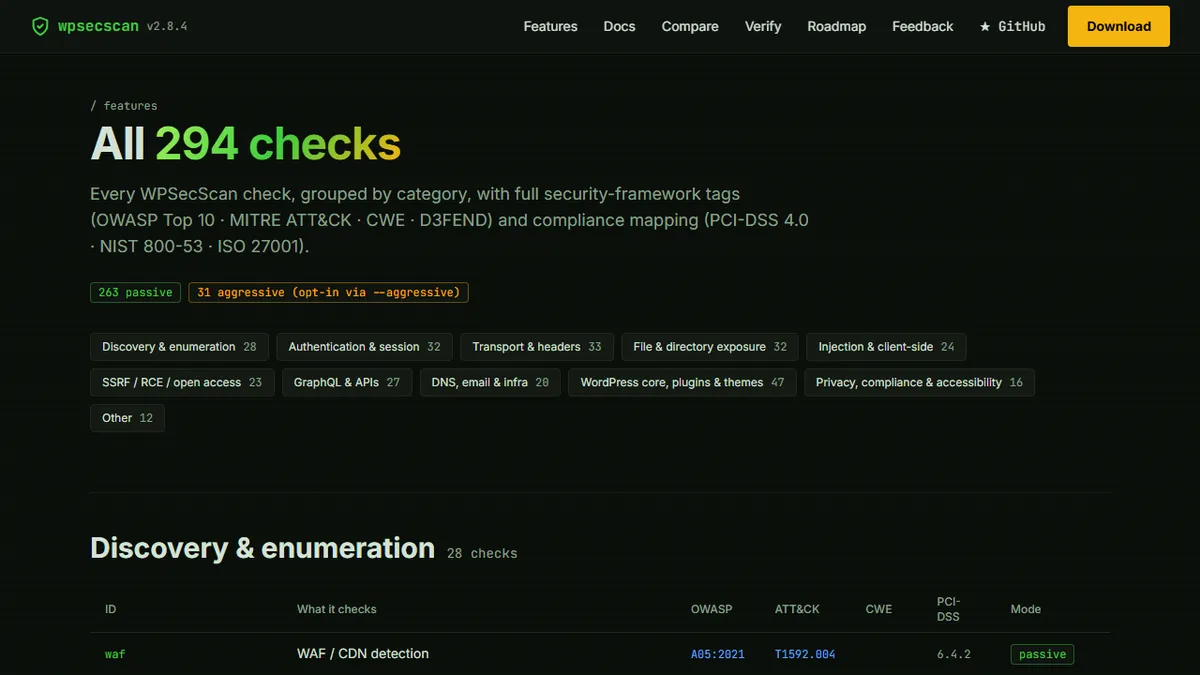
For the compliance framework tag coverage across all 294 checks, each check carries tags for every framework it maps to, enabling filtered report generation by framework.
PCI-DSS 4.0: What WordPress Sites Need to Demonstrate
PCI-DSS 4.0 (the most recent major revision of the Payment Card Industry Data Security Standard) introduced several requirements that have direct implications for WordPress sites processing card payments. Requirement 6.3 specifically addresses software components and their vulnerabilities, requiring that organisations identify all authorised software and protect against known vulnerabilities. This maps directly to plugin and theme version auditing, which is one of the most straightforward automated checks.
Requirement 8 covers authentication and access controls — login rate-limiting, session management, multi-factor authentication for administrative accounts, and password complexity. A scanner that checks these controls and tags findings against PCI-DSS 8.x requirements generates evidence that an auditor can use to assess control compliance.
Transport layer requirements under PCI-DSS 4.0 have also tightened. TLS 1.0 and 1.1 are prohibited; the supported cipher suite must exclude weak algorithms; and certificate health must be verifiable. Automated TLS auditing with PCI-DSS tagging produces the evidence needed for these requirements without manual testing.
HIPAA Technical Safeguards and How They Map to Scanner Checks
Healthcare organisations running WordPress face the Technical Safeguard requirements of the HIPAA Security Rule, which cover access control, audit controls, integrity controls, and transmission security. The common misconception is that HIPAA compliance requires specialised healthcare IT tools. In practice, many of the technical controls are generic web security measures that any capable scanner can verify.
Access control requirements — unique user identification, emergency access procedures, automatic logoff, and encryption of ePHI — translate into authentication audits that check user enumeration exposure, session timeout configuration, and encryption in transit. Integrity controls translate into checks for file modification and tamper detection. Transmission security translates into TLS auditing.
Where HIPAA compliance diverges from general WordPress security is in the documentation requirement. Auditors want to see not just that controls are in place but that the organisation can demonstrate they were tested and verified on a documented schedule. A scanner with HIPAA-tagged checks that exports timestamped reports provides the documentation trail that satisfies this requirement.
GDPR and CCPA: Privacy Checks That Double as Compliance Evidence
GDPR and CCPA compliance has a technical dimension that is often underestimated. Cookie consent mechanisms need to be correctly implemented and auditable. Third-party trackers installed by plugins need to be inventoried and disclosed in a privacy policy. Data subject request workflows need to be functional. A WordPress site that cannot process a deletion request is technically non-compliant regardless of what its privacy policy says.
An automated scanner can check cookie consent implementation, enumerate third-party tracking scripts loaded on page, and identify plugins that may be collecting personal data without adequate disclosure. Each of these findings, tagged with the relevant GDPR article or CCPA provision, becomes compliance evidence rather than just a security observation.
Generating Compliance Reports From Scan Output
The practical workflow for generating compliance-mapped reports is to run a scan with framework filtering enabled, select the target framework for the output, and export in a format that supports structured compliance evidence: HTML for human review, JSON for integration with GRC tools, or PDF for formal submission.
A well-designed compliance report groups findings by framework requirement rather than by technical check category. An auditor reviewing a PCI-DSS 4.0 report wants to see all findings relevant to Requirement 6 in one section, all findings relevant to Requirement 8 in another, not a flat list of technical observations that they must cross-reference against the standard manually.
Maintaining a Continuous Compliance Posture Between Audits
Annual compliance audits create a dangerous cycle: teams scramble to close findings in the weeks before the audit, then let controls drift over the following year. The evidence-based scanning approach works best when scans are scheduled frequently enough that the compliance posture is genuinely maintained rather than temporarily achieved.
Monthly scans with compliance-tagged output, archived as timestamped reports, create a documentary record that demonstrates continuous control effectiveness. When an auditor asks for evidence that a control was operating throughout the year, twelve monthly scan reports are more compelling than a single report generated the week before the audit.
The overhead for this approach is low once the initial scan configuration is in place. The payoff — audit readiness at any point in the year — is considerable for organisations where compliance failure carries regulatory or contractual consequences.