Why Statutory Structure Matters for Ordinary Readers
Federal statutes govern more aspects of daily American life than most people realize: employment rights, drug safety, banking consumer protections, environmental standards, telecommunications rules. When a dispute arises, understanding what the relevant statute actually says is the first analytical step. Yet most people who attempt to read a federal law for the first time give up within minutes, overwhelmed by numbering systems, cross-references, and terminology that seems designed to exclude non-specialists.
The terminology is dense, but the structure is logical. Federal statutes follow a consistent organizational grammar that, once internalized, transforms an intimidating wall of text into a navigable document. This guide teaches that grammar.
The U.S. Code: Titles, Subtitles, Chapters, and Sections
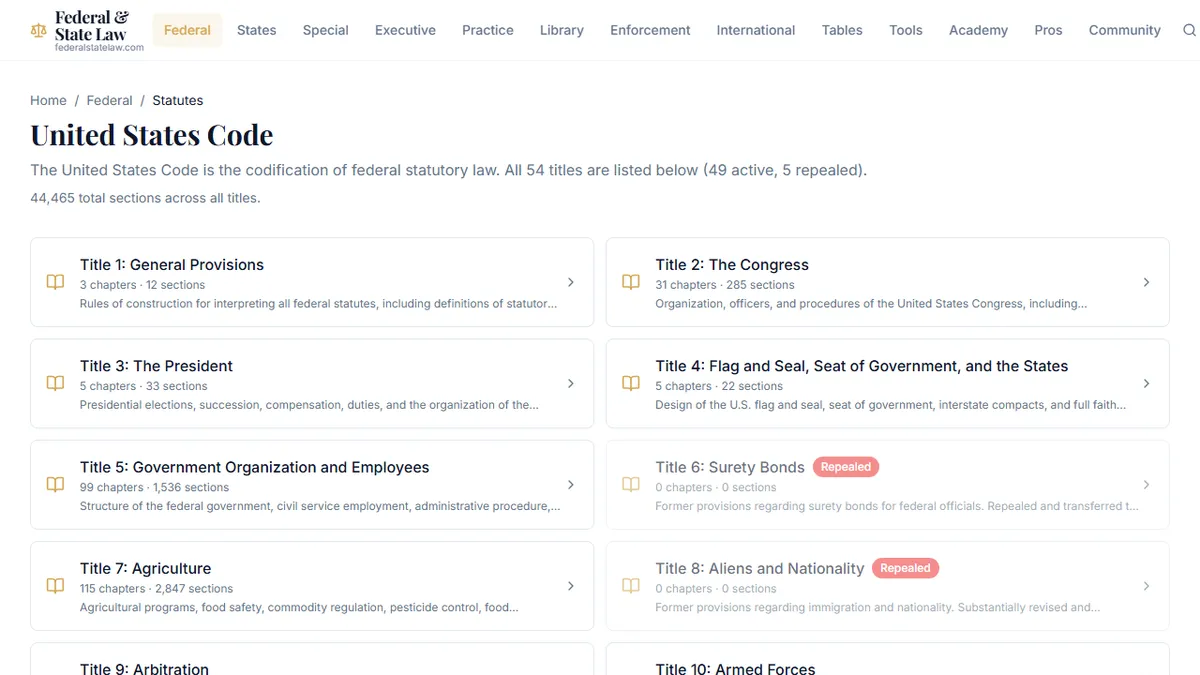
The United States Code is the official compilation of federal statutory law. It organizes all permanent federal laws into fifty-four titles, each covering a broad subject area. Title 11 is bankruptcy. Title 26 is the Internal Revenue Code. Title 42 covers public health and welfare, which contains the bulk of civil rights statutes. Title 29 is labor.
Within each title, the organizational hierarchy flows downward: subtitle, then chapter, then subchapter, then part, then section. Not every statute uses every level (some jump from chapter directly to section), but the numbering always follows a nested logic. The section number is the most important unit for citation purposes. When someone refers to "Section 1983," they mean 42 U.S.C. section 1983, the provision in Title 42 that allows people to sue state officials for constitutional violations.
The full citation format, once you understand it, contains all the structural information you need. "29 U.S.C. section 206" tells you: Title 29 (labor), United States Code, at section 206 (the federal minimum wage provision). You can go directly to the right title and section without navigating through chapters.
Browse the U.S. Code organized by title for direct research to see how this structure looks in practice before reading further.
How to Find the Definitions Section First
Every well-drafted federal statute contains a definitions section, usually near the beginning of a chapter or subchapter. This is the single most important section to locate before reading anything else, and most non-lawyers skip it.
Federal statutes use common English words with precisely defined meanings that frequently differ from everyday usage. "Person" in a federal statute often includes corporations, partnerships, and government entities, not just human beings. "State" sometimes includes territories and the District of Columbia. "Commerce" in a statute enacted under the Commerce Clause may encompass activities that bear only a minimal relationship to buying or selling goods.
Reading a provision that references "any person who knowingly" without first reading the statute's definition of "person" can lead to a completely wrong conclusion about who the law covers. Locate the definitions section (often titled "Definitions" or "As used in this chapter") and read it before proceeding to the substantive provisions.
Cross-References and Amendments: Navigating the Footnotes
Federal statutes are rarely static documents. Congress amends them frequently, and the U.S. Code incorporates those amendments into the existing text without a separate amendment document. When you read a provision in the current U.S. Code, you are reading the version as amended through the most recent legislation, often without any visible signal that the text differs from what Congress originally enacted.
Editorial notes and source notes at the end of each section in official compilations tell you when the section was enacted, when it was amended, and which public laws made those changes. If you are researching what a law said at a specific point in time, for a legal dispute over a past event, you need the version in effect at that time, not the current version.
Cross-references are equally important. A provision will often say something like "as defined in section 101(a)(3)" or "subject to the requirements of part B of this subchapter." Those internal references are structural. You must follow them to complete your understanding of the provision. Treat every cross-reference as a mandatory detour rather than an optional footnote.
Regulations vs. Statutes: What the CFR Adds
A statute is what Congress enacted. A regulation is what a federal agency created under the authority granted by that statute. The two are distinct sources of law that operate together.
The Code of Federal Regulations, or CFR, contains the administrative regulations that agencies have promulgated. The CFR uses a parallel structure to the U.S. Code: fifty titles organized by subject area. Title 29 of the CFR, for example, covers labor regulations. The Occupational Safety and Health Administration's specific workplace safety standards live there, implementing the general authority Congress granted in the Occupational Safety and Health Act.
When a statute says that an agency "shall promulgate regulations" or "may prescribe rules," the resulting regulations in the CFR carry the force of law. To understand how a statute actually operates in practice, you often need to read the relevant CFR provisions alongside the statutory text. The statute sets the framework; the regulation fills in the operative detail.
Practical Walkthrough: Reading a Real Provision Step by Step
Take the Fair Labor Standards Act, which contains the federal minimum wage requirement. The relevant provision is 29 U.S.C. section 206. Before reading section 206, you would locate the Act's definitions section (section 203) to confirm how terms like "employer," "employee," and "enterprise engaged in commerce" are defined. Those definitions determine who the Act covers.
Section 206(a)(1) establishes the specific wage rate. It cross-references the conditions under which higher rates may apply, and section 207 addresses overtime pay, cross-referencing back to the employment relationship covered by section 206. An adjacent statutory provision in section 213 lists exemptions (categories of workers excluded from the minimum wage requirement), which are essential reading before concluding that any particular worker is covered.
Following this sequence (definitions, main provision, cross-referenced sections, exceptions) gives you the complete picture the text intends to convey.
Where to Access Official Statutory Text for Free
Three sources provide free, authoritative statutory text. The Office of the Law Revision Counsel publishes the U.S. Code at uscode.house.gov, which is the most frequently updated official version. GovInfo at govinfo.gov provides authenticated versions of the U.S. Code in searchable PDF form, along with historical editions. Cornell Law School's Legal Information Institute at law.cornell.edu formats the U.S. Code in a highly readable web interface with hyperlinked cross-references.
For regulatory text, the Electronic Code of Federal Regulations at ecfr.gov is the official daily-updated version. It allows you to browse by title or search by keyword and shows the current regulatory text as modified by all agency rulemaking.
Reading statutes is a learnable skill. The structure is there to help you navigate — once you stop treating the numbering as bureaucratic noise and start reading it as a map.