Reading a Fight Card: Main Card, Prelims, and the Booking Logic
A UFC event arrives as a structured list of matchups presented in a specific order, and that order communicates something. The entire event is divided into two or three blocks: the early prelims, the prelims, and the main card. Within each block, bouts are ordered from the least anticipated to the most anticipated, with the main event closing the show.
The main event is almost always a title fight or a marquee matchup between two high-profile fighters. The co-main event, immediately before it, is the second most significant bout on the card. Every fight before that is either developing a narrative, building a contender's ranking position, or giving emerging fighters broadcast experience in front of a large audience.
Understanding this structure immediately makes a card more readable. The early prelim bouts often feature fighters making UFC debuts or working through a run where the promotion wants to evaluate whether they belong at this level. By the time the main card begins, the fighters involved are nearly all ranked or have clear title-track significance. Watching the prelims with that framing turns them from filler into a scouting exercise: you are watching the next generation of main-event fighters before they get there.
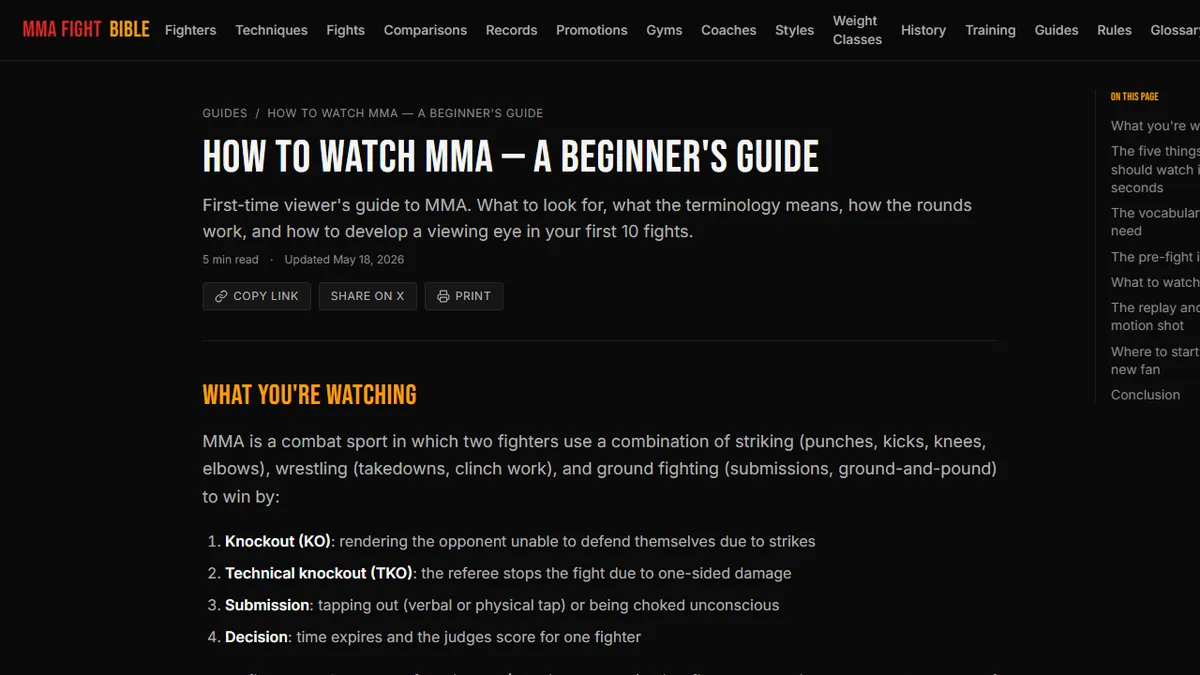
For a deeper foundation, the full beginner's primer on watching MMA covers card structure, commentary vocabulary, and the visual cues that separate informed viewing from casual watching.
Weight Classes Explained — Why They Matter More Than in Boxing
Boxing has weight classes too, but in boxing the weight classes above middleweight blur together as fan interest concentrates at the top. MMA does not follow that pattern. Each UFC weight division has its own dominant style tendencies, its own set of top contenders, and its own historical narrative. A flyweight fight and a heavyweight fight look like different sports on the same card.
The UFC weight class breakdown runs from strawweight at 115 pounds through heavyweight at 265 pounds, with nine men's divisions and four women's divisions currently active. The weight limits are hard cutoffs: fighters who miss the contracted weight on the morning of fight day face financial penalties and, in non-title bouts, can still compete if the opponent agrees.
Why does this matter for a first-time viewer? Because stylistic expectations shift significantly across the weight spectrum. Lighter divisions tend to produce faster, more technical grappling exchanges and higher-volume striking. Heavier fighters carry more stopping power but typically tire faster in championship rounds. A light heavyweight fight at 205 pounds will look noticeably different from a welterweight contest at 170 pounds, even if both fighters are equally skilled. Knowing the division tells you what kind of fight you are likely to watch.
The Three Positions Every Fight Passes Through
An MMA fight moves between three broad phases, and following the action requires recognizing when the fight shifts between them. The first is the striking range, where both fighters are on their feet and separated enough to trade punches, kicks, and knees. This is what most broadcast highlights capture, and it is where knockout finishes occur.
The second phase is the clinch (the close-quarters standing range where both fighters grip each other). From the clinch, a fighter can land short elbows, knees to the body, attempt takedowns, or try to throw the opponent. The clinch often looks like two fighters holding on, but skilled competitors are constantly battling for position, trying to control the opponent's head or hips to gain leverage.
The third phase is the ground game, where the fight reaches the canvas. One fighter typically ends up on top, trying to advance position and land ground-and-pound. The fighter on the bottom is trying to survive, reverse position, or submit the opponent from below. Grappling on the ground has its own hierarchy of positions — guard, half-guard, mount, back control — and recognizing which fighter occupies the dominant position clarifies what you are watching.
How to Spot a Submission Attempt Before the Tap
Submission finishes often appear sudden to new viewers, but the setup is nearly always visible several seconds before the tap. The mechanics depend on which submission is being attempted, but two universal signals appear across almost all of them.
The first signal is the transition to position. Before any submission can be applied, the attacking fighter needs to secure a specific body arrangement: behind the opponent for a rear naked choke, with the arm isolated and extended for an armbar, with the head and arm captured for a triangle. Watching for these positional moves gives you an early read on intent.
The second signal is the hand fight. The defending fighter immediately tries to prevent the grip that makes the submission work: grabbing at the choking arm, pulling an arm back to prevent extension, tucking the chin to protect the neck. When you see one fighter working to establish a specific grip and the other fighting desperately to disrupt it, the submission is either already locked or very close to being applied.
A rear naked choke, the most common submission finish in MMA, is almost always visible before the tap: the attacker's forearm slides across the throat, the other arm wraps behind the head, the body locks up. From that position, the defender has very little time before the blood choke takes effect.
What Commentators Mean by Round Scoring vs. Fight Narrative
Television commentary during MMA events serves two audiences simultaneously: the casual viewer who needs context and the experienced fan who already knows the rules. This creates a conversational pattern that can confuse newer viewers: commentators discuss both the official round scoring and the broader dramatic arc of the fight, and these two narratives are not always in agreement.
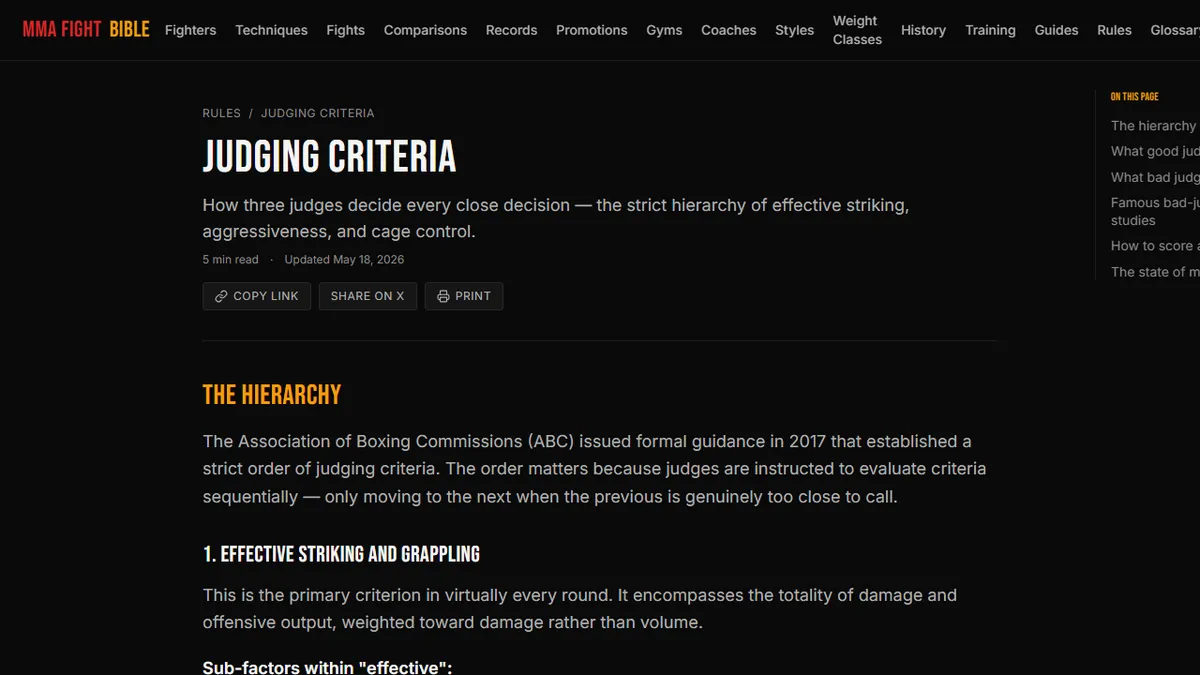
The official round scoring is the 10-point must system described in the rulebook, a mathematical exercise conducted by three cageside judges after every round. The fight narrative is the storytelling layer that broadcast teams use to maintain tension and engagement: who needs a finish, who is controlling the pace, what adjustments each corner is making.
These can diverge. A fighter can be behind on the judges' scorecards while dominating the commentary narrative because they are landing the flashier strikes. Learning to separate these two tracks (asking "who is winning points" as a distinct question from "who looks better right now") makes every close fight more analytically interesting.
Choosing Your First Fighter to Follow
The fastest way to become a genuine MMA fan rather than a casual viewer is to follow a specific fighter across multiple fights. The sport makes much more sense as an accumulated narrative than as a series of isolated events. Watching a fighter you have context on (knowing their style, their history, what they are trying to prove) transforms every exchange in their bout into information.
Choose someone whose style appeals to you visually. If the strikes in a fight excite you more than the grappling, find a striker to follow. If the chess-match ground game holds your attention, find a grappler. The technical specifics matter less than genuine curiosity. Pick someone whose next fight you will be impatient to watch, and let the sport's depth accumulate from there.