The Four Official Judging Criteria (and Why Damage Is Only One of Them)
After every close decision, the same argument erupts: the wrong fighter won, the judges were blind, the guy who bled clearly lost. But the fans making these arguments and the three judges seated cageside are often working from entirely different scorecards, because most viewers believe MMA is scored primarily on visible damage, and the Unified Rules of MMA do not share that belief.
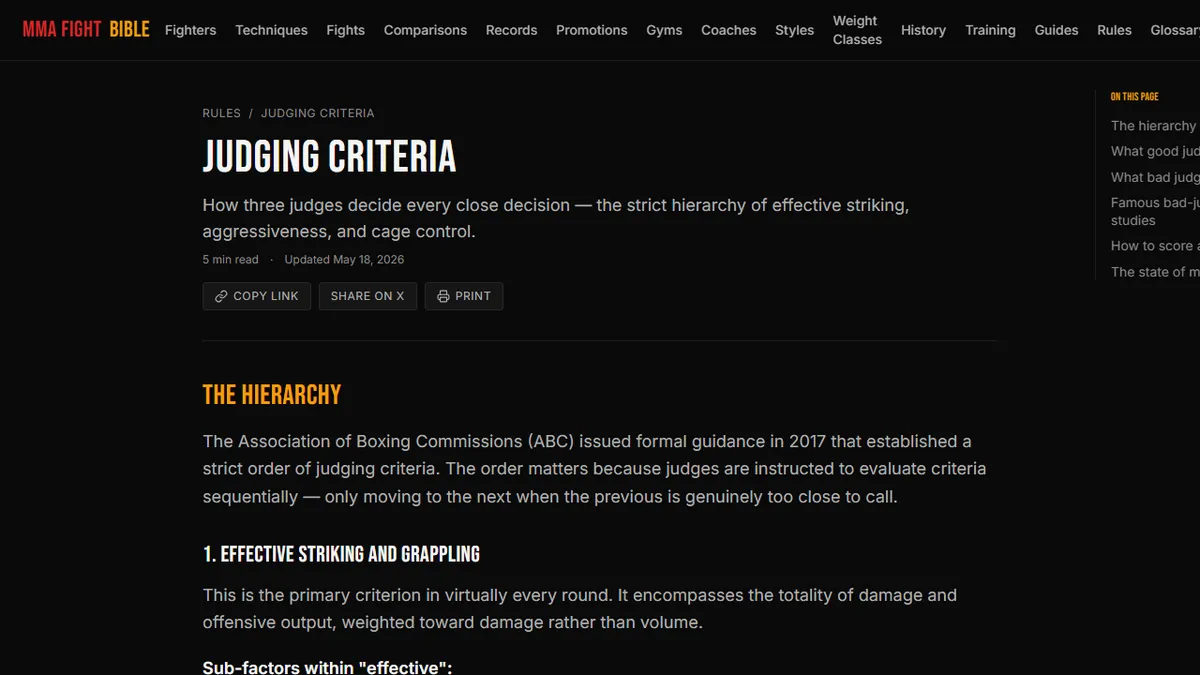
The four official MMA judging criteria are effective striking, effective grappling, effective aggression, and octagon control. Damage is part of effective striking (a knockdown or a cut that changes the fight's dynamic will affect how a round is scored), but it sits within a broader framework. A fighter who lands fifty clean jabs and controls the pace of a round can outscore an opponent who landed one flashy uppercut, even if the uppercut left a mark.
This framework is borrowed from a lineage of combat sports judging that predates the UFC. The 10-point must system came directly from boxing. The specific four-criteria breakdown emerged from the Nevada State Athletic Commission's early attempts to create a scoring standard that accounted for grappling, the element boxing judges had no vocabulary for.
How the 10-Point Must System Works Round by Round
The mechanics are straightforward. After each round, all three judges independently assign a score. The round winner receives ten points; the round loser receives nine. A clearly dominant round — one featuring a knockdown, a near-finish, or sustained control with significant damage — earns the winner a 10-8. A round so even that neither fighter established an advantage is technically scoreable as a 10-10, though most judges treat this as a last resort.
At the end of the scheduled rounds, scores from all three judges are tallied. The fighter with the higher total on two of the three cards wins. Three identical cards produce a unanimous decision. Two cards for one fighter and one for the other produce a split decision. Two cards for the same fighter with the third a draw produces a majority decision.
The step-by-step guide to MMA judging lays this out in full, but the core implication fans frequently miss is this: judges score the round they just watched, not the fight as a whole. A fighter who gets dropped in round one but dominates rounds two and three wins the fight on the scorecards. The accumulated story of the bout does not override the round-by-round arithmetic.
Effective Aggression vs. Forward Movement: The Most Common Fan Mistake
The criterion most reliably misread by fans is effective aggression. The word "effective" is doing critical work there, and it is easily overlooked. Under the Unified Rules, effective aggression means moving forward while attempting to finish the fight: landing strikes, threatening submissions, pressuring with a purpose. It does not mean walking toward an opponent while eating shots.
This distinction matters enormously in fights where one fighter circles out and counters while the other plods forward. A crowd watching that fight will often attribute the aggression credit to the forward-moving fighter. Judges are supposed to evaluate whether that forward movement is producing successful offense. A fighter who charges after an opponent for three rounds but gets picked apart on the counter does not win the effective aggression criterion. They lose it.
The confusion is understandable. Visually, forward movement reads as intent and desire. In the stands or on a broadcast, it signals a fighter is trying to take the fight somewhere. But the rulebook is explicit: aggression without effectiveness is not scored.
Octagon Control: What It Is and Why It Sways Judges
Octagon control is the criterion that most closely resembles the boxing concept of "ring generalship." It rewards the fighter who dictates where the fight happens: who chooses the range, who sets the tempo, who makes the opponent move defensively rather than offensively.
A fighter demonstrating octagon control is typically the one setting up in the center rather than retreating to the fence, choosing when to engage and when to reset, and forcing the opponent to react. This does not mean planting in the center and waiting. It means controlling the cage space in a way that makes the opponent follow rather than lead.
In practice, octagon control often overlaps with the other criteria. A fighter who controls the cage is usually also landing effective strikes and demonstrating effective aggression. But in a round where neither fighter lands cleanly and neither grappling exchange goes anywhere, the judge who has to choose a winner will often give that round to the fighter who looked like they were in charge, which is octagon control doing its work.
Why Championship Rounds Are Scored Identically to Early Rounds
A persistent misconception holds that championship rounds, rounds four and five in five-round bouts, are worth more. They are not. A round five is worth exactly as many points as round one. The only rounds that carry structural weight are the ones that actually sway the scorecards, and that is a function of who wins them, not when they occur.
What makes championship rounds feel more significant is the context: a fighter who knows they are behind on points has to take risks to change the outcome, which raises the drama and often the quality of action. A fighter ahead on points may become more conservative, which changes the pace. Neither of these dynamics alters the scoring math. Every round is a clean slate.
Controversial Decisions That Changed How the Criteria Are Applied
The judging conversation in MMA has been shaped by specific bouts that exposed flaws or ambiguities in the criteria. Contested decisions, bouts where significant portions of the analytical community scored the fight differently than at least one official judge, have pushed commissions toward clarification and occasional revision of how judges are instructed to weight the criteria.
The 2021 Nevada commission memo that gave clearer weight to damage within the effective striking criterion was partly a response to decisions where clean work appeared to score lower than accumulated volume. The ongoing conversation about grappling scoring — whether top-position control without damage should outscore striking that avoids takedowns — continues to generate policy discussion.
How to Score Along with the Judges on Your Next Card
Watching MMA with the judging criteria in mind transforms the experience. Between rounds, ask yourself four questions: who landed the cleaner significant strikes, who controlled the grappling exchanges, who was moving forward with intent, and who dictated where the fight happened. Weight those answers in that rough order, and you will produce a scorecard much closer to what the officials are seeing.
The fights that produce the loudest post-decision arguments are usually the fights where different viewers weighted different criteria differently, not fights where judges got the math wrong. Most controversial decisions, examined against the full criteria, are genuinely close calls that reasonable judges could score either way.
That does not make every decision correct. But it does suggest that post-fight outrage and post-fight analysis are often talking past each other.