Why the Fight Was Actually Close to Happening
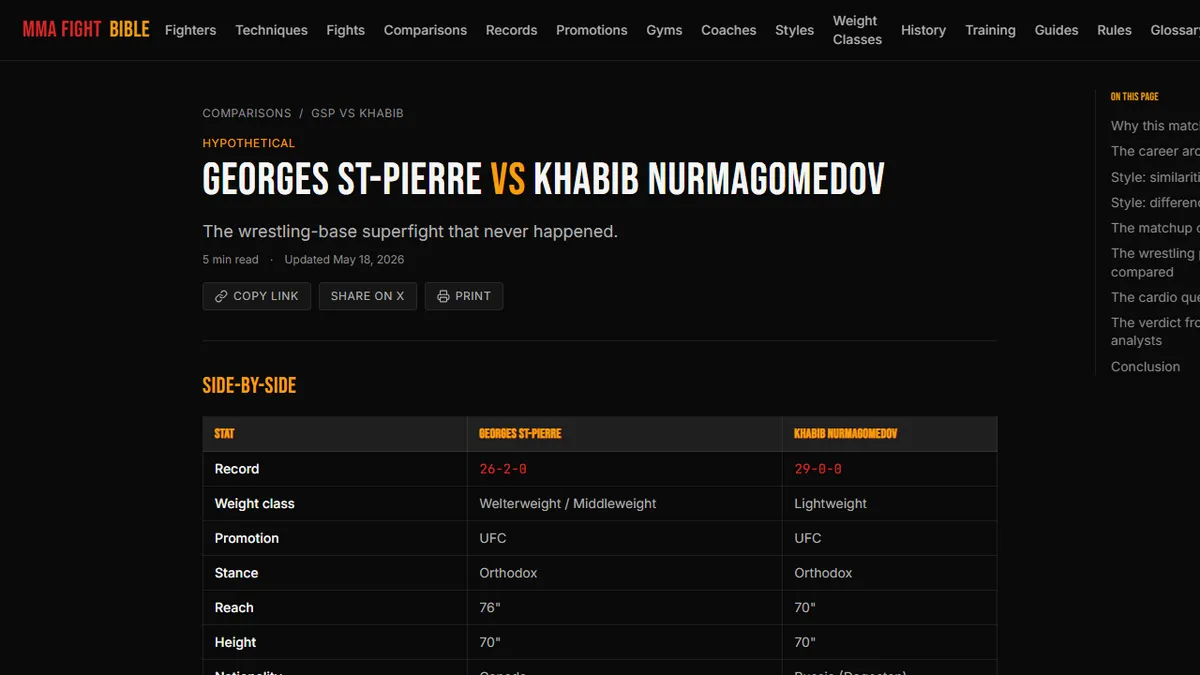
By 2019, the superfight conversation was more than fan fiction. Georges St-Pierre had returned from a four-year retirement at UFC 217 in November 2017, won the middleweight title from Michael Bisping in the fourth round, and then vacated the belt citing ulcerative colitis complications. He was healthy, in extraordinary shape at 37, and publicly interested in returning. Khabib was the undefeated lightweight champion sitting at 27-0, searching for opponents capable of generating significant pay-per-view interest.
The matchmaking logic existed on paper. A special-dispensation catchweight bout, likely at 155 or 160 pounds, would have paired the sport's most dominant champion of the 2010s against the man who appeared to be its dominant champion of the 2020s. Media conversations explored the possibility into 2020 before Khabib retired after UFC 254 and removed the scenario from the realm of the possible permanently.
The reason the fight never materialized was primarily structural: GSP was at middleweight when Khabib needed the matchup most, and by the time GSP was nominally available at a lower weight, Khabib's retirement ended the negotiation before it began. The timing gap between two athletic peaks that never quite overlapped is itself one of the sport's great missed opportunities.
The Wrestling Pedigree Gap: Sambo Champion vs. Kyokushin Karate Base
This matchup's stylistic interest begins with the grappling credentials of both fighters, which are substantial and distinct. Khabib was the product of Dagestani wrestling and combat sambo, a system that fuses Soviet freestyle wrestling with a submission-catalog emphasis. The Nurmagomedov family training structure, developed in the village of Sildi under his father Abdulmanap, emphasized chain wrestling from every position: the ability to flow from a failed double-leg into a body-lock trip into a high-crotch finish without pausing to reset. He was a two-time combat sambo world champion before he entered MMA.
GSP's grappling base came from a different origin. His striking foundation was Kyokushin karate, but his wrestling was developed later and specifically for MMA under coaches at Tristar Gym in Montreal. He was not a decorated amateur wrestler: his grappling credentials were built entirely through professional MMA training. What he developed was functionally excellent: a Greco-Roman level-change off the jab, takedown sequences that combined snap-downs with body locks, and a top game built on half-guard control and posture-breaking ground-and-pound.
The gap between a combat sambo world champion and a professionally trained MMA wrestler is real, and it is the central argument Khabib's proponents make in this hypothetical. At the point of engagement (the wrestling exchange itself), Khabib's raw technical background would have been a credential advantage that very few fighters in history could match.
Top-Game Philosophy: GSP's Control-Time Model vs. Khabib's Pressure Ground-and-Pound
Both fighters were built around taking the fight to the ground and controlling it there, but their philosophies diverged sharply once position was achieved. The detailed GSP vs Khabib technical breakdown explores this at length, but the summary version is instructive: GSP accumulated control time, denied scrambles, and won rounds through sheer positional dominance, while Khabib used top control as a platform for constant offensive output.
GSP on top was a wall. He would pin opponents in half-guard, break their posture with short strikes, deny shrimping space, and let the round clock run in his favor. His worst critics called this boring; his best defenders called it perfect MMA: winning rounds without taking meaningful damage in exchange.
Khabib on top was a pressure system that escalated continuously. His ground-and-pound did not aim for highlight knockouts; it aimed to force reactions. When opponents shelled up, he worked submissions. When they defended submissions, he returned to hammer fists and elbows. The combination never let the bottom fighter settle into a static defensive frame.
Against each other, this philosophical difference matters enormously. GSP's defense on the bottom — framing, shrimping, guard recovery — was technically sophisticated. Whether it would have been sufficient against Khabib's specific weight and pressure is genuinely unknowable, but no fighter in Khabib's era ever solved it cleanly from the bottom position.
Striking Differentials and What the Standing Phase Would Have Looked Like
In the striking range, GSP had a structural advantage that Khabib could not fully replicate. His Kyokushin karate base gave him the footwork and distance management to operate from the outside, his jab was a genuine technical weapon rather than a setup disguise, and his combination volume at 170 pounds was among the highest in welterweight history.
Khabib's striking existed primarily as a takedown catalyst. His jab pushed opponents toward the fence to compromise their defensive base for the level change that followed. His low calf kicks disrupted stance. His overall output was low (he fought at a pace that prioritized position over volume), and he operated with full awareness that his advantage was on the ground, not on the feet.
In a 155-pound or 160-pound catchweight bout, GSP's striking output advantage would likely have been visible in rounds where Khabib was unable to immediately close the distance. GSP's lateral movement and counterpunching against committed level changes had neutralized elite wrestlers before, including Josh Koscheck and Jon Fitch.
The Catchweight Problem: How Walk-Around Weight Changes the Fight
Any version of this fight would have required a catchweight. GSP competed at 170 pounds and walked around significantly above that; Khabib competed at 155 and rehydrated to a walk-around weight substantially higher than his contracted limit. The two fighters were not naturally the same size, and the weight at which they met would have shaped the competitive dynamics significantly.
At 160 pounds, both fighters would have been cutting from similar territory, and the size differential would have been minimal. At 155, GSP would have been giving away a rehydration advantage. At 170, Khabib would have been walking into a weight class he never competed in, against a fighter who had been a dominant 170-pound champion for a decade. The catchweight negotiation would itself have been a competitive battleground before the walkout.
A Round-by-Round Projection of How Each Path to Victory Unfolds
Projecting a fight that never happened requires honest uncertainty. Khabib's path to victory runs through his takedown volume: if he can put GSP on his back twice per round, as he did against virtually every opponent, he wins rounds through position accumulation, body-lock pressure, and the submission threat that forced taps from Justin Gaethje and Dustin Poirier. At 29-0, Khabib's complete fighter profile shows no fighter ever solved that equation.
GSP's path requires neutralizing the takedown threat through his own famous takedown defense and controlling distance to land effective striking from the outside. His record against elite wrestlers (Koscheck twice, Jon Fitch, Matt Hughes) shows a fighter capable of denying the takedown from a high-level opponent over five rounds.
The most defensible projection acknowledges that this fight would likely have been close: probably competitive through three rounds, with the championship rounds determining everything. Khabib's gas tank and top-pressure system improved as fights progressed. GSP's game management and sport psychology (his ability to execute a consistent game plan under pressure) were unmatched in his era.
The Legacy Question: Would a Win or Loss Have Changed Either GOAT Case?
Neither fighter's GOAT argument would have been definitively settled by this hypothetical. Khabib retired at 29-0 in a weight class he never vacated: no loss in his record, no mandatory rematch unfulfilled. A loss to GSP at a catchweight above his division would have been contextualized as a freak result outside his natural range.
GSP's case, already built on two championship reigns across two weight classes, would have benefited from a win over the sport's most dominant active champion. It would not have closed any debate. In the GOAT conversation, no single hypothetical resolves everything, which is precisely what keeps this one alive.