Why Wood Choice Matters More Than Most Buyers Realise
First-time stick buyers often treat wood choice as an aesthetic decision: blackthorn looks more traditional, ash looks more utilitarian, so which one matches the buyer's sense of themselves. This misses the point entirely. The wood a stick is made from determines its weight, its flexibility under load, how it transmits ground shock to the hand, how it responds to wet conditions, and (in blackthorn's case) whether it can even be made to the buyer's required length without compromising the piece.
Getting the wood right is not a matter of taste. It is a specification decision with real consequences for daily use.
Blackthorn: The Iconic Choice and Its Real-World Trade-Offs
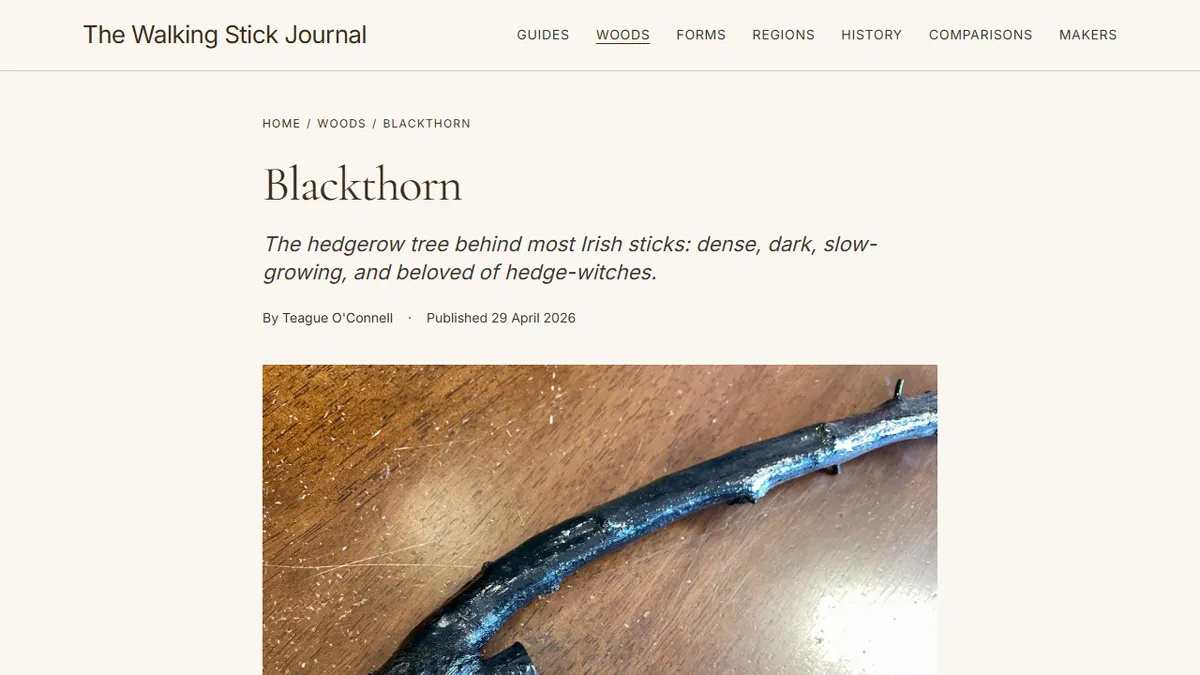
Blackthorn (Prunus spinosa) produces the stick that most people picture when they think of an Irish walking stick. The gnarled, knotted surface, the dark heartwood, the natural thorns removed and their bases left as subtle texture, the heavy root-burl knob at the head: this is the canonical form, and it carries centuries of Irish association. For the full blackthorn species profile, including its botanical characteristics and the counties where the best stick-quality growth is found, the species index gives the full picture.
The trade-offs are real and worth understanding before buying. Blackthorn is a hedgerow shrub rather than a timber tree. This means that finding a naturally straight shoot at the right length for a walking stick (typically 33 to 40 inches) requires searching through large amounts of material. The best pieces are genuinely found rather than cut to order. It also means blackthorn sticks carry more weight per inch than ash: a standard 36-inch blackthorn stick typically weighs between 350 and 420 grams, and denser pieces reach 450 grams. Carried for a mile over rough ground, that weight is felt in the shoulder.
Blackthorn is also harder and less springy than ash. Under the micro-impacts of each stride on hard ground, a blackthorn shaft transmits more vibration through to the hand than an ash shaft of similar dimensions. For casual use on soft terrain, this is irrelevant. For a long urban walk on paving or stone, it is noticeable.
Ash: Lighter, Springier, and Often Better for Walkers
Ash (Fraxinus excelsior) has a working profile that is almost the inverse of blackthorn's. It is lighter (typically 280 to 350 grams for a working stick), more shock-absorbing due to its open-grained springy structure, and far easier to source in the right dimensions. Ash sticks can be cut from managed coppice or young tree growth as well as from hedgerows, which means working makers can maintain consistent stock rather than searching for the right piece. See ash as a walking-stick material for the detailed wood-science breakdown.
Ash also seasons faster than blackthorn, a meaningful practical advantage, since seasoning is a non-negotiable step before working either wood. Where blackthorn demands two to five years of careful drying before it can be worked without cracking, ash can often be brought to working condition in one to two years, sometimes less in the right environment.
The aesthetic is different: ash is paler, smoother-grained, and less dramatic in character than blackthorn. It accepts stains and finishes readily, which means a working maker has more options for achieving a consistent look. Whether this is an advantage depends on the buyer's preference, but it is not a compromise in functional terms.
Weight and Balance Compared Head to Head
The weight gap between a typical blackthorn stick and a typical ash stick of the same length is roughly 80 to 100 grams (about three to four ounces). That sounds modest, but the experience over a day's walking is meaningful for users who are using the stick as a genuine walking aid rather than an occasional prop.
Balance also differs. Blackthorn's density tends to make sticks slightly head-heavy, particularly when the root-burl head is large. Ash sits more neutrally balanced along the shaft. For users who find themselves constantly correcting the stick's tendency to rotate forward in the hand, the lighter wood's more neutral balance is the practical fix.
Which Wood for Which Use: Walking Aid, Hill Stick, Ceremonial
For users whose primary need is a genuine walking aid — something that takes real load, used daily on mixed terrain — ash is nearly always the better choice. The weight saving reduces cumulative fatigue, the shock absorption matters on hard ground, and the availability of well-matched stock means a working maker can produce a properly sized piece reliably.
For hill walkers who want a single stick over uneven ground, ash again has the edge. Its shock absorption and lighter carry weight over a long day's ascent are clear advantages.
For ceremonial, gifting, or cultural-register use (a St Patrick's Day presentation piece, an heirloom stick, a gift to mark a significant occasion), blackthorn is the wood with the right associations. The appearance, the tradition, and the specificity of the object carry meaning that ash cannot replicate in the same way.
The Seasoning Question: Why Both Woods Need Time
Neither blackthorn nor ash can be worked freshly cut without risk of the shaft cracking as it dries. Both woods must be seasoned, allowed to dry slowly under controlled conditions, before the maker works the shaft. The difference is timescale.
Blackthorn's dense, resinous structure means it must dry very slowly to avoid surface checking. The conventional timeline among working Irish makers is two to five years for a stick blank cut from good-quality hedgerow material. Cut too soon, and the stick will develop surface cracks as the moisture gradient between the outer sapwood and the dense heartwood creates tension during drying.
Ash dries faster and more forgiving. A working maker with properly managed ash stock typically seasons blanks for one to two years. This is why ash sticks are generally easier to source at short notice from established makers, and why ash commissions carry shorter lead times.
Decision Tree: Four Questions That Pick Your Wood
The choice between blackthorn and ash resolves clearly if four questions are answered honestly.
Is weight a concern? If yes — because of arthritis, a long carry distance, or daily use over mixed terrain — the answer is ash. Blackthorn's extra weight accumulates over time in ways that matter for regular users.
Is appearance the primary priority — specifically the traditional Irish stick look with a knotted, gnarled surface and root-burl head? If yes, and weight is secondary, the answer is blackthorn.
Is the stick primarily for ceremonial, cultural, or gifting purposes? Blackthorn. The cultural register is unambiguous.
Is the stick for hill walking or terrain where shock absorption and light weight are safety factors? Ash.
If all four answers sit in the middle (the buyer wants something that functions well and looks good without a strong preference in either direction), ash is the practical default for a first stick. A second stick, once the buyer understands what daily use actually demands, can be made in whatever wood matches the experienced preference.