Mistake 1: Buying 'Irish' Sticks from Amazon Without Checking Origin
The volume of sticks sold online (on Amazon, eBay, and general gift platforms) under descriptions like "traditional Irish walking stick" or "authentic blackthorn shillelagh" is enormous. A significant portion of those sticks are machine-produced imports from workshops in India, Pakistan, or China, where they are made to look like Irish handcraft pieces through surface treatment and labelling rather than through the traditional making process.
This is not always easy to spot from a listing photograph, and the price (often between twenty and sixty pounds) can look like a bargain on something that resembles the eighty-pound-and-up range from an Irish workshop. The tell is usually in the ferrule detail, the handle uniformity, and the wood surface: genuine handmade sticks show the irregular character of natural material worked by hand, not the consistent machine-smoothed surface of a mass-produced piece.
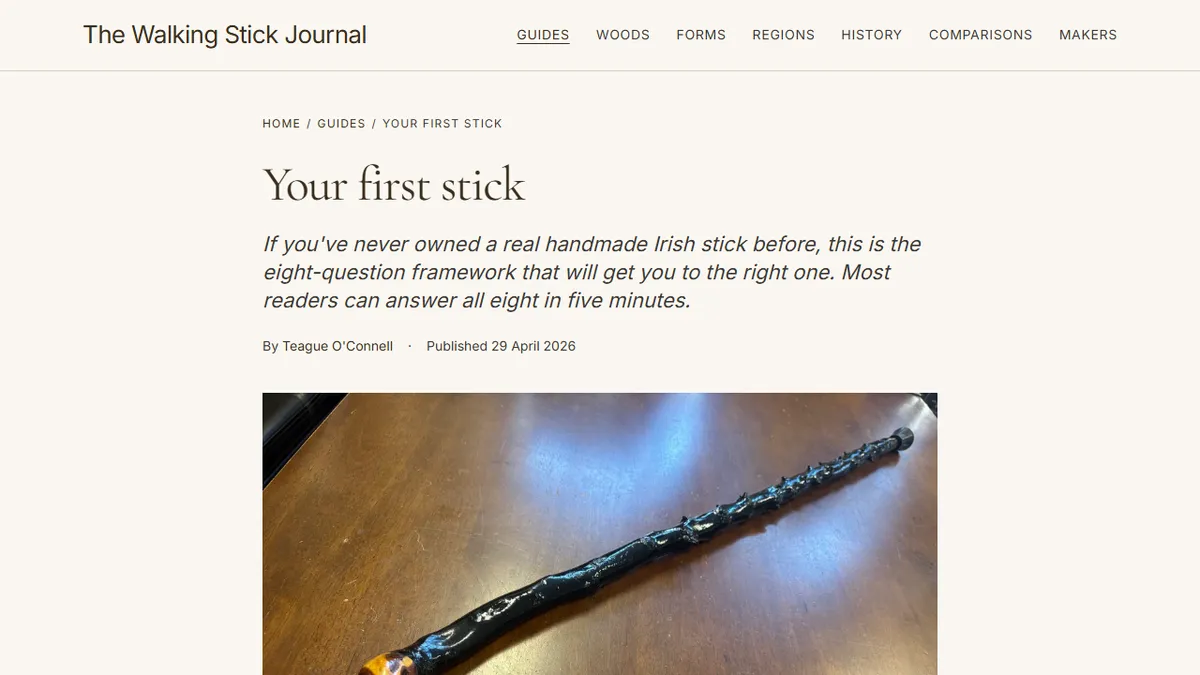
The safest approach is to buy from makers who will tell you their location and process, or from retailers who can confirm provenance. The eight-question framework for a first stick purchase includes a section specifically on how to vet a seller before committing.
Mistake 2: Sizing by Eye Rather Than Measurement
This mistake is covered elsewhere in depth, but it belongs on this list because it is the single most common cause of post-purchase regret. Walking stick height affects posture, shoulder load, wrist angle, and (particularly for users relying on the stick as a genuine walking aid) joint comfort over time.
The eyeball method, where a shop assistant holds the stick next to the buyer and declares it looks right, has a real-world error margin of two to three inches in either direction. Over a long walk, two inches of extra length forces the carrying shoulder into a raised position with every stride; two inches of insufficient length forces the wrist into a bent posture that produces discomfort quickly.
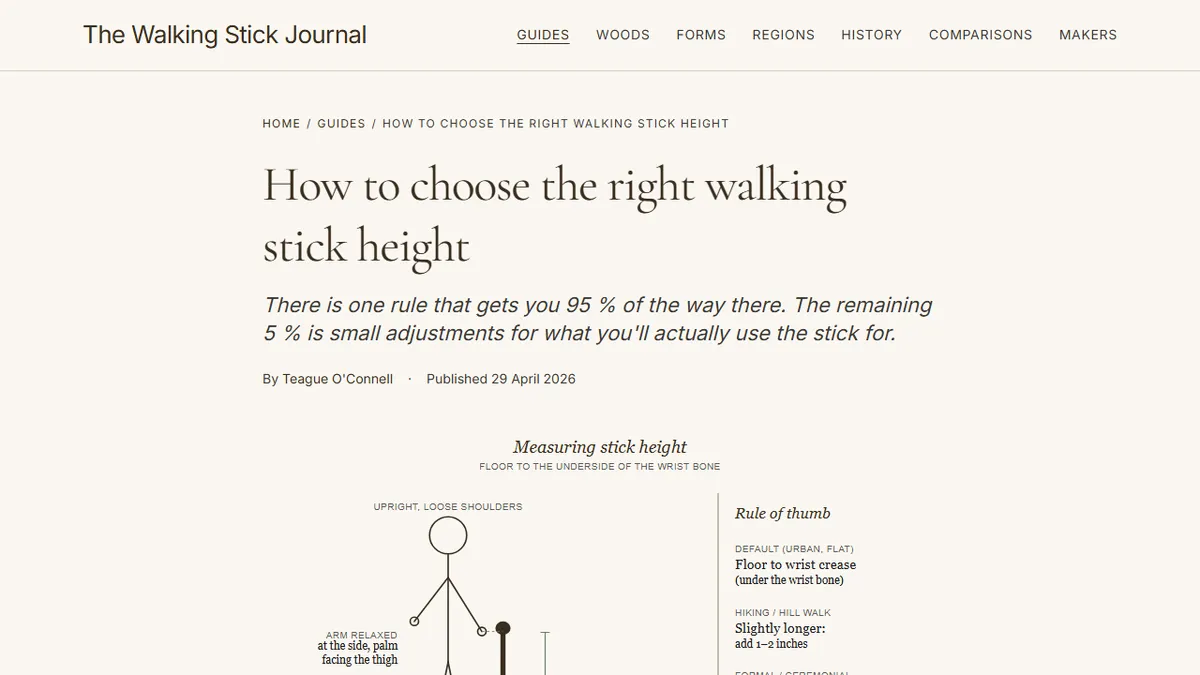
The correct method takes one measurement: from the floor to the bony protrusion on the outside of the wrist, the ulnar styloid, taken with the buyer standing in their usual walking shoes. That number is the target stick length. It takes thirty seconds. Do not buy without taking it.
Mistake 3: Choosing Wood for Looks, Not Use Case
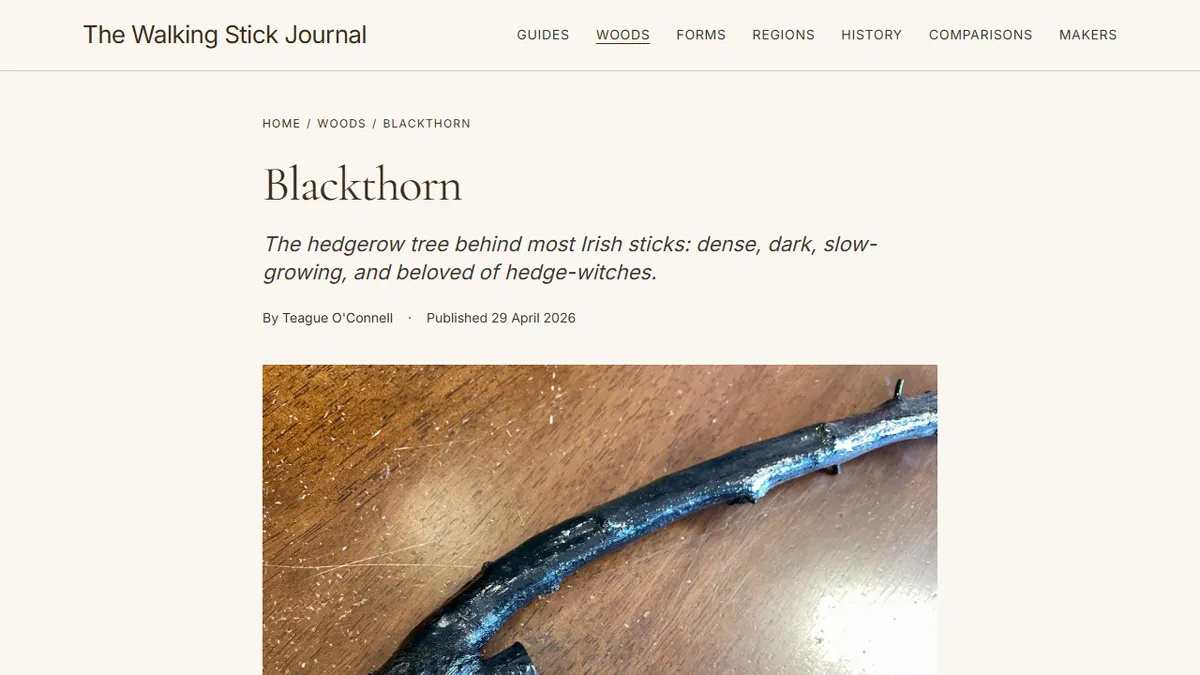
The natural tendency when buying a first stick is to choose the most visually striking piece in the selection. In an Irish craft context, that usually means blackthorn, the dark, gnarled, heavily knotted wood with the dramatic root-burl head. It looks exactly like what most people imagine an Irish stick to be.
For ceremonial use, for gifting, or for occasional outings where the stick is more symbol than tool, blackthorn is a perfectly reasonable choice. For daily use as a genuine walking aid, it is often the wrong choice. Blackthorn is the heavier of the two main stick woods; carrying that extra weight over a long walk or a full day produces fatigue in the carrying shoulder and wrist that builds up in ways a brief trial in a shop will not reveal.
Ash, hazel, and lighter character woods produce sticks that function better as daily walking aids. The aesthetic is different — less dramatic, more workmanlike — but the functional advantage is real. First-time buyers should decide whether the stick is primarily an object to carry or an object to look at, and choose accordingly. The distinction is not trivial.
Mistake 4: Ignoring Handle Ergonomics When Arthritis Is a Factor
Many stick buyers have some degree of arthritis in their hands, wrists, or fingers. That is often the very reason they are buying a stick in the first place. The error is to treat the handle as a secondary consideration, behind wood choice and appearance.
For users with arthritic hands, the handle is the most important specification on the stick. The traditional Irish root-burl knob — the rounded natural head that defines the canonical blackthorn form — concentrates load on the centre of the palm and on the bent-back fingers wrapping the knob's sides. For arthritic users, this is uncomfortable at best and aggravating at worst.
The fritz handle (an L-shaped horizontal projection gripped from above) distributes load widely across the flat palm, which is why modern orthopaedic walking aids use it. The derby handle, a curved inverted-U, is a sound second choice. Both are available from working Irish makers in ash, blackthorn, or hazel. The difference is not aesthetic compromise; it is functional necessity.
A first stick bought with the wrong handle for an arthritic user will often end up unused within a few weeks, not because the stick is bad but because every use reinforces the discomfort.
Mistake 5: Ordering a Shillelagh When You Actually Need a Walking Stick
Shillelaghs and walking sticks are two different objects. They share the same Irish cultural context and are often made from the same wood, but they are not interchangeable. A shillelagh — a weapons-tradition piece with a thick root-burl head, a relatively short shaft, and significant heft concentrated in the head — is typically 22 to 28 inches long. A walking stick, sized correctly for its owner, typically runs 31 to 40 inches depending on height.
Buying a shillelagh when you need a walking stick produces an object that is too short to function as a proper walking aid, with a head and shaft balance optimised for striking rather than for load-bearing stride support. Buyers who want the cultural object (the St Patrick's Day prop, the heritage piece, the gift) should buy a shillelagh with their eyes open about what it is. Buyers who want a functional walking stick should specify that clearly, because the two objects require completely different specifications from the maker. Reading how to tell handmade from machine-made will also help clarify what distinguishes a genuine working piece from a display reproduction.
The One Question That Prevents All Five Mistakes
Before any other consideration, a first-time buyer should answer this question clearly: is this stick primarily for use, or primarily for appearance and cultural significance?
A stick bought for use demands correct sizing, appropriate wood for the carrying load, and a handle matched to the user's hand condition. A stick bought as a cultural or ceremonial object can prioritise appearance, tradition, and drama without the functional constraints.
The market does not always make this distinction clear. Sellers have every incentive to present the most visually striking piece as the best choice regardless of use case. The buyer who arrives with a clear answer to the use-versus-appearance question is far harder to sell the wrong stick to, and far more likely to still be using their first stick ten years from now.