Bataireacht vs Generic Stick Fighting: What Makes It Distinct
Most cultures with a tradition of rural self-defence developed some form of stick combat. What distinguishes bataireacht (the Irish stick-fighting tradition) from the broader category of stick-based martial arts is not simply geography but a specific set of technical characteristics: a distinctive grip, a specific weapon form in the shillelagh, and a tactical tradition rooted in the particular social context of rural and small-town Ireland between the eighteenth and mid-nineteenth centuries.
Bataireacht is not a formalised school in the way that European sword systems produced codified manuals. It was transmitted orally and practically within families and local communities, which is both the reason it nearly disappeared and the reason that what survived is genuinely traditional rather than reconstructed from texts. For a deeper account of where the tradition fits in the broader history, the full history of Irish stick fighting covers the social and political context in full.
The Faction-Fighting Era: 1730 to 1850
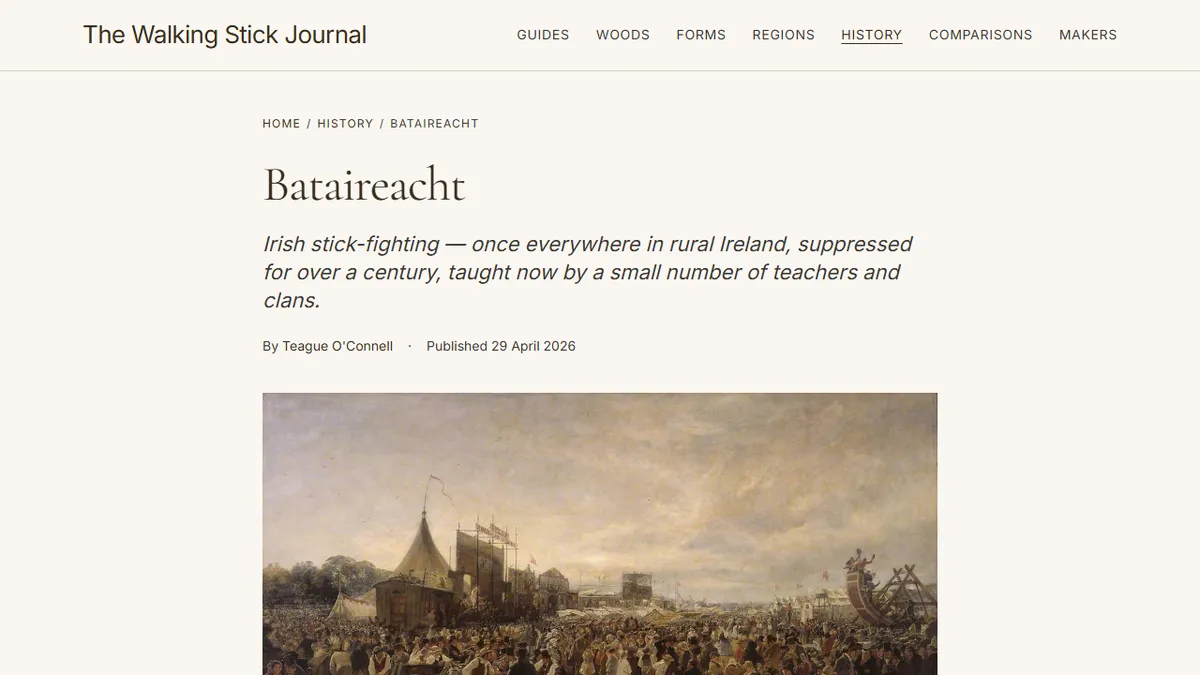
To understand bataireacht's social function, the faction-fighting era is essential context. From roughly the 1730s through the mid-nineteenth century, organised groups (factions, typically identified by family name or townland) met at fairs, patterns, and markets to fight. These were not disorganised brawls, though they sometimes escalated into them. They were structured encounters governed by loose conventions, and the weapon of choice was the shillelagh or bata, the Irish walking stick in its weapon-weighted form.
The factions involved were often large: dozens to hundreds of people gathering at specific events with the expectation that their group would encounter a rival faction. The violence was real (people were killed, and the records of the period document serious casualties), but the encounters also had a ritual dimension, a mechanism for resolving collective grievances between communities. The stick-fighter who was good at his art had a recognised social status; being the best stick man in your parish carried genuine prestige.
This is the world bataireacht was shaped by. Its technical solutions — how to manage range, how to defend against multiple opponents, how to use the weapon's weight and the environment together — were developed in response to real consequences.
The Distinctive Irish Grip and Why It Differs from European Traditions
The technical core of bataireacht is the grip. Unlike European single-stick traditions, where the weapon is typically held at the base and used as a lever with the arm extended, the Irish method involves gripping the shillelagh at or near the middle of the shaft, often with both hands relatively close together. This produces a weapon that can be used for both striking and controlling — pressing against an opponent's weapon or limb to bind and disrupt — and that makes the heavy root-burl head effective as both a striking mass and a prying tool.
The thumb position also differs from European conventions. In the standard bataireacht grip, the thumb runs along the shaft rather than wrapping around it, which allows more precise rotation of the weapon and faster transitions between overhead, lateral, and ascending strikes. This detail, seemingly minor, changes the entire geometry of how the weapon is used.
These characteristics mean that bataireacht cannot simply be mapped onto other Western stick or sword traditions, even where they share superficial similarities. The weapon, the grip, and the tactical context form an integrated system.
Suppression: Famine, the Church, and the RIC
The near-extinction of bataireacht happened through the convergence of three forces in the second half of the nineteenth century. The Great Famine of the 1840s devastated the rural communities in which the tradition was embedded, killing or displacing the population that carried it. The demographic collapse was catastrophic: communities that had practised bataireacht within specific social networks simply ceased to exist in their previous form.
The Catholic Church, particularly through the Temperance movement of Father Theobald Mathew in the 1840s and subsequent pastoral pressure on faction fighting, condemned the practice explicitly. Church condemnation carried enormous weight in rural Catholic Ireland, and the moral case against public fighting became increasingly effective as the century progressed.
The Royal Irish Constabulary provided the third pressure: consistent enforcement against faction-fighting events, which were increasingly treated as public order problems rather than tolerated social rituals. The combination of demographic collapse, religious condemnation, and police pressure reduced the public practice of bataireacht to near-zero within a generation.
How the Doyle Family Lineage Kept the Art Alive
What survived the suppression era was transmitted privately, within families, not publicly at fairs and markets. The most documented of the surviving lineages is associated with the Doyle family, which maintained a continuous oral and practical transmission of bataireacht techniques across several generations. The knowledge was not written down; it was demonstrated, corrected, and drilled within a closed family context.
This mode of transmission — private, familial, deliberately kept from public view during the period of suppression — is the reason bataireacht survived at all, and also the reason its survival was so precarious. Any generation that failed to transmit could have broken the chain permanently. The Doyle lineage's significance is not simply that it preserved techniques, but that it maintained the transmission structure through the most hostile period.
Bataireacht Today: Teachers, Lineages, and International Students
From the 1990s onward, a small number of practitioners began bringing bataireacht into public view for the first time since the suppression era. Glen Doyle, working from within the family lineage, began teaching and documenting the system, which attracted serious martial arts practitioners from Ireland, the United States, and elsewhere who had been trying to piece together the tradition from fragmentary historical sources.
The contemporary practice of bataireacht is not large. The number of people with genuine lineage-based instruction is counted in hundreds rather than thousands. But the revival is substantive: there are now structured instructional resources, recognised teachers, and an international community of practitioners. The Antrim Bata school, which has developed alongside and in dialogue with the Doyle lineage work, has contributed significantly to that public reconstruction, and the Antrim Bata school and its lineage covers that branch of the tradition in detail.
What the contemporary revival demonstrates, above all, is that bataireacht is not a historical curiosity. It is a technically coherent fighting system with identifiable principles and a specific weapon, and it survived a century of suppression because the people who held it understood that something real would be lost if the chain broke.