The Most Common Height Mistake (And Why Shops Don't Warn You)
Walk into a gift shop in any Irish town and ask which walking stick you should buy. Nine times out of ten, the person behind the counter will hold a stick up against your body, eyeball it, and say it looks about right. That transaction happens hundreds of thousands of times a year, and a significant portion of those buyers end up with a stick that is too long, too short, or (most commonly) too long by two or three inches.
The reason shops don't flag this is simple: an incorrectly-sized stick still sells. The discomfort usually arrives later, after the buyer has walked a mile or two and begun to notice that their shoulder is rising with each step, or that their wrist is bending at an uncomfortable angle to keep the ferrule flat on the ground. By then, the buyer is home, or back in their own country, and the correction happens (if it happens at all) on their own.
The fix is not complicated. One measurement, taken correctly, produces a starting length that eliminates virtually all sizing errors before they happen.
The Elbow Rule vs the Wrist-Bone Rule: Which Is Actually Correct
Most advice columns and many stick retailers cite the same instruction: hold the stick upright, bend your elbow to roughly 90 degrees, and the stick should reach your palm. The image is easy to visualise, and it sounds anatomically sensible.
The problem is that the 90-degree elbow position is difficult to reproduce accurately without a second person watching, and different individuals reach very different stick heights at what feels to them like 90 degrees. The margin of error on the elbow-angle method, measured across real buyers, is typically plus or minus two to three inches. That is enough to produce a genuinely uncomfortable stick.
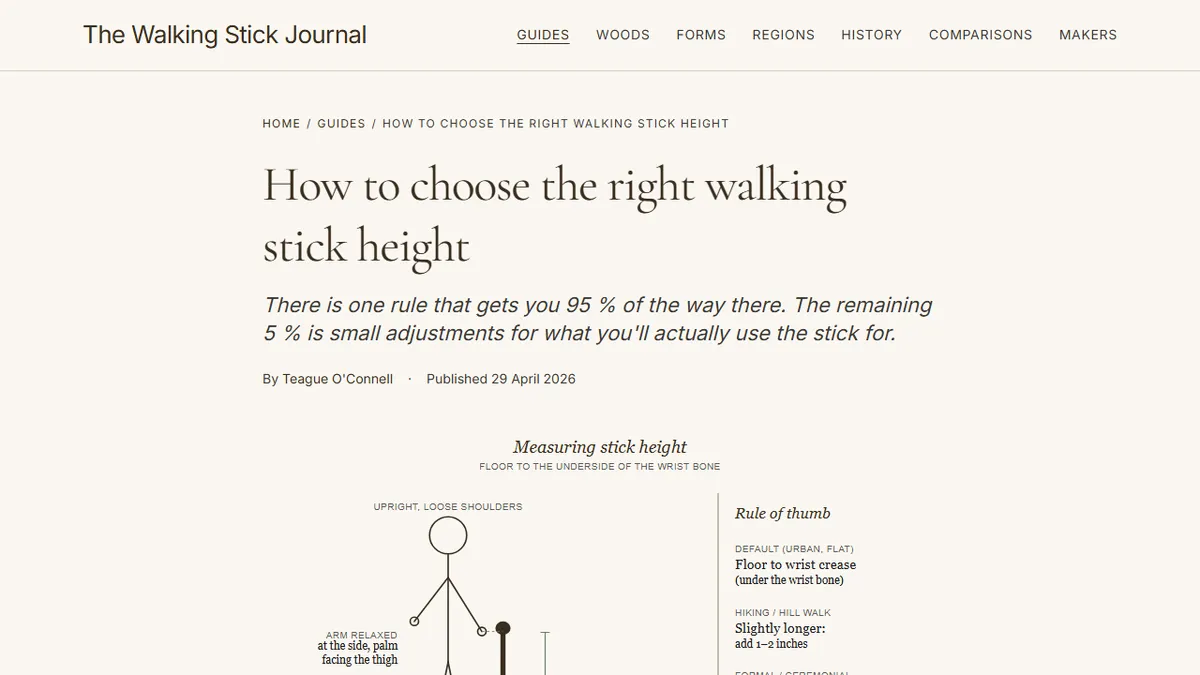
The wrist-bone method eliminates the subjectivity. Stand in your normal walking shoes, arms hanging naturally at your sides. Have someone measure the distance from the floor to the bony protrusion on the outside of your wrist (the ulnar styloid). That distance, in inches, is your target stick length. The method works because the ulnar styloid sits at a consistent anatomical position relative to the hand, regardless of posture variation or individual judgement. For more context on exactly how to apply this, the precise wrist-bone measurement guide walks through the procedure with reference photographs.
How to Take the Floor-to-Wrist Measurement at Home
You need flat shoes (or no shoes, if you plan to use the stick in flat shoes), a smooth floor, and a tape measure. Stand with your heels together, arms relaxed at your sides. Do not reach down, do not tense your shoulders. Have a second person place the zero end of the tape at the floor directly below the outside of your wrist. They should bring the tape straight up to the ulnar styloid, the small bony bump that you can feel on the outside of your wrist when you press lightly with your opposite thumb.
Note the measurement. That is your baseline. If you plan to use the stick primarily on rough terrain or hill ground, subtract half an inch. If you will be using the stick in boots rather than everyday shoes, add the approximate heel height of the boot (usually three quarters of an inch to one inch). If you have a forward-leaning posture due to hip stiffness or injury, subtract one inch.
You can take this measurement alone by standing against a doorframe and marking the height on the frame with a pencil, but the two-person method is more accurate.
Height Lookup Table for Quick Reference
Wrist measurements correlate roughly to standing heights. These figures assume normal shoes with a standard heel:
Standing height 5 ft 0 in corresponds to a stick of approximately 31 to 32 inches. Standing height 5 ft 2 in corresponds to 33 inches. Standing height 5 ft 4 in corresponds to 34 to 35 inches. Standing height 5 ft 6 in corresponds to 35 to 36 inches. Standing height 5 ft 8 in corresponds to 36 to 37 inches. Standing height 5 ft 10 in corresponds to 37 to 38 inches. Standing height 6 ft 0 in corresponds to 38 to 39 inches.
These figures are starting points. They hold for users with proportional arm-to-height ratios; users with unusually long or short arms should always use the direct wrist measurement rather than the height approximation.
Use-Case Adjustments: Hill Walking, Thumb Sticks, and Shillelaghs
The wrist-measurement baseline describes an ideal stick height for flat-ground walking with a conventional handle. Several use cases call for intentional adjustments away from that baseline.
Hill walkers typically go shorter by one to two inches. When ascending, the hill raises the ground relative to your feet, which raises the effective stick length; a shorter stick avoids the shoulder-rise that comes from a stick that is too tall on uphill ground. Descending is a different geometry, and some hill walkers carry a telescoping pole for that reason, but on a fixed-length stick, shorter is the right compromise.
Thumb sticks, which are gripped differently from conventional walking sticks — with the thumb resting in the V of the fork rather than the whole hand wrapping a handle — are typically used slightly shorter, since the grip point sits lower on the hand.
Shillelaghs, which are weapons-tradition objects with a root-burl knob head, are not sized for walking efficiency in the same way. Their appropriate length is closer to 22 to 28 inches for a one-handed weapon, well below what a walking measurement would produce.
What to Do If Your Existing Stick Is the Wrong Length
If you already own a stick and have discovered it is the wrong length, the options depend on direction of error. A stick that is too short has no practical fix — adding length to a traditional stick is a significant craft operation that no working maker would recommend. The stick is either the right length for someone shorter, or it becomes a display piece.
A stick that is too long is a different situation. Many overlong sticks can be reduced to the correct length at the foot, by trimming the shaft and refitting the ferrule. This is a job for a working maker or a woodworker with experience in the material; it is not a DIY task for most buyers. The guide to trimming an over-length stick at home covers when the job is feasible and exactly what it involves, including which tools are needed and what to watch for when refitting the ferrule.
Before commissioning or purchasing your next stick, take the wrist-bone measurement. It takes under a minute, it eliminates the most common source of post-purchase dissatisfaction, and it is the only method that treats the stick as a functional object rather than an approximate decorative one.