DeFi Heat Score: What 77 Means in Historical Context
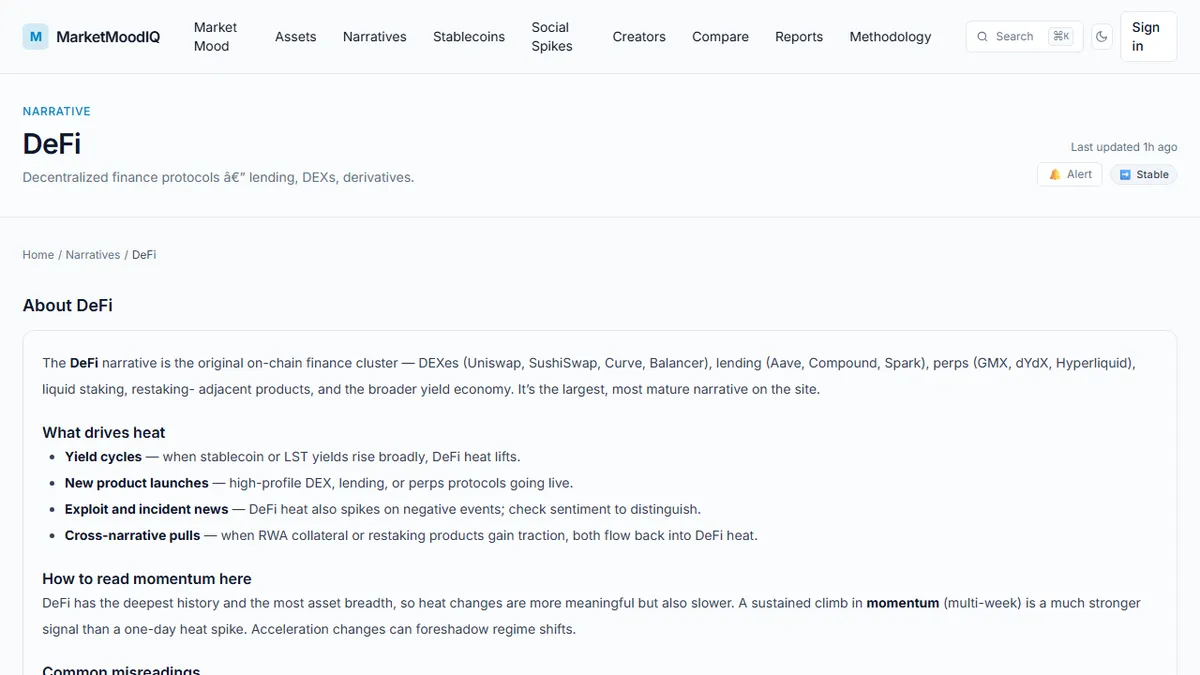
A DeFi narrative heat score of 77 sits well above the midpoint of the zero-to-one-hundred scale, which is a meaningful observation. Narrative heat above 70 typically indicates that multiple constituent assets are simultaneously generating elevated social attention, that community sentiment is broadly positive, and that the breadth of engagement (not just one or two tokens pulling the score) justifies the high reading.
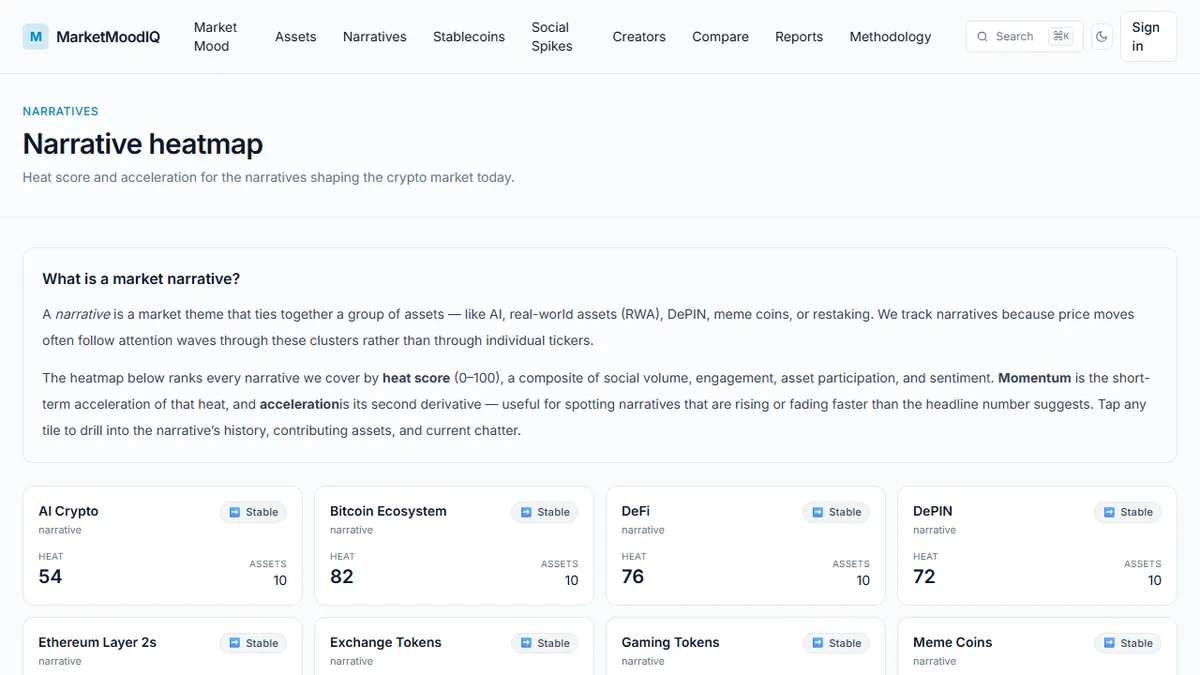
In a field where the two highest-rated narratives (Bitcoin Ecosystem and Solana Ecosystem) are sitting at 83, DeFi's 77 places it in a tight cluster with Prediction Markets at 80, and a tier above DePIN and Real World Assets, both at 74. This positioning matters because capital does not operate in a vacuum: it rotates between narratives in rough order of heat, and DeFi's current placement suggests it is actively drawing attention from the middle of the distribution toward the top.
What makes 77 genuinely interesting rather than just statistically elevated is that DeFi reached this level after a period of relative dormancy. The narrative spent much of 2024 and 2025 underperforming the heat table, overshadowed by the Solana ecosystem's rapid rise and the AI crypto narrative's early momentum. A return to near-top positioning suggests structural factors driving the reversal, not mere volatility in the metric.
Which Assets Are Driving the Narrative (Aave, Curve, Uniswap)
Narrative heat scores derive from aggregated engagement across constituent assets, which means understanding which specific tokens are carrying the score reveals where the conviction is concentrated.
Aave is currently one of the leading contributors. With a mood score of 53, Aave's individual reading might appear modest in isolation, but Aave's current mood and sentiment score should be read alongside its relative social velocity, which has been running above baseline. The protocol's evolution toward multi-chain expansion and real-world asset collateral integration has provided genuine fundamental narrative for community discussion beyond the purely speculative.
Curve and Uniswap occupy complementary roles. Curve's significance within the DeFi ecosystem (particularly its relationship to stablecoin liquidity and the overall health of decentralised exchange rails) means discussions about DeFi health tend to include Curve even when the token's individual price performance is unremarkable. Uniswap brings volume and governance discourse that amplifies during periods of broader DeFi interest.
The breadth question is important here. When three or more major DeFi assets are contributing meaningfully to social volume rather than one dominating, the narrative's heat reading is more trustworthy. Single-asset concentration would suggest the narrative label is being applied loosely to an individual token story.
Creator Sentiment: Are the Loudest Voices Bullish or Just Loud?
Social volume can be inflated by controversy as easily as by conviction. The creator sentiment component of DeFi's narrative heat attempts to distinguish these two cases by examining the tone of commentary from the most influential voices in the conversation.
In the current DeFi cycle, creator commentary has shifted notably toward discussing DeFi's structural role in the broader financial system rather than treating it purely as a speculative vehicle. Discussions reference protocol revenue, real-yield mechanics, and DeFi's integration with tokenised real-world assets: the kind of substantive discourse that tends to attract professional capital rather than just retail speculators.
This matters because the creator layer acts as a credibility amplifier. When prominent voices are discussing DeFi in terms of its structural merits (liquidity infrastructure, yield generation, composability) rather than simply predicting price targets, the narrative is grounded in something more durable than pure excitement.
However, creator sentiment being broadly positive does not rule out concentrated promotional activity. A useful check is whether the bullishness is distributed across many creators with varying approaches, or whether a small cohort is generating a disproportionate share of the positive commentary. The former is more organically meaningful.
On-Chain vs Social: When They Agree and When They Diverge
Narrative heat scores work from social data, not on-chain data. This is both their strength and their limitation. Social signals can surface community attention before capital has fully committed — but they cannot, by themselves, confirm that the attention is translating into actual protocol usage.
The most encouraging scenario for a DeFi revival is when social heat and on-chain activity move in the same direction simultaneously. Rising total value locked across major DeFi protocols alongside elevated narrative heat is confirmation that the social interest reflects real economic engagement, not just speculative conversation about an asset class.
The divergence scenario (high social heat with flat or declining on-chain activity) is more common and more ambiguous. It might represent a narrative that is building toward on-chain adoption, with social attention arriving as a leading indicator. Or it might represent speculative rotation where traders are talking about DeFi without actually using its protocols, in which case the heat may not be as durable as the number suggests.
The DeFi narrative heat and momentum tracker surfaces the social component cleanly. Pairing it with a DeFi-focused on-chain aggregator gives you the full picture: when both signal the same direction, confidence in the narrative's durability is substantially higher.
Five Questions to Answer Before Treating Heat as a Buy Signal
A heat score of 77 is informative, but it is not a trading recommendation. Before acting on narrative heat, five questions are worth working through explicitly.
First: is the heat broad or concentrated? As discussed above, breadth across multiple assets is more reliable than a single asset inflating the aggregate.
Second: is momentum still positive? A heat score at 77 that was 80 three days ago is decelerating. A score at 77 that was 65 three days ago is still building. Same number, opposite implications.
Third: does the social sentiment within the narrative match the heat score? High heat with mixed or declining sentiment suggests the volume increase is controversy-driven rather than constructive-buzz-driven.
Fourth: what is the price performance of the leading assets in the period that generated the heat increase? If Aave, Uniswap, and Curve have already rallied 60 to 90 percent during the same window that produced the heat surge, some of the expected narrative-heat benefit may already be priced.
Fifth: is there a competing narrative that is likely to draw attention away? In the current market, the Bitcoin Ecosystem and Solana Ecosystem narratives are both at 83. Capital flowing toward those themes might slow the DeFi rotation even if DeFi's heat score remains elevated.
Scenario Analysis: Continuation vs Fade
Two plausible scenarios follow from the current DeFi heat reading.
In the continuation scenario, the narrative's heat score holds above 70 and edges toward the low eighties over the coming weeks. This would require sustained social volume, continued positive creator commentary, and, ideally, on-chain data confirming that the social interest is translating into protocol usage. Aave's multi-chain expansion story, combined with the real-world asset integration angle, provides a structural basis for this scenario.
In the fade scenario, the heat score plateaus or begins declining from its current level. This is the more historically common outcome for narratives that have reached the 75 to 80 range — they are prone to mean reversion, particularly when competing themes are simultaneously hot. A fade does not invalidate the DeFi narrative but would suggest that the strongest part of the current rotation has already occurred and that patience is required before the next leg of engagement materialises.
Monitoring the heat score over the next two to three weeks (watching specifically for whether momentum remains positive) is a cleaner way to distinguish between these scenarios than attempting to predict which is more likely today.