On this page
Why Most DeFi Losses Are Not Random
The framing of DeFi exploits as unpredictable misfortune does not survive scrutiny. When researchers examine the conditions present before major protocol losses, the same structural warning signs appear repeatedly: unaudited or outdated smart contract code, admin keys with no timelock, oracles vulnerable to price manipulation, or a TVL composition that concentrates liquidity risk in a single exit point.
None of these signals are hidden. They are all publicly visible on-chain or in documentation that any user can access before depositing. The losses happen because most participants do not look, not because the information is unavailable. A consistent pre-deposit checklist brings the same discipline to DeFi that a careful investor would apply to any financial decision. In a space without deposit insurance or regulatory recourse, that discipline is the only available protection.
Check 1: Has the Protocol Been Audited by a Reputable Firm?
An audit is the minimum threshold, not a guarantee of safety. The audit process involves a security firm reviewing the contract code for known vulnerability classes (reentrancy, integer overflow, access control failures, flash loan attack vectors) and reporting findings to the development team.
Names with meaningful reputations in this space include Trail of Bits, OpenZeppelin, Certik, Halborn, and a small number of others. An audit from a firm no one has heard of, posted as a PDF without a public URL, provides almost no assurance. Check the audit firm's own website to confirm the report is real and publicly listed.
Check 2: Is the Audit Recent and Does It Cover Current Code?
An audit conducted eighteen months ago on a codebase that has since been substantially modified covers something that no longer exists. The relevant questions are: when was the last audit completed, does the audit hash match the current deployed contract, and have there been significant upgrades since the last review?
Protocols that have undergone governance-voted upgrades without subsequent audits represent the same risk profile as unaudited protocols from the smart contract perspective. Look for a clear correspondence between the audit timestamp, the contract version audited, and what is currently deployed.
Check 3: What Is the Admin Key Setup and Timelock Duration?
The admin key structure determines what a protocol's team, or an attacker who compromises them, can do to your deposited funds. In the worst cases, a single private key can pause the protocol, upgrade contracts, or drain funds without any prior notice. In better designs, admin functions are controlled by a multisig wallet requiring several independent signers, with a timelock that delays execution by 24, 48, or 72 hours.
A timelock is significant because it provides a window for users to withdraw before a malicious or compromised admin action takes effect. Protocols without timelocks require you to trust that the team is both honest and operationally secure indefinitely. Verify the admin key setup on Etherscan or the protocol's documentation before depositing.
Check 4: How Does the Oracle Fetch Price Data?
Price oracles are the mechanism by which DeFi lending markets and derivatives protocols determine the current value of assets. If this mechanism can be manipulated (for example by exploiting a low-liquidity spot price in a single block via a flash loan), an attacker can create artificial collateral valuations and drain protocol reserves.
The most robust oracle design uses Chainlink price feeds, which aggregate data from multiple independent sources and include circuit breakers against single-block manipulation. Protocols that rely solely on an internal TWAP (time-weighted average price) from their own AMM pool are substantially more exposed if that pool has shallow liquidity. Look for the oracle documentation in the protocol's technical docs or audit report.
Check 5: What Is the TVL Trend and Liquidity Depth?
Total Value Locked reflects both the size and the health of a protocol. A rising TVL across a diverse range of depositors is a positive signal. A falling TVL, particularly if concentrated in a small number of whale wallets, raises questions about confidence and exit liquidity.
Check DeFi Llama for TVL history rather than a snapshot. A protocol that had 300 million in TVL eight months ago and now has 40 million warrants a specific question about why capital left. Also verify whether the TVL is denominated in a reliable asset or inflated by the protocol's own governance token.
Checks 6 through 10: Bridge Exposure, Team Identity, Governance History, Bug Bounty, Insurance Options
Bridge exposure matters when a protocol's funds are accessible across multiple chains through a bridge. As the history of bridge exploits demonstrates — Ronin, Wormhole, Nomad among the most costly — bridges concentrate risk in a way that base-layer protocol security cannot address. If a protocol you're evaluating routes funds through an external bridge, that bridge's security becomes part of your risk profile.
Team identity is a practical signal, not a requirement. Pseudonymous teams are common in DeFi and some have excellent track records. However, a named, publicly identifiable team with a verifiable history creates accountability that an anonymous team cannot provide. Note the difference, and calibrate accordingly.
Governance history reveals how the protocol has handled past disagreements, emergency proposals, and parameter changes. A protocol that has rushed through changes without community scrutiny, or that has a governance structure dominated by a small group of whales, may respond poorly under stress.
A public bug bounty programme (particularly one listed on Immunefi or Code4rena) signals that the team welcomes external security review and is willing to pay for it. Protocols without any bounty programme have less external scrutiny by construction.
On-chain insurance through protocols like Nexus Mutual or InsurAce can partially mitigate smart contract risk, though coverage limits and claim conditions should be read carefully before treating insurance as a full backstop.
Building the Habit: Making the Checklist Automatic
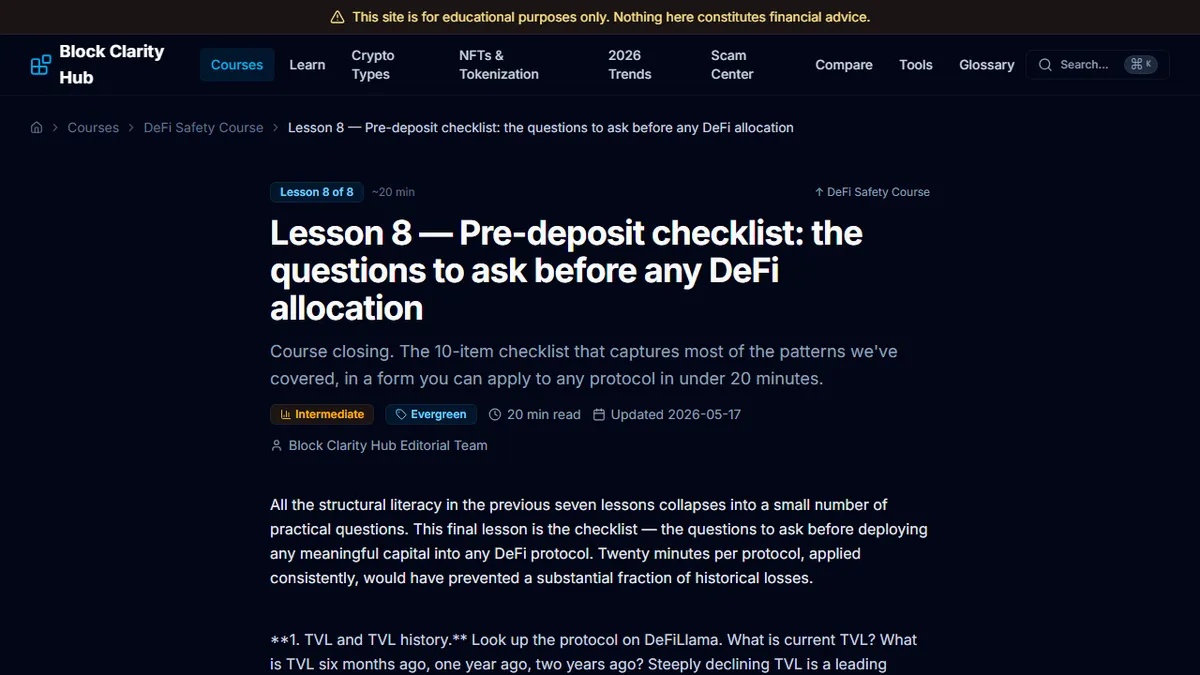
The pre-deposit DeFi safety checklist course lesson walks through each of these checks with live protocol examples, explaining how to find the relevant information on-chain and in documentation without relying on a protocol's own marketing materials.
Performing all ten checks takes between fifteen and thirty minutes for a new protocol. That investment scales well: the more you practise, the faster the pattern recognition becomes. Experienced DeFi users can complete a meaningful triage in a few minutes because the signals become familiar. The key is building the habit before the first large deposit, not after the first large loss.