Why Region Matters Before You Book Anything
Most first-time visitors to Great Britain do what feels logical: they book flights into London, spend three nights in the capital, and then make a vague plan to "see a castle somewhere." The result is usually a dash to Windsor, a glimpse of Bath, and a creeping sense that the country is somehow smaller and more homogeneous than advertised.
It isn't. Great Britain contains four distinct national cultures, radically different landscapes, and travel environments so varied that a week in the Scottish Highlands bears almost no resemblance to a week on the English Riviera. Region genuinely matters, not just aesthetically, but practically. Distances are longer than the map suggests, rural transport ranges from sparse to nonexistent, and the character of each area shapes what you can realistically do there. Getting this right before you book saves disappointment later.
England's Nine Regions at a Glance
England is divided into nine government-defined regions, but for travel purposes three broad bands do most of the work. The South and Southeast (anchored by London, with Bath, Oxford, the Cotswolds, and the chalk coast radiating outward) is by far the most visited and most straightforward to navigate by rail. Distances are short, trains run frequently, and almost every major attraction is accessible without a car.
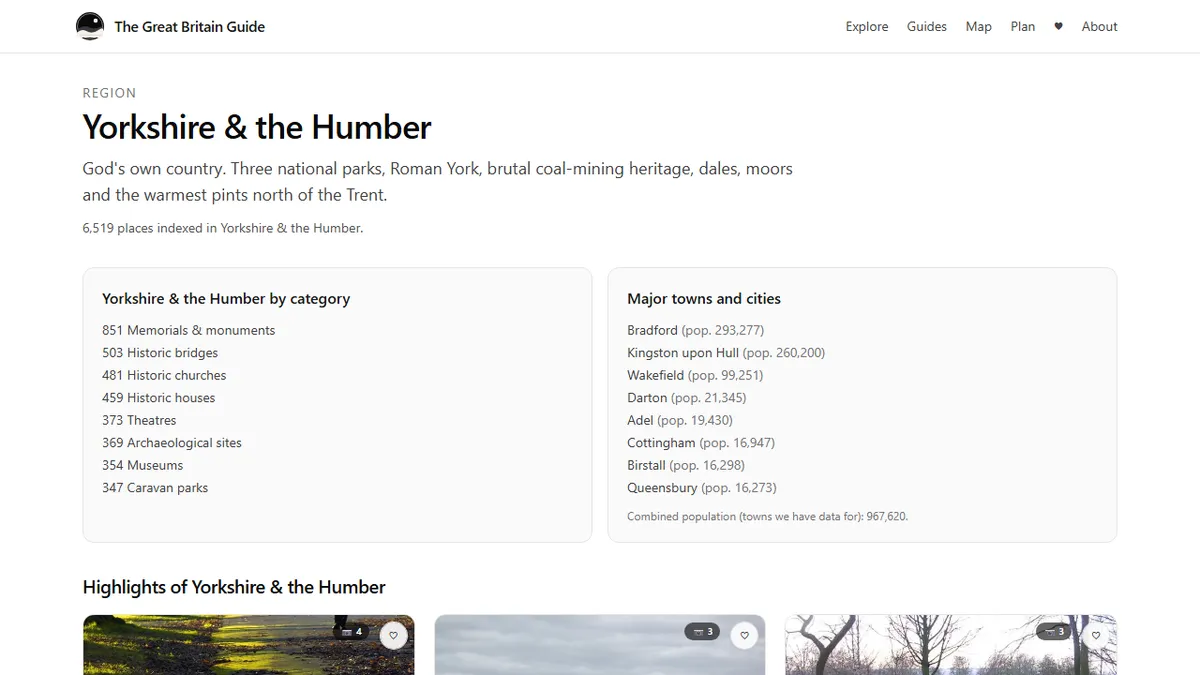
The Midlands occupy the country's centre, combining industrial heritage with surprising green pockets: the Peak District sits on its northern edge, Stratford-upon-Avon sits in its heart, and Birmingham has emerged as one of Britain's most genuinely interesting food cities. Further north, the Yorkshire and Lancashire corridor contains a spectacular concentration of landscape and history in a relatively compact area; places listed across Yorkshire give a useful overview of what the region offers before you decide where to focus.
The far North (Northumberland, County Durham, Cumbria) is the least visited and arguably the most rewarding for travellers who want dramatic landscape without the queues. Hadrian's Wall, the Lake District, and the Northumberland coast together form one of Britain's most underrated travel corridors.
What Scotland's Lowlands, Highlands, and Islands Offer
Scotland is large (roughly the size of the Czech Republic), and the divisions between its zones are more than geographical. The Central Belt, containing Edinburgh and Glasgow, offers the density of a capital combined with a genuinely distinctive culture. Edinburgh's Old Town, its castle, and the Fringe festival make it one of Europe's most compelling short-break destinations. Glasgow has reinvented itself as a design and music city that surprises almost every visitor who expects grime and neglect.
The Highlands begin roughly north of the Highland Boundary Fault and quickly become a different country. Roads narrow, distances expand, and the landscape turns elemental: open moorland, lochs, and mountains that are low by Alpine standards but dramatic in their exposure. Travel here requires either a car or careful planning around Caledonian Sleeper routes and infrequent bus services.
The islands (Skye, the Outer Hebrides, Orkney, Shetland) represent a further step into remoteness. Each island group has its own character: Skye draws hikers and photographers, Orkney attracts those with a serious interest in prehistoric monuments, and Shetland is for travellers who genuinely want to reach the edge of things.
Wales — Small Country, Outsized Variety
Wales is the country that first-time visitors most consistently underestimate. At roughly 20,000 square kilometres it can be driven end to end in under four hours, yet it contains three distinct zones with very different characters. North Wales offers the Snowdonia massif (genuine mountain terrain with the highest peak in England and Wales) alongside a chain of Edward I castles that rank among the finest medieval fortifications in Europe.
Mid Wales is the quietest part: thinly populated hill country centred on the Cambrian Mountains, with market towns like Aberystwyth and Brecon that move at their own pace. South Wales swings between the industrial heritage of the coalfield valleys, the regenerated capital Cardiff, and the Gower Peninsula (Britain's first designated Area of Outstanding Natural Beauty), and a place with beaches that would attract international attention if they were anywhere else.
Welsh is an actively spoken language rather than a historical curiosity, and the signage, the culture, and even the accent shift noticeably as you move west. It matters for how the place feels.
Northern Ireland's Compact Highlights
Northern Ireland occupies the northeast corner of the island of Ireland and is technically a separate nation within the United Kingdom rather than part of Great Britain. Many visitors include it on a British Isles trip regardless, and the logistics have become considerably easier since Belfast's revival as a tourist destination.
The Causeway Coast is the primary draw: a stretch of north Antrim coastline that takes in the Giant's Causeway, Carrick-a-Rede rope bridge, and Dunluce Castle within thirty miles. Belfast itself rewards two or three days: the Titanic Belfast museum is one of the best heritage visitor attractions in these islands, and the food scene has improved dramatically over the past decade. The Glens of Antrim offer quiet, beautiful valley walking for those who want to move beyond the highlights.
The whole of Northern Ireland can be toured in a long weekend if you have a car, which makes it an easy add-on to a broader British Isles itinerary.
How to Match a Region to Your Travel Style
The simplest framework is to pair your interest to the region that concentrates it. Literary and historic landscapes: the Cotswolds, Yorkshire, Edinburgh. Serious mountain walking: the Lake District, Snowdonia, the Cairngorms. Prehistoric monuments: Orkney, Wiltshire, Pembrokeshire. Industrial heritage: South Wales, the Black Country, South Yorkshire. Coastal drama: Northumberland, the Gower, the Cornish peninsula.
Where this framework breaks down is in the assumption that regions are internally consistent. Yorkshire alone spans everything from the industrial streets of Bradford to the limestone meadows of the Dales to the dramatic cliff coast of the North York Moors. Any region rewards staying longer than the average visitor gives it.
Using an Online Place Directory to Pre-Scout Stops
Before committing to an itinerary, browsing a structured place directory filtered by region and category does a job that general search cannot. It surfaces attractions that sit outside the headline tier (local nature reserves, working mills, heritage railways) without requiring you to already know what you're looking for. For each region in Great Britain, this kind of pre-scouting typically turns up three or four stops that weren't on your original plan and end up being the best moments of the trip.