Why Stonehenge Gets So Crowded (and When)
More than 1.5 million people visit Stonehenge each year, which works out at roughly four thousand visitors per day averaged across the calendar. In practice, it is nothing like that even: summer weekends, school holidays, and the windows around the solstices concentrate demand into brief, intense spikes that transform the visitor path into something more closely resembling a queue at a theme park than a walk around a 5,000-year-old monument.
The root problem is logistical. English Heritage operates a timed-entry ticketing system that provides some management, but the majority of visitors arrive on coach packages from London or Bath, and those coaches tend to depart at similar times and arrive in similar windows. The result is predictable: mid-morning on a Saturday in July sees the pathway around the stones packed to capacity. The experience is not ruined by this, but it is substantially diminished.
Three factors drive the busy periods: school holiday overlap (late July and August), the solstices (particularly June), and good weather forecasts on weekend mornings in spring and summer. Understanding the pattern allows you to work against it.
The Free Viewing Option You Probably Don't Know About
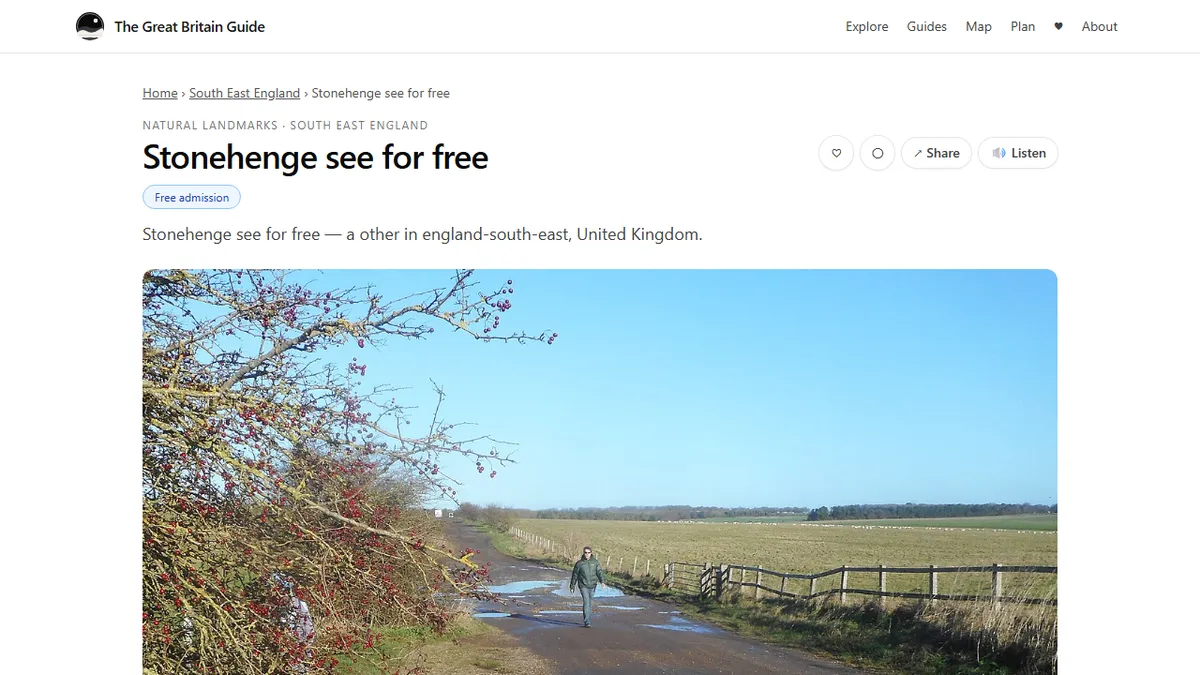
Most visitors do not know that Stonehenge is visible from a public road without purchasing a ticket. The A344, which formerly ran directly past the monument, was closed to traffic in 2013 as part of a landscape restoration project, but the roadside spot where Stonehenge is visible at no cost still exists. From the lay-by on the A303 near Airman's Corner, the stones sit clearly in the middle distance against the open skyline.
This is not the same as being inside the monument enclosure: you are viewing from several hundred metres away and cannot walk among the stones. But for visitors with genuinely limited time, or those travelling with people who are not deeply interested in prehistory, it provides a clear sight of the monument without the admission fee or the timed entry logistics. Photographers note that this vantage point can produce cleaner compositions than the official pathway, where the visitor infrastructure often intrudes into frame at close range.
Best Time of Day and Year to Visit
The evidence from visitor patterns is consistent: the two hours after opening (currently 9am, though this shifts seasonally) are substantially less crowded than the midday peak. Arriving at opening time on a weekday (particularly Tuesday through Thursday) delivers the most favourable conditions across most of the year.
Seasonally, October and November offer a combination of low visitor numbers, lower ticket prices, and the kind of atmospheric light that the monument produces most dramatically when the sky is big and unsettled. The stone circle was oriented to capture the winter solstice sunset and summer solstice sunrise, which means the low winter light is not incidental. It is the light the monument was designed to work with.
March and early April balance reasonable weather probability against shoulder-season visitor numbers. The summer solstice is a special case: English Heritage runs a separate access event around 21 June that allows much closer proximity to the stones than normal visits permit, but it attracts very large numbers and requires advance booking well ahead of time.
The Inner Circle Access Scheme — Is It Worth It?
English Heritage offers occasional Stone Circle Access visits outside normal opening hours (typically at dawn or dusk) that allow entry within the stone circle itself rather than onto the surrounding pathway. These visits are strictly limited in numbers, substantially more expensive than standard admission, and can sell out months in advance.
For visitors with a serious interest in the monument, the answer is almost certainly yes. Standing inside the circle rather than viewing it from the pathway changes the experience in a way that is difficult to anticipate: the scale of the individual sarsens becomes apparent in a different way, and the alignment of the monument relative to the sky can be observed directly. For casual visitors, the standard pathway visit is likely sufficient, and the premium over standard admission represents significant money for a short guided experience.
Check Stonehenge entry and visitor details for current pricing, booking windows, and seasonal availability of the inner circle scheme, as these change from year to year.
Combining Stonehenge With the Wider Avebury Landscape
Stonehenge sits within a prehistoric landscape of extraordinary density. Within a few miles: Woodhenge, a timber circle whose post holes are now marked by concrete stumps; the Cursus, a Neolithic earthwork enclosure stretching nearly two miles; and the West Kennet Long Barrow, a chambered tomb that predates the stone circle by several centuries and into which visitors can still walk.
Avebury (roughly 25 miles north of Stonehenge) offers something Stonehenge cannot: a stone circle so large that an entire village sits inside it, with houses and a pub enclosed by the megalithic ring. Avebury has no admission charge and no pathway restrictions. Visitors can touch the stones, walk among them without a guided route, and experience a prehistoric monument in a genuinely unmediated way.
Planning a day that takes in both sites is straightforward by car; the journey between them passes through some of the most beautiful chalk downland in southern England.
Getting There Without a Car
The standard car-free approach is the Stonehenge Tour bus from Salisbury railway station, which runs hourly in peak season and takes around 30 minutes. Salisbury itself is well served by direct trains from London Waterloo. For visitors wanting to add Avebury, a car is almost necessary: the direct public transport link between the two sites is limited and the journey by bus involves changes and significant walking.