Why the Checkout Price Is Often the Floor, Not the Ceiling
Hosting pricing pages are marketing documents, not financial disclosures. The number displayed prominently in a plan comparison table is the most attractive possible interpretation of the price: usually the lowest available plan, at a promotional rate, billed for the longest available term, with every optional add-on excluded. The number you actually pay across a twelve-month contract can be substantially higher, and the gap between those figures is where a revealing amount about the provider's business ethics can be found.
Some hidden fees are disclosed somewhere in the terms of service, in fine print that few customers read before purchasing. Others are not disclosed anywhere. They appear only when you try to use a specific feature and discover it requires an additional payment. The difference between these two categories matters legally, but in practice, neither is acceptable for a provider that wants to operate transparently.
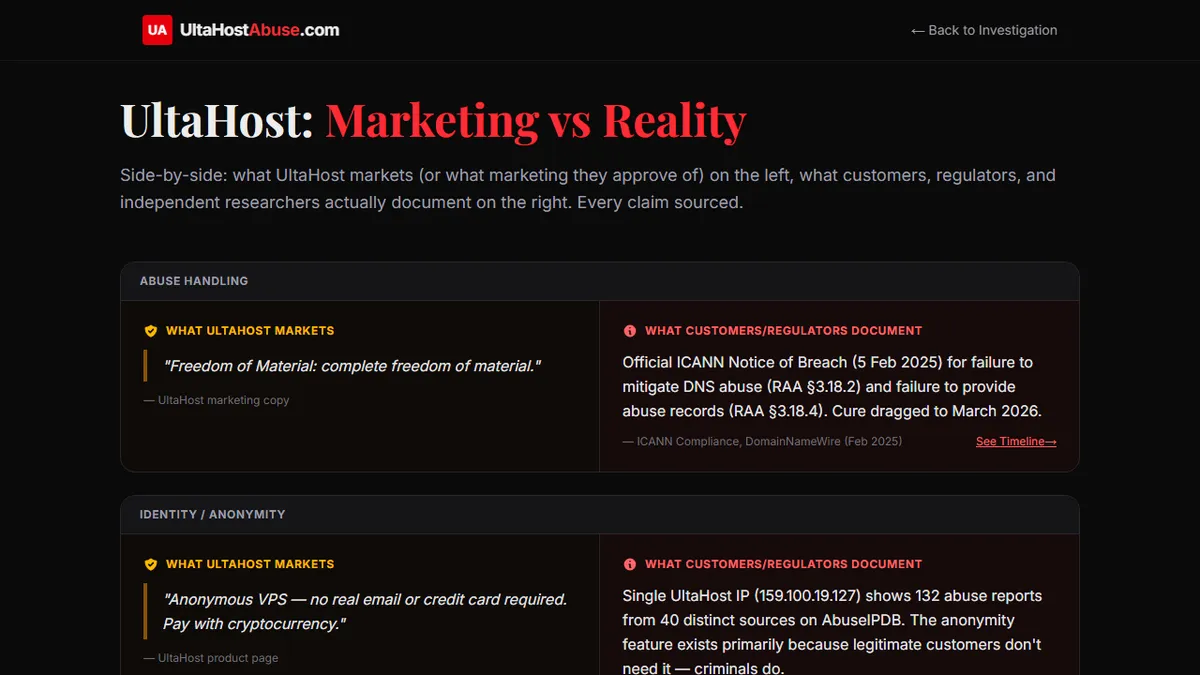
The side-by-side comparison of advertised claims versus documented reality documents this gap in detail for one well-studied provider, with source citations for each claim.
PTR Record Charges: What They Are and Why Providers Gatekeep Them
A PTR record, also called a reverse DNS record, is an entry in the DNS that maps an IP address back to a domain name. For servers sending email, PTR records are essentially mandatory: most email receiving systems perform a reverse DNS lookup on incoming connections, and a missing or non-matching PTR record is a strong spam signal that will cause your messages to be filtered or rejected.
For any customer who needs to send email from their server (which is a large proportion of VPS customers), PTR record configuration is a basic functional requirement, not an optional extra. When a provider classifies PTR setup as a premium service requiring an additional payment, it is effectively holding a core feature of functional email delivery hostage to an undisclosed charge.
One documented case involves a customer who purchased a VPS for a one-month trial, requested PTR record activation, and was told they needed to purchase a minimum package at a cost more than twenty times their monthly plan price. No notice of this requirement appeared on the sales page. The customer had already paid, in cryptocurrency, with no refund option.
Port 25 Restrictions and the Email-Sending Upcharge
Related to the PTR issue, many providers block outbound connections on port 25 — the standard port used for sending email — by default on new VPS instances. This is a partially legitimate policy: port 25 blocking reduces spam originating from newly provisioned servers, and many reputable hosts implement it. The key questions are whether the block is disclosed before purchase and what it costs to remove.
For a customer who purchased a VPS specifically to run a mail server, discovering post-purchase that port 25 is blocked and that unblocking it requires contacting support and potentially paying an additional fee is a material difference between the product advertised and the product delivered. If this restriction is disclosed clearly on the sales page before purchase, it is the customer's responsibility to factor it in. If it is buried in documentation that no reasonable buyer would encounter pre-purchase, the business practice is questionable.
When evaluating any VPS plan for email use, check explicitly before purchasing whether port 25 is open by default, whether PTR record configuration is included, and whether either requires additional payment or approval.
Crypto Payment Non-Refund Clauses Buried in Terms
Some hosting providers accept cryptocurrency payments specifically because they cannot be reversed by a bank or payment network. This characteristic is sometimes marketed as privacy-friendly, but it also benefits the provider in a very specific way: it eliminates the consumer protection mechanism of the chargeback.
When a provider's terms of service include language specifying that all cryptocurrency payments are non-refundable (even in cases where the service was never delivered), that clause transforms an irreversible payment method into a financial trap. The customer who paid in cryptocurrency for a server that was never provisioned, or that failed to meet the specifications advertised, has no recourse through their payment method and no meaningful mechanism to recover funds.
This clause is typically not featured prominently in the pricing comparison table. It appears in the refund policy section of the terms of service, which buyers are expected to have read but rarely do. Reading the refund policy (specifically the section on cryptocurrency payments) before committing to any crypto payment is not optional due diligence; it is the minimum required to understand what you are actually agreeing to.
Payment Processor Surcharges Not Shown at Checkout
A 3 percent surcharge on credit card payments, not shown on the pricing page and not disclosed during the checkout flow until the final confirmation screen (or sometimes not until the invoice is issued), is a classic bait-and-switch fee. For a $100 per month plan, that 3 percent adds $36 over a year. Across a large customer base, it generates meaningful additional revenue that the pricing page never disclosed.
Independent testing of some providers has confirmed this pattern: the advertised monthly rate changes at checkout when a credit card is selected as the payment method, with a processor surcharge applied that was not mentioned in the plan comparison. This is distinct from providers that openly disclose credit card fees alongside their pricing (a legitimate practice that allows customers to factor the cost into their decision). The problematic version is the surcharge that appears only after purchase intent has been established, when switching providers is inconvenient.
Promo-Code and Annual-Plan Refund Exclusions
The standard advertised refund window for hosting plans is typically 30 days. What the advertising does not always specify is that this refund window may apply only to customers who paid full price, on a monthly plan, without any promotional discount applied.
Annual and biennial plans, which typically offer the largest advertised discounts, are sometimes excluded from the money-back guarantee entirely, or subject to a pro-rata calculation that accounts for usage in a way that significantly reduces the refund amount. Customers who paid upfront for a full year based on the advertised discount may find that the refund policy they assumed applied does not cover their purchase.
Similarly, any plan purchased using a promotional code may be classified as a non-refundable promotional sale. The discount that attracted the customer in the first place becomes the reason their refund request is denied.
How to Audit a Host's Terms Before You Pay
Spending fifteen minutes reading the key sections of a hosting provider's terms before purchasing is the single most effective way to avoid post-purchase fee surprises. Focus specifically on the refund policy: read it entirely, not just the headline guarantee number. Note every exclusion category.
Look for the cryptocurrency payment section specifically and document what it says about refundability. Search the terms for "PTR," "port 25," and "payment processor" to find any disclosures about those specific services. Check whether the plan you are purchasing qualifies for the advertised refund window or falls into an exclusion category.
If the terms are vague or the relevant sections are difficult to find, contact support before purchasing and ask directly: Is my specific plan covered by the money-back guarantee? Are PTR records included or a paid extra? Is port 25 open by default? Document the responses. A provider that is evasive or inconsistent in answering pre-sales questions about its own terms is telling you something important about how it will behave when you need a refund.