Why Older Adults Are Disproportionately Targeted
The assumption that older adults fall for phone scams because they are less intelligent or less technologically aware is wrong, and it is harmful, because it shapes well-meaning conversations into condescending ones that shut down communication rather than opening it. The actual reasons for disproportionate targeting are structural and psychological, and they have nothing to do with cognitive capacity.
Older adults are more likely to be home during the day and more likely to answer unknown calls. They grew up in an era when a call from a bank, a government department, or a utility company was a routine part of life: the phone call as a channel of legitimate authority is embedded in their frame of reference in a way it simply is not for younger generations who default to email and apps. Fraudsters know this. Their scripts exploit the social norm of engaging politely with callers rather than hanging up abruptly.
There is also a neurological component that is worth understanding before having this conversation with a parent. Research suggests that the brain circuitry responsible for detecting insincerity and social threat weakens in older adulthood, while emotional responsiveness to apparent warmth and urgency remains intact. A scammer who sounds friendly, authoritative, and concerned will trigger trust responses that are physiological as much as cognitive. This is not a failure of intelligence; it is an exploited feature of how the brain ages.
For targeted guidance on keeping grandparents safe from fraud callers, the most effective approaches treat older adults as collaborators in their own protection rather than as passive subjects of management.
The Most Common Call Scams Targeting Seniors
Three scam types account for the majority of losses among older adults contacted by phone. The first is tax impersonation: a caller claiming to be from HMRC, the IRS, or an equivalent revenue authority and threatening arrest or legal action unless immediate payment is made. The threat of legal consequences creates the panic that overrides scepticism.
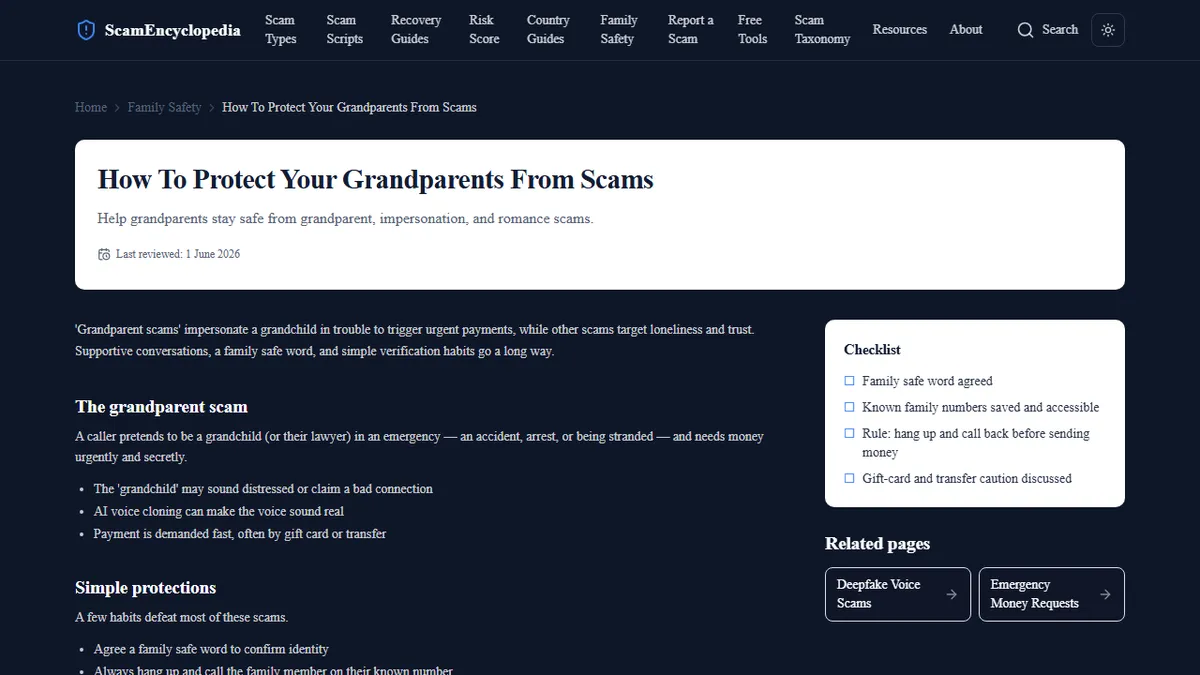
The second is the grandparent scam, in which a caller poses as a grandchild in urgent trouble (typically described as a car accident, a legal problem, or an emergency abroad) and asks for immediate funds, often via gift cards or wire transfer. A second caller then "confirms" the situation, posing as a lawyer, police officer, or hospital administrator.
The third is bank impersonation: a caller claiming to be from the fraud team of a named bank, warning that the account has been compromised and that funds must be moved immediately to a "safe account." The "safe account" belongs to the fraudsters.
How to Set Up Call Blocking and Carrier-Level Scam Filters Together
The most practical first step is setting up call blocking at both the device level and the carrier level. Most major UK carriers (BT, EE, Sky, Virgin Media) offer free opt-in scam call filtering. These services block known fraud numbers at the network level before the phone even rings. The equivalent in the United States includes AT&T's Call Protect, Verizon's Call Filter, and T-Mobile's Scam Shield.
For step-by-step call-blocking setup for an older relative, the process typically takes under fifteen minutes and can be completed remotely with your parent on the call alongside you.
At the device level, iPhones running iOS 13 and later include a "Silence Unknown Callers" option in settings that routes calls from numbers not in the contacts list directly to voicemail. Android devices offer equivalent functionality through the Phone app settings. Neither option blocks all fraud calls (known numbers can be spoofed) but both reduce volume significantly.
Establishing a Family Verification Word for Urgent Money Requests
A family verification word is a short, privately agreed phrase that anyone claiming to be a family member in an emergency must supply before money is discussed. The concept is simple: if someone calls claiming to be your grandchild in trouble, your parent asks for the word. Someone who does not know it cannot be the grandchild.
The word should be memorable, unusual enough not to be guessed, and not posted anywhere online. A childhood pet's name combined with a number, a place name from a family holiday, or a made-up word all work. The critical step is agreeing the word in person or via a verified channel and not via text or email, and reminding your parent that under no circumstances should the word be volunteered to a caller who claims to have forgotten it. A genuine family member who forgets the word can wait while you call them back on a saved number.
Having the Conversation: Language That Informs Without Patronising
How you raise the subject of phone scams with a parent matters as much as what you say. Framing the conversation around your own concern ("I've been reading about how sophisticated these calls have become and I wanted to talk through it with you") invites participation rather than implying incompetence. Avoiding phrases like "these days you really can't trust anyone" or "people like you are targeted because..." keeps the conversation collaborative.
Be specific. Share a real example rather than speaking in generalities. The grandparent scam, described in concrete detail, lands differently than a vague warning about phone fraud. Specific scenarios are easier to recognise when they occur, and recognition is the goal.
Agree on a simple rule together: money is never moved in response to a phone call, no matter how urgent the caller sounds. If a caller claims the urgency makes waiting impossible, that urgency is itself the sign something is wrong. Legitimate organisations (banks, tax authorities, police) all have processes that accommodate the need for independent verification.
Setting Up Bank Transaction Alerts as a Safety Net
Most banks now offer free transaction alert services via text or email. Alerts can be configured to trigger at any transaction above a chosen threshold: £50, £200, or whatever amount makes sense for your parent's spending habits. This creates a low-friction monitoring layer that allows family members to be aware of unusual activity without accessing account details.
If your parent consents, adding a trusted contact to their bank account (not as a joint account holder but as a named person the bank can contact if they have concerns) provides an additional safety net that some UK banks now offer explicitly for fraud protection purposes.
When to Involve a GP or Social Worker If a Parent Is Repeatedly Victimised
If a parent has been targeted multiple times or has transferred money despite previous conversations about fraud, this may indicate cognitive changes beyond the normal vulnerability that affects everyone as they age. A GP can assess whether any underlying factors warrant a referral, and local social services can provide financial safeguarding support in cases where vulnerability is clinically established.
Approaching this step with the same collaborative framing matters. The goal is not to remove autonomy — it is to create a support structure that makes exploitation harder without reducing quality of life. Framing it as adding a team rather than removing control makes the conversation significantly easier.