On this page
The Cover-Up Fingerprint: What Documented Cases Share
Popular culture tends to treat cover-ups as seamless operations, a circle of powerful actors who share a secret indefinitely, leaving no trace. The historical record shows something different. Real cover-ups are messy, leak-prone, self-undermining processes that typically leave more documentation than the participants intended. They get exposed not because someone heroically penetrates an impenetrable wall, but because institutions, financial records, and the competing interests of participants gradually make concealment unsustainable.
Looking across confirmed cases, a set of structural fingerprints appears consistently. First: a bounded group of named actors with specific roles and documented interactions. Second: a financial or documentary trail that persists despite partial destruction efforts. Third: institutional self-protection as an explicit motive, distinguishable from routine administrative decision-making. Fourth: exposure through multiple independent channels, not a single convenient whistleblower. When all four elements are present, the documentary basis for a cover-up verdict becomes strong. When they are absent, the honest analyst calls it speculation.
Watergate: The Tapes, the Erasure, the Confession
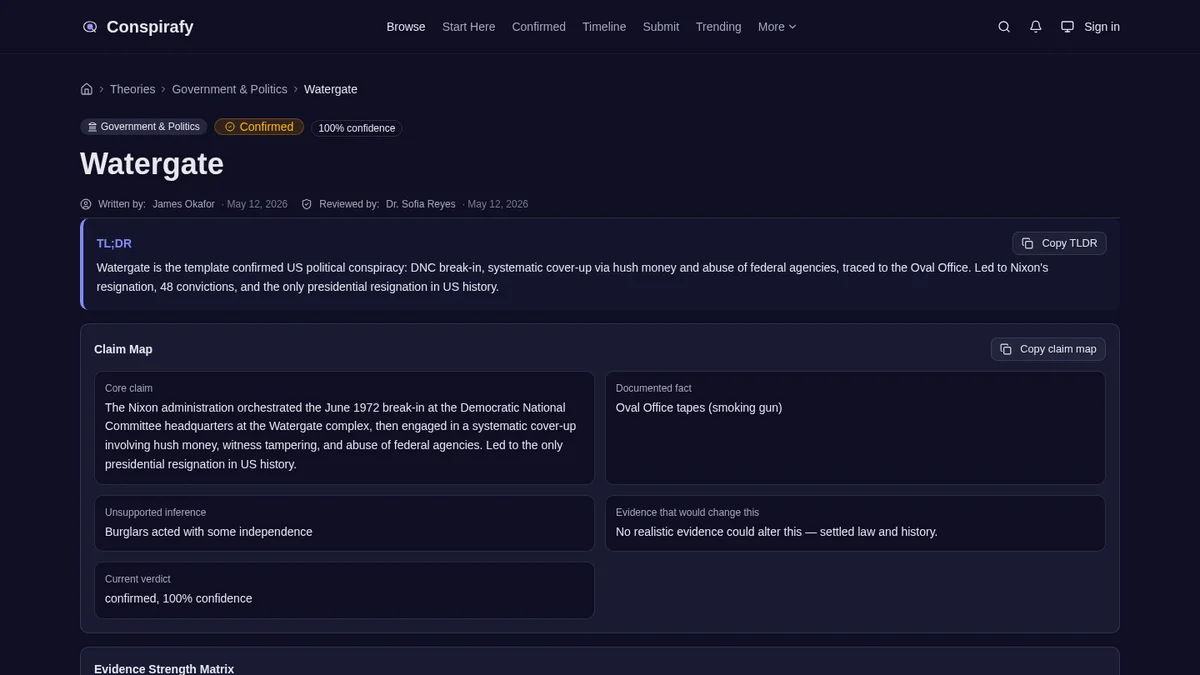
Watergate meets every criterion so completely that it functions as the textbook case. The DNC break-in in June 1972 was carried out by operatives connected to the Committee for the Re-Election of the President. The subsequent cover-up involved hush-money payments to the arrested operatives, abuse of the CIA to obstruct the FBI's investigation, and the deliberate destruction of evidence, most famously the 18.5-minute gap in a White House tape recording that Nixon's secretary attributed to accidental erasure in circumstances that technical analysts found implausible.
The Watergate confirmed conspiracy: timeline and convictions documents what the evidence ultimately showed: the smoking gun tape of June 23, 1972, captured President Nixon explicitly instructing the CIA to tell the FBI that the investigation touched on CIA national security matters — using a false claim to obstruct a criminal inquiry. He resigned on August 9, 1974. Forty-eight individuals were convicted.
What made Watergate both instructive and unusual was the audio record. Most cover-ups leave financial documents, memos, and testimony. Watergate left Nixon's own voice directing the obstruction. That level of self-documentation is rare; the principle it illustrates, that cover-up participants typically generate evidence they cannot fully control, is not.
Iran-Contra: Pardons as Institutional Self-Protection
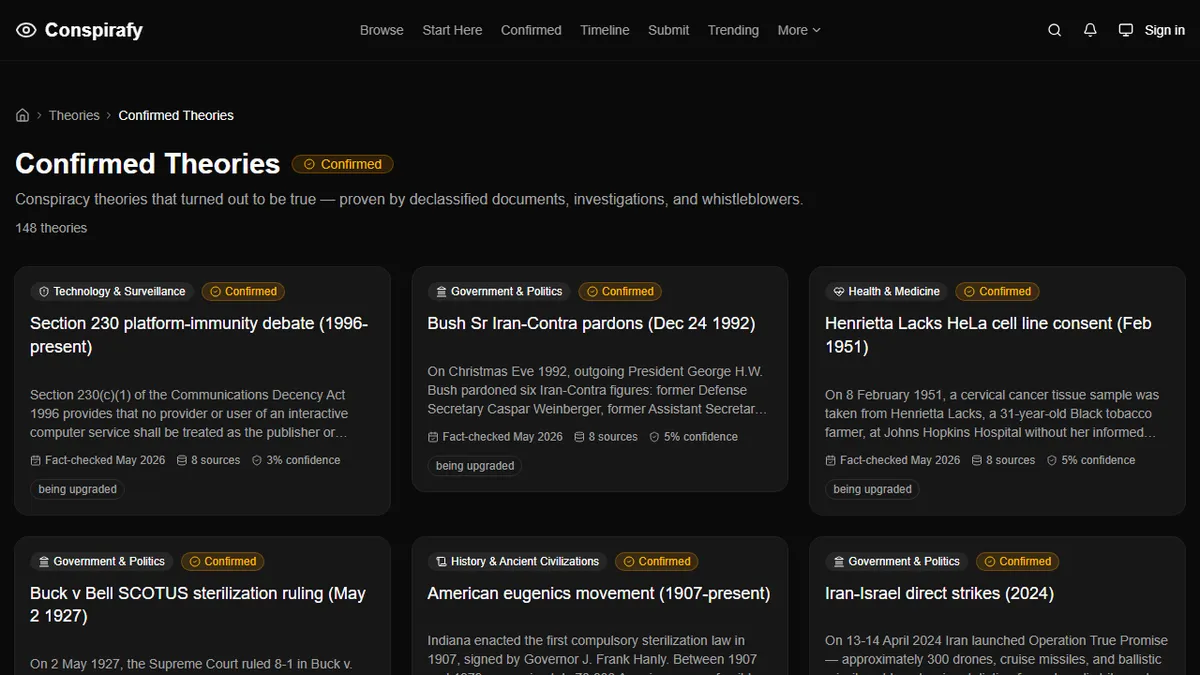
The Iran-Contra affair demonstrates a different mechanism of institutional self-protection: the pardon. By December 1992, Independent Counsel Lawrence Walsh had built prosecutable cases against several senior Reagan administration officials for their roles in the covert weapons-for-hostages transactions and the illegal diversion of funds to Nicaraguan Contra rebels. On Christmas Eve, outgoing President George H.W. Bush pardoned six defendants, including former Secretary of Defense Caspar Weinberger, whose trial had been scheduled for January 1993.
Walsh's 1993 final report described the pardons as completing a cover-up that had begun during the Reagan years. His report documented that Bush had withheld his own diary entries from investigators, entries that Bush later acknowledged contained references to his knowledge of the operation. The diary entries, once released, confirmed his awareness. "I was one of the few people that knew fully the details," he wrote at the time.
The Iran-Contra case illustrates how institutional self-protection operates through legitimate governmental mechanisms (pardons are constitutionally valid acts) in ways that functionally preserve a cover-up without requiring any obviously illegal single act. The cover-up mechanism was dispersed across personnel destruction, classification decisions, and finally executive clemency.
The Epstein Non-Prosecution Agreement and Immunity Provisions
Jeffrey Epstein's 2008 non-prosecution agreement with the US Attorney's Office for the Southern District of Florida is among the most documented examples of an unusual legal arrangement in recent American history. Epstein, who had been under federal investigation for sex trafficking involving dozens of minors, received a deal that allowed him to plead guilty to two Florida state charges, serve 13 months in county jail with generous work-release terms, and avoid federal prosecution entirely.
The NPA contained a provision that granted immunity not only to Epstein but to "any potential co-conspirators", unnamed individuals who were never charged. Federal judge Kenneth Marra ruled in 2019 that the agreement had violated the Crime Victims' Rights Act by failing to consult with Epstein's victims before execution. A Department of Justice Inspector General review found "institutional failure." The Miami Herald's investigation by reporter Julie K. Brown, published in 2018, documented the NPA terms in detail and triggered the subsequent SDNY prosecution that ended with Epstein's 2019 arrest and death.
The Epstein NPA immunity provisions and what was documented traces the specific legal architecture of the agreement. Ghislaine Maxwell's conviction in December 2021 for sex trafficking confirmed the broader network's reality. What the documented record does not establish is a comprehensive list of the unnamed co-conspirators who received NPA immunity or evidence sufficient to determine who influenced the original deal's unusual terms.
Cover-Up vs Incompetence: The Key Diagnostic Question
The most important analytical distinction in evaluating alleged cover-ups is between deliberate concealment and institutional incompetence. Both produce similar surface symptoms: incomplete investigations, missing evidence, inconsistent official accounts, and outcomes that benefit powerful actors. They require different evidentiary standards to distinguish.
Deliberate cover-up requires documentation of intent to conceal: memos directing the destruction of evidence, testimony about coordinated decisions to withhold information, financial transfers that only make sense as hush money, or audio recordings of instructions to obstruct. Watergate has all of these. The Iran-Contra pardons have documentary evidence of at minimum Bush's awareness that they were being used to end a criminal investigation.
Incompetence requires only documenting the failure without establishing intent. Bureaucratic failures routinely produce incomplete investigations. Witnesses are not interviewed. Evidence is mishandled. Investigative leads are not pursued. This is the normal operating condition of large institutions under time and resource pressure. When a cover-up allegation rests solely on evidence that could equally support an incompetence explanation, the cover-up verdict is not warranted without additional documentation.
How to Apply This Framework to Current Claims
When a new cover-up allegation emerges, the structural fingerprint provides a practical checklist. Are there named actors with documented roles — not just a general institutional category, but specific individuals and specific decisions? Is there a financial or documentary trail, however partial, that independent investigators can examine? Is there evidence of institutional self-protection as a motive, distinguishable from routine negligence? Has the allegation been examined by multiple independent investigators with access to primary sources?
The cases above all eventually answered yes to most of these questions, which is why they carry confirmed status. The majority of contemporary cover-up allegations fail the checklist at the first step — they involve unnamed actors, zero documentary evidence, and a single source whose access and motives cannot be independently verified.
Applying the framework does not make the analysis comfortable. It sometimes means acknowledging, as in the Epstein case, that a real cover-up is partially confirmed while its full extent remains genuinely unknown. That honest uncertainty is preferable to the false precision of either full confirmation or full dismissal. The documents determine the verdict. That is the only standard the evidence can support.