From hype to reality: what AI music actually means
The phrase "AI-generated music" gets thrown around in headlines as though it describes a single, simple thing: a computer pressing a big red button marked "song." The reality is messier, more impressive, and far more interesting than the hype suggests.
AI-generated music is music produced by machine learning models trained on enormous amounts of audio data. These models learn patterns across melody, harmony, rhythm, timbre, and structure. Once trained, they can generate new audio that follows those patterns, not by stitching together existing recordings, but by producing entirely new waveforms that conform to learned musical logic. The output is original sound, not a copy.
What makes the current wave different from older algorithmic composition is the combination of scale and coherence. Earlier computer-music experiments could produce technically valid chord progressions but sounded mechanical and lifeless. Contemporary audio models produce tracks that feel musically intentional: they build tension, they resolve it, they shift energy across a full song arc.
How audio models learn to write melodies and beats
The training process behind an audio model resembles how a human musician absorbs influence, just compressed and scaled. The model is exposed to thousands of hours of recorded music across genres, tempos, and structures. During training it adjusts its internal parameters to minimise prediction error, essentially getting better and better at understanding what comes next in a piece of music.
By the time training is complete, the model has encoded a rich internal representation of musical grammar: what kinds of rhythmic patterns feel stable, which harmonic progressions build anticipation, how a melodic phrase shapes itself over eight bars. None of this knowledge is stored as explicit rules. It exists as a vast web of numerical weights that collectively produce musically coherent output when prompted.
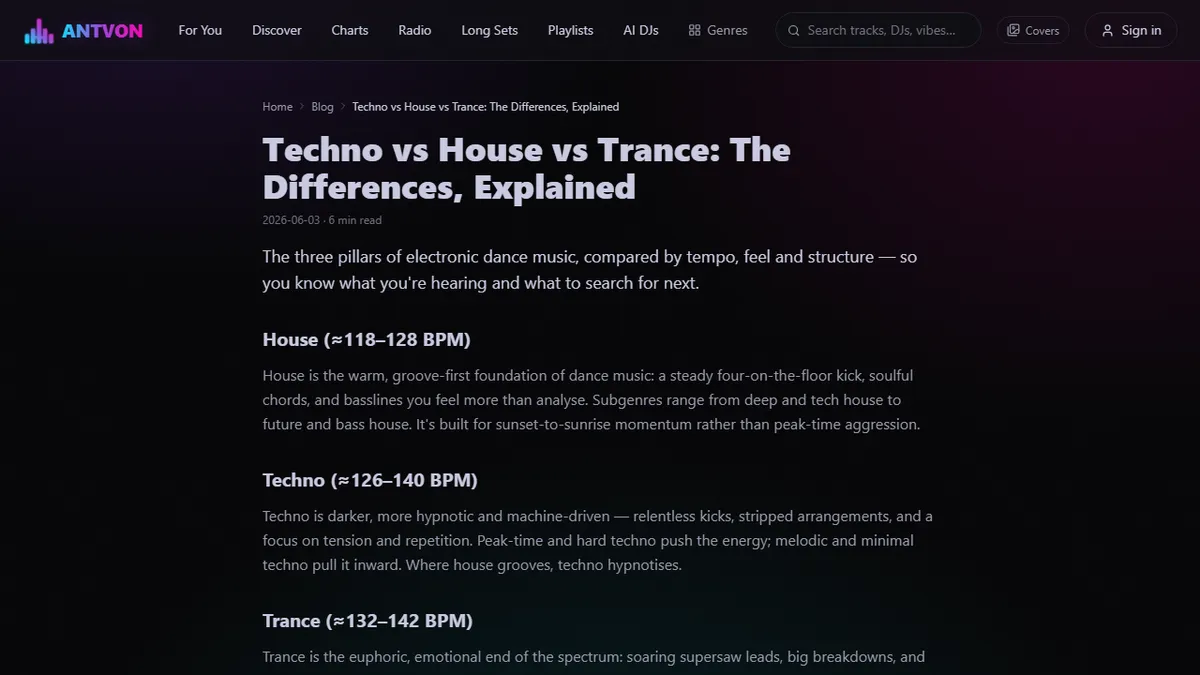
Prompting the model is where genre and style enter the picture. A model can be directed toward techno, toward trance, toward deep house, and it adjusts its output accordingly, drawing on the genre-specific patterns it absorbed during training.
The production pipeline: generation, tagging, mastering
Generating a melody or a beat structure is only the beginning. What listeners actually hear when they press play is the product of a multi-step pipeline that would be recognisable to any human music producer, even if the tools are entirely different.
After raw audio is generated, it goes through automated tagging: BPM detection, key identification, genre classification, energy-level scoring, and mood profiling. These tags are not decorative: they drive the discovery system that lets a listener filter a catalogue of thousands of tracks down to exactly what they want right now.
Mastering is the final production stage, where the overall loudness, dynamic range, and frequency balance are calibrated for playback on headphones, speakers, and streaming platforms. An AI-mastered track goes through the same fundamental process as a human-mastered one: limiting, EQ adjustment, stereo widening, and loudness normalisation to meet streaming loudness standards. The result is a finished product, not a demo.
Why AI tracks have genres, BPMs, and keys just like human-made music
Some listeners assume that because AI music is generated rather than composed, it must exist outside the normal organisational logic of music — that it is genre-less, structure-less, vaguely ambient. This assumption is wrong.
AI-generated tracks have genres, BPMs, and musical keys for the same reason human tracks do: musical grammar is consistent across all music, regardless of who or what produced it. A techno track generated by a model is operating within the same rhythmic and harmonic framework as one produced by a human artist in Berlin. The kick falls on the beat, the groove builds over phrases, the energy structure follows a recognisable arc.
This matters enormously for the listener experience. It means AI music can be sorted, filtered, and organised the same way as any other catalogue. You can search for 128 BPM tracks in A minor with a high energy rating and get results that actually match those criteria.
Common myths busted: 'it all sounds the same', 'it steals from real artists'
Two objections come up constantly in conversations about AI music, and both deserve a direct answer.
The first, that all AI music sounds identical, was partially true of early models but does not hold for current generation systems. Modern audio models produce meaningfully distinct output across genres, subgenres, tempos, and production styles. A track generated in the style of melodic techno sounds nothing like one generated in the style of liquid drum and bass. The variation is real, not cosmetic.
The second objection, that AI music is simply pirated human music in disguise, misunderstands the generation process. Training a model on music is analogous to a musician listening to music and absorbing influence. The model generates new audio; it does not splice or replay source recordings. The output waveforms are not copies of training data. For a deep dive into how AI-generated music is built, the technical detail rewards the curious reader.
Where to stream AI-generated music right now
The practical question for most readers is simple: where can you actually hear this? The short answer is that dedicated AI music platforms now offer catalogues large enough to serve genuine listening needs, not just demos and novelties.
The most useful platforms organise their catalogues by subgenre, BPM, energy, and mood, and allow filtering so a listener can arrive quickly at tracks that match a specific context. Some offer genre radio stations for passive listening, others offer long continuous DJ sets assembled from generated tracks, and others provide standard streaming interfaces close to what you would recognise from Spotify or Apple Music. Account creation is not always required. Many platforms allow free streaming from the first visit, which removes the barrier that often prevents people from forming an actual opinion about the music.
The key thing is to listen with an open expectation about what you are going to hear. AI-generated music is not trying to be indistinguishable from human music — it is trying to serve a listener well, and on those terms, it increasingly succeeds.