Why genre labels matter on a dancefloor
Walk into any club and ask the bartender what genre is playing. If they hesitate, they're probably not a regular. Genre labels in electronic music are not marketing categories invented by streaming platforms: they're descriptive shorthand for genuinely different listening experiences built around different rhythmic logics, emotional targets, and structural conventions.
For a newcomer, the labels can feel arbitrary and confusing. Techno, house, and trance all share a four-on-the-floor kick pattern, all operate in a similar BPM range, and all fill similar venue sizes. Yet they produce radically different physical and emotional responses. Understanding why requires listening for the right things. Once you hear those things, the distinction becomes permanent and automatic.
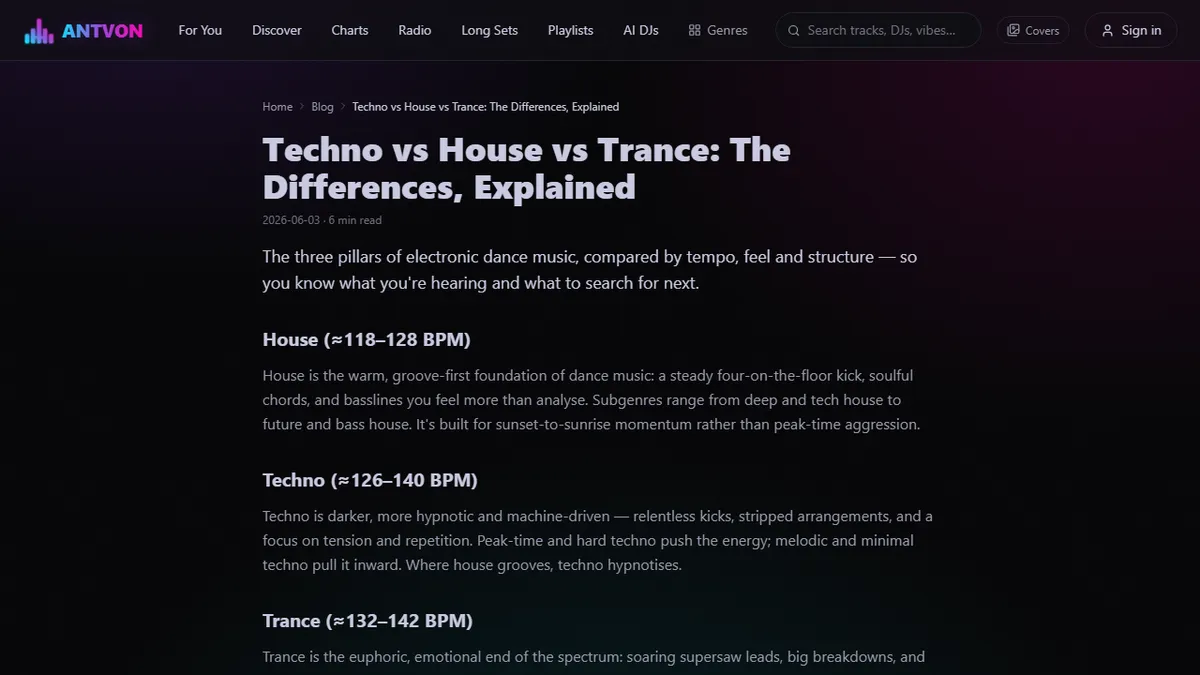
House: the groove-first blueprint
House music was born in Chicago in the early 1980s, and its founding logic was groove: specifically, the rolling, syncopated relationship between the kick drum, hi-hat, and bassline. A house track invites you to move your whole body, not just nod your head. The kick anchors the pulse but the offbeat clap or snare on beats two and four is what creates the swinging, forward-momentum feeling that defines the genre.
Tempo sits comfortably in the 120–128 BPM range, which maps neatly onto a relaxed walking pace scaled up. The basslines are melodic and often vocal in character, frequently sampled from soul and funk records or constructed to evoke that warmth. Synthesiser chords appear in full harmonic voicings rather than the sparse, functional stabs of techno. Vocals (sampled or original) are common and central. House music is fundamentally optimistic: even at its darkest, it retains a sense of communal warmth.
Techno: industrial repetition and tension
Techno emerged from Detroit in roughly the same period as house, but its emotional logic is the inverse of groove-optimism. Techno is tension accumulation. A techno track builds sustained pressure through rhythmic repetition, minimal harmonic movement, and a kick drum that arrives with mechanical, clock-like precision. Where house grooves, techno marches.
BPM sits slightly higher, typically 130–145, and the kick drum is harder and more compressed: a punching, industrial sound rather than a warm thud. Melodic content, when present, tends toward minor keys and atonal textures that generate unease rather than resolution. Tracks are long, often running eight or more minutes, because the payoff of techno is the gradual transformation of the listener's physical and psychological state through relentless repetition, not a chorus or a drop. By the third minute of a good techno track, something in your nervous system has shifted.
Trance: the euphoria build and release
Trance is the most emotionally explicit of the three genres, and also the most polarising. Its central mechanism is the build-and-release arc: an extended sequence of rising energy, layered melodic and harmonic tension, and then a drop that delivers what the build has been promising. Done well, this arc produces an emotional response in listeners that has been described, without much exaggeration, as euphoric.
The BPM range is typically 128–145, overlapping with both house and techno, but trance's structural markers are unmistakable. The breakdown — a section where the kick drops out, leaving only pad layers, a rising synth lead, and atmospheric texture — is trance's signature moment. Everything pauses except the harmonic and melodic tension, which continues to rise. When the kick returns, the release hits harder because of the preceding silence. This call-and-response between tension and resolution is what distinguishes trance from both house (which maintains groove continuity) and techno (which resists emotional resolution entirely).
Side-by-side: BPM, structure, and mood compared
Laid out as a direct comparison, the three genres look like this. House runs 120–128 BPM with a swinging, groove-forward feel; its structure follows verse-drop-breakdown patterns borrowed loosely from pop and soul; its emotional register is warm, communal, and physical. Techno runs 130–145 BPM with mechanical precision and minimal variation; its structure is linear and long-form, designed for gradual transformation rather than discrete sections; its emotional register is industrial, hypnotic, and introspective.
Trance runs 128–145 BPM but uses that tempo for a different purpose: to sustain a building emotional arc; its structure is explicitly dramatic, with pronounced breakdowns and builds; its emotional register is euphoric, cinematic, and occasionally overwrought in a way that is either a feature or a flaw depending on the listener. The genre comparison guide with listening examples extends these distinctions into specific track analysis for those who want to test their ear.
Subgenres to explore once you've got the basics
Mastering the three parent genres opens a much larger map. House fractures into deep house (warmer, slower, soulful), tech house (harder, more percussive), and progressive house (longer arcs, more melodic development). Techno branches toward minimal techno (stripped to near-silence), melodic techno (adding harmonic richness back in), and hard techno (extreme tempo and aggression). Trance expands into uplifting trance (maximalist euphoria), vocal trance (lyrics as emotional centre), and psytrance (hypnotic, psychedelic, 145 BPM and above).
Each subgenre rewards attention. Once you have the parent genre blueprint in your ears, the variations become legible quickly: you can hear exactly what a subgenre has borrowed, what it has discarded, and what it has invented. For listeners who want to stream trance tracks sorted by mood and BPM, a filtered catalogue is the fastest way to test your ear across the variations.