On this page
Myth 1: 'AI music all sounds the same'
This was a fair observation in 2021. It is no longer true, and repeating it as though it describes the current state of AI music generation reflects a failure to update on evidence.
Contemporary AI audio models produce genuinely distinct output across genres, subgenres, production styles, and emotional registers. A melodic techno track and a vocal trance track generated by the same underlying system share no perceptible sonic similarity beyond both being electronic music. The variation within subgenres is similarly real: two tracks tagged as minimal techno will differ in tempo, key, the specific character of their bass elements, and the timing and intensity of their tension cycles.
The confusion often stems from listeners encountering low-quality or undifferentiated early-generation AI music and extrapolating. Current-generation systems are several development cycles beyond those early outputs. Forming an opinion based on what AI music sounded like three years ago is equivalent to dismissing streaming audio quality based on a dial-up MP3 from 2001.
Myth 2: 'It's just remixing real artists' work'
The technical misunderstanding at the root of this myth is the conflation of training with copying. Training a machine learning model on a dataset of music allows the model to learn the statistical patterns of music: the relationships between notes, the typical structures of different genres, the frequency characteristics of various production styles. It does not store the training data. It does not reproduce it.
When an AI model generates a new track, it produces original audio waveforms. It is not stitching together samples, looping recordings, or reconstructing melodies from training examples. The output is new audio generated by numeric processes that have been shaped by, but do not contain, the training data. The relationship between training data and generated output is closer to influence than to reproduction. Influence has never been considered theft when humans exercise it.
Myth 3: 'AI can't capture emotion in music'
This claim rests on an unexamined assumption: that emotional content in music originates in the emotional state of the person creating it and is transferred to the listener through that origin. If that were true, music produced without a human emotional state would be incapable of producing emotional responses. But the listening evidence contradicts this.
Emotional responses to music arise from structural and acoustic features: tempo, key, harmonic tension and resolution, timbral warmth, dynamic arc. These features can be produced by any system capable of generating audio with those properties, human or AI. A minor-key melodic line that rises in pitch and volume over eight bars produces a feeling of anticipation and yearning in listeners regardless of whether a human or an algorithm generated it. The emotional mechanism is in the sound, not in the biography of its creator.
Myth 4: 'You need a subscription or account to access it'
The assumption that AI music requires sign-up, payment, or account creation derives from the general experience of commercial streaming platforms, where locked content and subscription gates are the dominant model. It does not describe the AI music landscape accurately.
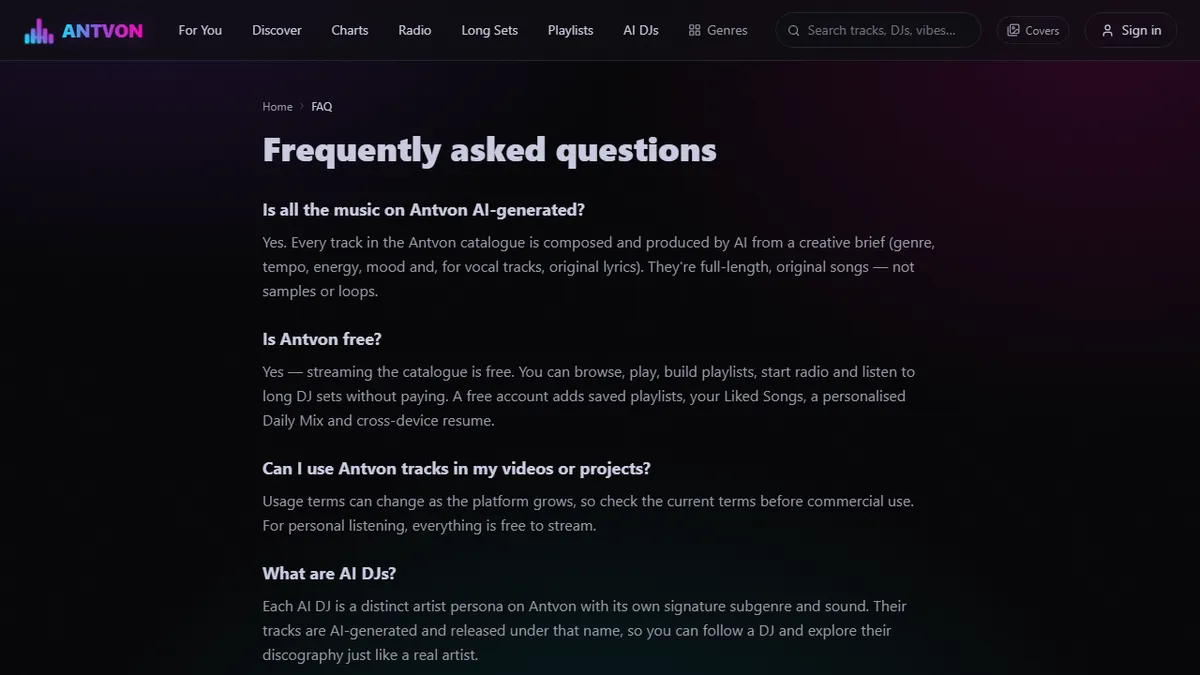
Multiple AI music platforms offer their full catalogues for free streaming without requiring account creation. You can arrive at the homepage, press play, and hear a finished, tagged, well-produced electronic track without providing an email address or a credit card number. The common questions about AI music answered in plain language covers this directly for listeners who have been deterred by assumptions about access. The no-account model is not an exception: for several platforms it is the default.
Myth 5: 'AI music has no genre structure or theory behind it'
This myth imagines AI music as formless: a probabilistic noise generator that happens to produce sounds in roughly musical frequency ranges, with no internal logic relating to keys, BPMs, harmonic structure, or genre conventions. It is the opposite of accurate.
AI-generated tracks are produced with explicit genre, tempo, key, and energy metadata, not as labels applied after the fact but as constraints that shape the generation process. A model prompted for a 128 BPM track in D minor with a techno genre tag will produce output that conforms to techno's rhythmic conventions at the specified tempo in the specified key. The music theory is not incidental; it is part of the generation process.
Myth 6: 'It's only useful as background noise'
Background listening is a legitimate and frequently undervalued use case. It is not, however, the only thing AI music is good for. Describing it that way reflects a narrow conception of what electronic music in general is for.
AI-generated electronic music is used for active focused listening, for long DJ set immersion, for genre discovery and education, for high-energy workout accompaniment, and for emotional regulation across a wide range of contexts. The same tracks that function as excellent background for deep work function equally well as the subject of close attention, because the music has internal structure, production craft, and musical logic that rewards engagement. The use cases are not one-dimensional.
Myth 7: 'AI DJs aren't real artists' — reframing identity in electronic music
The concept of artistic identity in electronic music has always been looser than in other genres. Electronic music has a long tradition of anonymous artists, collective identities, concept-driven projects, and machine-assisted production. The question of what makes an artist "real" in this context does not have a straightforward answer even when applied to human artists.
AI DJs carry signature production characteristics, consistent subgenre focus, and developing discographies. Listeners form preferences for specific AI artists on the basis of those characteristics: preferring one artist's approach to melodic techno over another's, seeking out a specific trance-focused entity's catalogue because its production style matches their taste. The listener's relationship to the music is identical whether the artist is human or AI. That relationship (the preference, the recognition, the accumulated familiarity) is what artistic identity is functionally for. Whether the identity requires biological authorship to be legitimate is a philosophical question, not a musical one.