On this page
The house family tree: where deep and tech house branch off
House music has always contained multitudes. From its Chicago origins, it spread globally and fragmented into subgenres that shared a fundamental rhythmic logic (the four-on-the-floor kick, the offbeat hi-hat, the looping groove structure) but diverged sharply in emotional intent and production vocabulary. Deep house and tech house represent two of the most important branches, and understanding where they split explains a great deal about the contemporary club landscape.
Deep house traces its direct lineage to the original Chicago house sound, particularly the soulful, jazz-influenced tracks being made in the mid-to-late 1980s. It preserved the genre's warmth and its connection to Black American music traditions while evolving production techniques. Tech house, emerging in the early-to-mid 1990s at the intersection of house and techno, introduced harder percussion, more minimal basslines, and a functional energy that prioritised dancefloor effectiveness over emotional warmth. Both are called house music. Both fill the same clubs. They feel nothing alike.
Deep house: warmth, soul, and the 'late night' feeling
Deep house is characterised above all by its emotional temperature. The basslines are melodic and often played with a vocal, almost human quality. They breathe and move rather than simply repeating. Chord progressions favour seventh chords and jazz-influenced harmony, giving the music a harmonic richness that house's straighter relatives lack. Piano stabs, Rhodes passages, and organic instrument textures (sampled or recreated) appear regularly and create the warm, lived-in feeling that defines the subgenre.
The tempo is typically in the 118–124 BPM range, slightly slower than tech house, and the overall energy level is restrained. Deep house is music for the latter hours of a night rather than the peak: for 5am when the crowd has thinned and the few remaining people have been dancing long enough that they no longer need to be pushed by volume and aggression. It rewards being heard at conversation-level volume as much as at club level, which is why it translates unusually well to headphone listening.
Lyrically, deep house is more vocal-forward than most other house subgenres. Sampled vocal phrases, spoken word passages, and full vocal performances appear more frequently, contributing to the sense that the music has a story or a memory attached to it rather than existing purely as functional dancefloor material.
Tech house: percussive drive and functional energy
Tech house operates from a fundamentally different premise. Its primary goal is functional: it is designed to sustain dancefloor energy over long periods through rhythmic drive, percussive density, and bass clarity. Where deep house invites introspection, tech house commands physical response.
The production is harder and more compressed. Kick drums arrive with the mechanical precision characteristic of techno, and the basslines tend toward the minimal and repetitive (a single, evolving bass motif rather than a melodic excursion). Percussion is dense and layered, with groove elements derived more from techno's industrial aesthetic than from house's soul and funk heritage. Chord content is sparse or absent; the energy comes from rhythm and bass rather than harmony.
BPM typically sits at 124–130, slightly faster than deep house and overlapping with the lower end of techno's range. The overlap is not accidental: tech house exists precisely in that intersection, borrowing techno's rhythmic rigour and house's groove philosophy and synthesising them into something with the accessibility of house and the drive of techno.
Production anatomy compared: bass, pads, percussion
The most reliable way to distinguish the two subgenres in practice is to listen to three specific production elements: the bass, the pads, and the percussion.
In deep house, the bass is melodic, often moving through chord tones or passing notes, and has a warm, rounded frequency character that sits comfortably in the low-midrange. Pads are present and prominent, contributing harmonic texture and the sense of atmospheric depth. Percussion is relatively sparse, with the groove emerging from the interplay of kick, bass, and occasional hi-hat rather than from layered percussion elements.
In tech house, the bass is minimal and rhythmically focused (often a driving, one-note or two-note pattern designed to create forward motion rather than harmonic interest). Pads are either absent or used very sparingly as decorative texture rather than structural elements. Percussion is dense and varied, with multiple hi-hat layers, clap patterns, and organic percussion sounds creating a rhythmic complexity that keeps the body moving even when the harmonic content is near-static.
Which to choose: mood-matching guide
The practical question for most listeners is not which subgenre is better but which fits a given moment. Deep house is the right choice when you want music that enriches a space (home listening, a dinner gathering, a late-night wind-down session after a long day). It is music that rewards attention but does not demand it. It works at low volume, it works as partial background, it works as full immersive listening.
Tech house is the right choice when you need to sustain energy (a workout, a focused work session requiring rhythmic drive, a social gathering where the music is supposed to keep the room moving rather than invite conversation). It is music that commands the physical environment rather than decorating it.
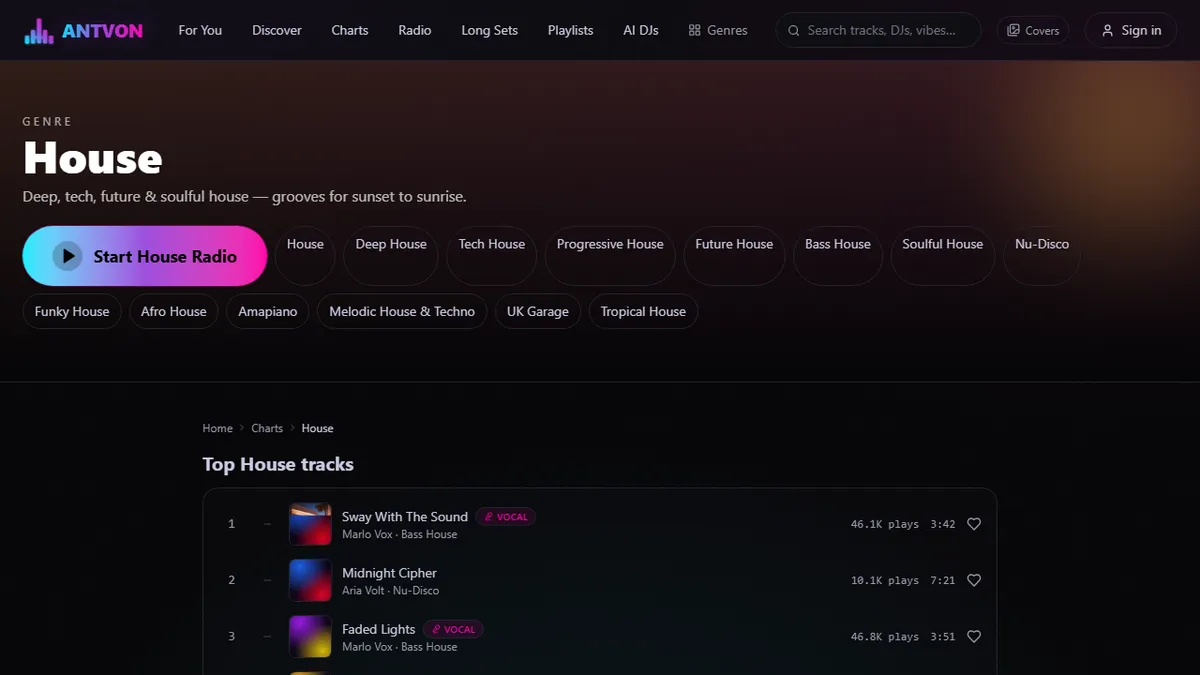
To browse house music subdivided by subgenre and energy with filtering that lets you move between deep, tech, and other house variants is the quickest way to hear the contrast directly and develop your own preference.
Going further: progressive house, future house, and beyond
Both deep and tech house connect outward to a range of related subgenres. Progressive house extends the melodic and structural ambitions of deep house into longer track forms with more dramatic build-and-release cycles. It is house music with aspirations toward the epic emotional scale of trance, and it occupies an interesting middle ground between the two parent genres.
Future house, which emerged in the mid-2010s, applies modern synthesis and production techniques (heavy sidechaining, synthesised bass that mimics horn and vocal sounds, highly polished high-frequency textures) to classic house rhythmic foundations. It is glossier and more commercial than either deep or tech house but shares their structural DNA. Understanding deep and tech house first makes the relationship to these derivative styles immediately legible, which is why starting at the roots always pays dividends.