On this page
What makes a long set different from a playlist
The easiest mistake to make about long DJ sets is to treat them as playlists with smoother transitions. A playlist is a collection of individual tracks, curated by someone with taste, designed to be satisfying if each track is good and the overall vibe is consistent. A DJ set is something architecturally different: a single continuous performance with an internal structure, an emotional trajectory, and a relationship between its parts that makes the whole more than the sum.
A skilled DJ (or a well-assembled AI DJ set) does not simply play one good track after another. The set is designed around energy: where the crowd or listener is at the opening, where they need to be taken, how that transition is managed, and how the energy sustains across an arc measured in hours rather than minutes. Track selection in a DJ set serves the arc. In a playlist, track selection serves individual quality. The distinction is subtle but the listening experience it produces is completely different.
The energy arc: how a well-built DJ set moves through time
Understanding the energy arc unlocks the DJ set as a listening format. Most long sets follow a recognisable macro-structure even when the specific tracks vary enormously. The opening section introduces the listener gently, not at peak energy but at a level that invites engagement without demanding it. Tempo might be slightly lower, harmonic content warmer, the overall intensity relatively contained.
The middle section builds. New elements appear more frequently, tempos step up incrementally, the complexity of the mix increases. This is not a sudden escalation. It is a gradual rise that the listener experiences physically as increasing engagement. By the midpoint of a well-constructed 90-minute set, the energy is higher than the listener consciously registered arriving there.
The peak section delivers maximum energy: the heaviest tracks, the densest arrangements, the most intense emotional moments. After the peak, the arc curves back down, not immediately but over 20 or 30 minutes, settling the listener back toward equilibrium. This entire arc is why walking into the middle of a DJ set at a club feels disorienting: you have missed the structure that was supposed to carry you to where the energy currently is.
Single tracks: when precision beats journey
Single tracks serve a completely different function. A five-minute track has its own internal structure (intro, build, drop, breakdown, outro) but it operates on a scale designed for immediate impact and efficient delivery of a specific musical experience. You press play and the thing you need to hear is available within thirty seconds.
This makes single tracks optimal for specific use cases: sampling a new genre or artist, satisfying a sudden craving for a particular sound, adding specific tracks to a playlist, or using music as a targeted tool for a specific functional purpose such as warming up before exercise or winding down before sleep. The precision of the single track (the fact that it delivers exactly one thing, clearly and efficiently) is its primary advantage over the long set format.
Single tracks are also the right format for active listening: when you want to give a piece of music your full attention, analyse how it is constructed, or decide whether to explore more from a particular artist. The long set by contrast is more suited to passive or semi-active listening where the music should carry you through time rather than demand moment-by-moment attention.
Use-case matching: work, commute, event, background
The decision between formats is most practically framed as a use-case question. For deep work (the kind of sustained focused task that benefits from consistent background rhythm without demanding engagement), a long set is almost always superior. Once a set is underway, the continuous audio stream removes the need to select or approve anything. The music simply continues, carrying the listener forward without interruption.
Commuting by public transport is a natural fit for long sets if the commute is 30 minutes or longer. The format handles variable commute lengths without the awkward mid-track interruption of arriving at your destination while a five-minute track is two minutes in. A well-assembled set also manages the mental transition from one environment to another: the commute-as-decompression function works better with journey music than with individual tracks.
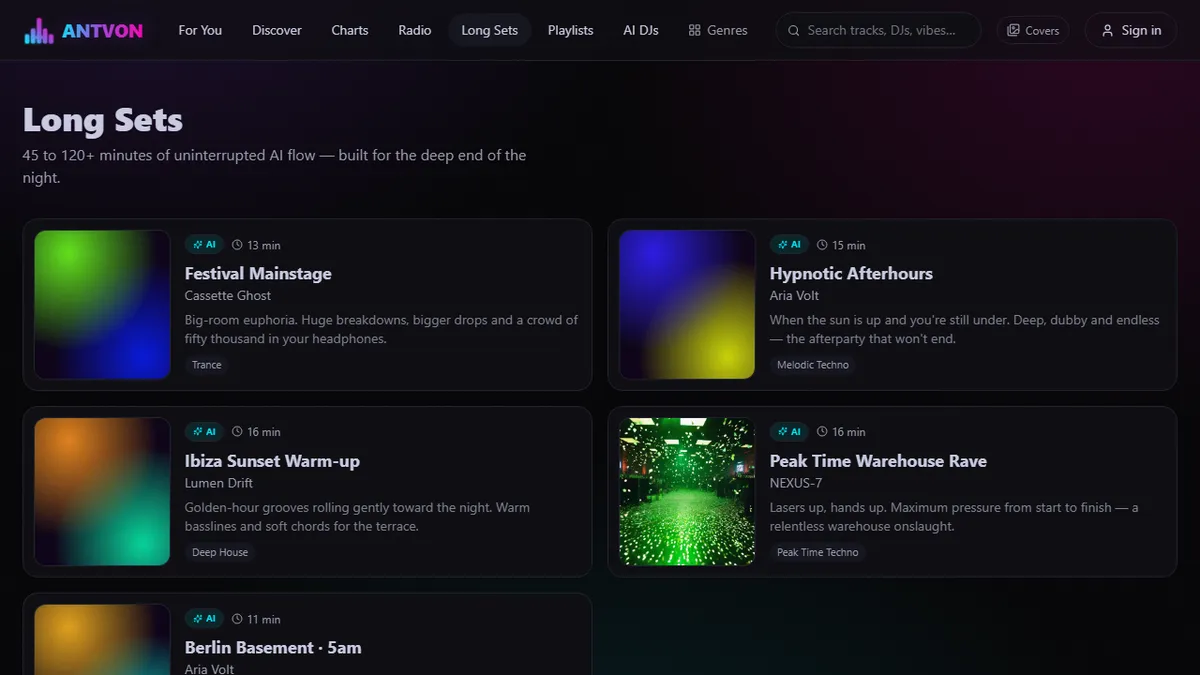
For background listening at social gatherings, single tracks or playlists tend to work better because the social environment requires music that functions at varying attention levels (sometimes central, sometimes peripheral), and the playlist format handles interruption and resumption more gracefully than a set designed for continuous consumption. The 45-to-120-minute continuous AI DJ mixes to stream free cover the full range of long-set use cases across multiple genres and energy levels.
How AI DJ sets maintain energy arc without a human at the deck
Human DJs build energy arcs from years of experience reading crowds, knowledge of their music library, and real-time improvisation. AI DJ sets achieve a comparable result through algorithmic energy-arc assembly: tracks are ordered using BPM progressions, energy-level metadata, and structural tags that identify which tracks work as openers, builders, peak-time tracks, and closers.
The result is a set that follows the same macro-structural logic as a human-built one (gradual build from opener to peak, sustained peak section, graceful descent) without requiring real-time human decision making. The transitions between tracks are handled by overlapping compatible sections based on tempo and frequency content, which maintains the continuity that makes a set feel like a unified experience rather than a sequence of separate tracks.
The metadata layer is what makes this possible. A track tagged with an energy level, BPM, genre, and structural position tag can be placed correctly in a set without human curation. The arc is assembled from those tags according to pacing rules that replicate what experienced DJs do intuitively.
Mixing both formats into a complete listening habit
The most satisfying electronic music listening practice uses both formats deliberately. Long sets for sustained periods (work sessions, commutes, events) and single tracks for active discovery, playlist building, and targeted functional listening. The two formats are not competing for the same listener attention; they serve different states and contexts.
A practical approach is to use genre radio or single track browsing as a discovery mechanism, saving tracks that stand out, and then treat long sets as the sustained-immersion format that makes up the bulk of your listening time. Over time, the accumulated familiarity with specific subgenres and production styles from single-track discovery pays dividends when listening to long sets: you start to recognise track types, understand transitions, and appreciate the structural decisions that a well-assembled set makes.