On this page
The Five Adult Belts and What Each One Signals
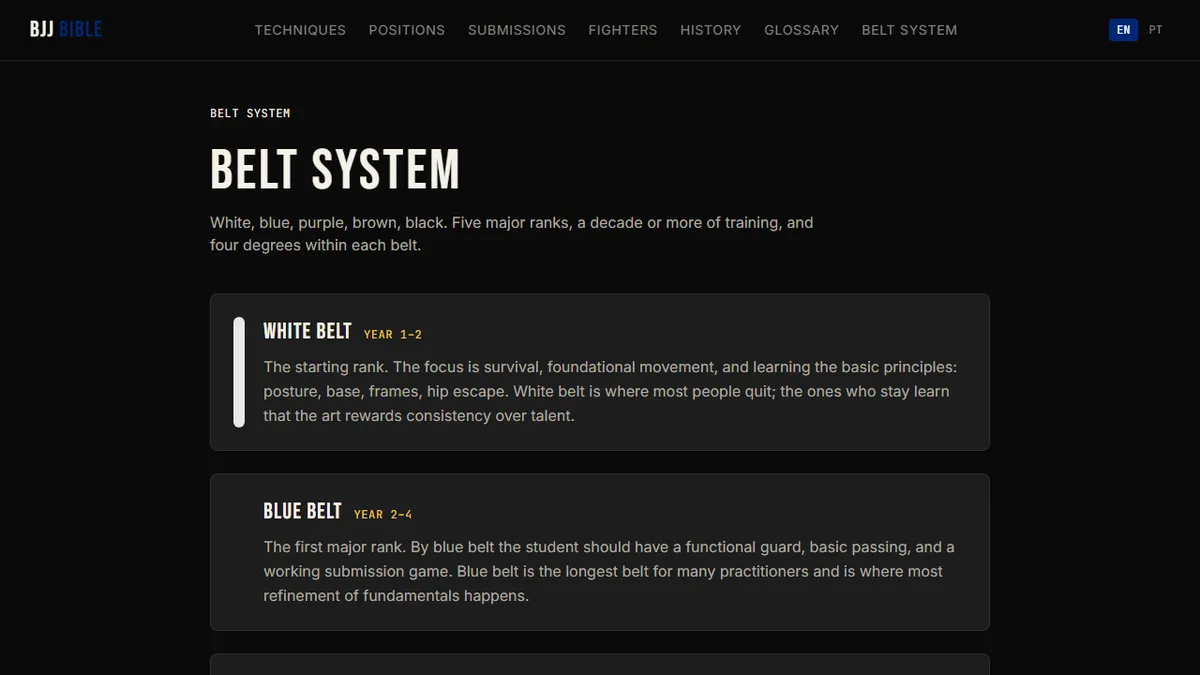
Brazilian Jiu-Jitsu's adult belt ranking uses five colours: white, blue, purple, brown, and black. Unlike most martial arts where belts accumulate visibly over a period of months, BJJ promotions are sparse and meaningful: the average practitioner spends years at each rank, and the art makes no pretence of quick progress. Each belt is a genuine and substantial shift in technical sophistication, not a curriculum milestone passed.
White belt is everyone's starting point, with no minimum time requirement to receive a blue. Blue belt signals that a practitioner has the fundamental positions and submissions under control and can hold their own against other beginners. Purple belt marks the transition from student to technician (someone with a developing personal game and a reliable competency across positions). Brown belt is the refinement phase, where practitioners whose game is largely built begin producing it consistently under high pressure. Black belt in Brazilian Jiu-Jitsu carries more weight than in almost any other martial art precisely because of how long the path is and how much live sparring separates the award from the ceremony.
Beyond the core five, there are also coral belts (seventh and eighth degree black belt) and red belt (ninth and tenth degree) for those who have contributed a lifetime of extraordinary service to the art, a category occupied by the founding generation and a small number of their direct students.
IBJJF Minimum Time Requirements at Each Belt
The International Brazilian Jiu-Jitsu Federation publishes minimum age and time-in-rank requirements that function as a floor, not a ceiling. An instructor cannot promote someone too quickly by IBJJF standards and have those promotions recognised in IBJJF competition, but nothing stops an instructor from taking far longer.
For adult practitioners, the IBJJF minimum at blue belt is no minimum time from white: blue can theoretically be awarded at any point. From blue to purple, the minimum is two years. Purple to brown requires one and a half years, and brown to black requires one year. In practice, these minimums rarely govern anyone's timeline. The practical floor at blue belt for most reputable academies is between one and two years, and the average path from white to black typically runs somewhere between eight and thirteen years of regular training.
The complete breakdown of IBJJF belt requirements and stripe criteria covers the specific age minimums that also apply. BJJ is unusual in having age floors at the higher belts, reflecting the federation's view that the higher ranks require not just technical maturity but personal maturity as well.
Stripe Graduations: What They Mean and How They Work
Stripes are small pieces of white athletic tape applied to the belt, typically up to four per belt before a colour promotion. They are not standardised in any universal way. The IBJJF does not legislate stripe requirements, and different academies use them differently. In many schools, stripes mark consistent attendance and demonstrable progress within the belt level; in others, they are treated as indicators of competition performance or coaching evaluation milestones.
What stripes universally signal is that a coach is paying attention and communicating with the student. A stripe ceremony, however informal, creates the kind of periodic feedback loop that helps practitioners track progress across long belts where improvement is sometimes hard to see. Blue belt, for instance, can last three to five years in many academies, and the absence of any visible acknowledgement across that span is a known factor in the dropout rate that plagues BJJ in the middle years.
At academies that use them formally, a fourth stripe typically indicates that the student is approaching readiness for the next belt (not guaranteed, but approaching). At others, a fourth stripe on a purple belt might mean five more years of training before brown.
Why Some Black Belts Are Promoted at 7 Years and Others at 15
Timeline variance in BJJ is enormous, and it is not a sign of a broken system: it is the expected result of an art that places promotion authority entirely in the hands of individual instructors without mandating a fixed syllabus or testing procedure.
The fastest legitimate paths to black belt typically involve very frequent training (five or more sessions per week), high levels of competition experience that accelerates technical development, and alignment between a student's game and their instructor's areas of expertise. Gordon Ryan's path was famously fast. Competitors who train full-time under elite coaches in high-density training environments can sometimes reach black belt in seven to nine years while being genuinely deserving of the rank.
The longest paths involve lower training frequency, long gaps for life obligations, or instructors who hold a traditional view that the rank should represent a body of knowledge that takes decades to accumulate. A practitioner who trains twice a week from their mid-thirties might reach black belt in fifteen years and be every bit as technically sound as a competitive twenty-eight-year-old who took eight.
What matters in assessing a black belt is not the time taken but the quality under pressure.
The Kids and Teen Belt System and How It Differs
Brazilian Jiu-Jitsu has a separate belt structure for children and teenagers, using additional colours not found in the adult system. Young students progress through white, grey, yellow, orange, and green belts before being eligible for the adult ranks at age sixteen. These intermediate belts exist partly to provide more frequent positive reinforcement for younger students and partly to prevent children from holding adult belt ranks that their physical maturity does not reflect.
A teenager who reaches green belt in the kids system does not automatically carry those stripes into the adult system. The transfer from youth to adult ranks is re-evaluated by the instructor, and it is common for a green belt teenager to be placed at white belt when they enter the adult programme, a decision that reflects technical standing in the adult context, not any slight to the student's youth achievements.
Common Myths About Belt Promotions Debunked
Perhaps the most persistent myth is that BJJ belts are primarily won through competition. They are not, at most academies. A practitioner who never competes but trains consistently and demonstrates the required technical and philosophical depth will be promoted on the same timeline as their competing peers. Competition accelerates certain aspects of development (especially the high-pressure performance of techniques against resisting, unfamiliar opponents), but it is an accelerant, not a requirement.
A related myth holds that belt promotions should be predictable in timing. They should not be, and any academy that promises promotion timelines based on months attended rather than skill demonstrated is misrepresenting the art. BJJ is not a belt-for-payment system, and any school running a paid belt track should be regarded cautiously.
The third myth is that a black belt in another martial art should translate to rapid promotion in BJJ. In most cases it does not, and this is not disrespect for the other art. BJJ's live sparring-based development measures performance against resistance, and a black belt in a system with less live pressure typically arrives on the mat as a knowledgeable beginner rather than as a seasoned grappler. Many instructors do give credit for athletic background and physical coordination, but the mat time still has to happen.