Why the First Month Feels Impossible — and Why That's Normal
Walk into your first Brazilian Jiu-Jitsu class and nothing will work the way you expect. Your body will not move as you intend. Positions that look simple from the side of the mat will feel alien the moment someone is physically contesting them. You will be tapped by people who appear to be doing nothing. You will gas out in minutes. You will wonder, quietly and persistently, whether you are simply too uncoordinated for this.
Every single person who has ever trained BJJ has had this experience, including the instructors on the mat who are now making it look easy. The learning curve at the start of Brazilian Jiu-Jitsu is among the steepest in any physical discipline, because the art asks you to do two things simultaneously: learn how to move in entirely new ways, and do it while another person is actively working to stop you. There is no parallel in gym culture or in most team sports. You cannot practice a golf swing under resistance. In BJJ, you cannot avoid the resistance: it is the point.
The good news is that the feeling of being completely lost typically lasts between four and eight weeks. After that, the human brain begins recognising patterns in chaos, and the floor-level competence that felt unreachable suddenly starts arriving. Knowing this in advance does not make the first month comfortable, but it does make it survivable.
The Only Two Skills That Actually Matter in Month One: Shrimping and Posture Breaking
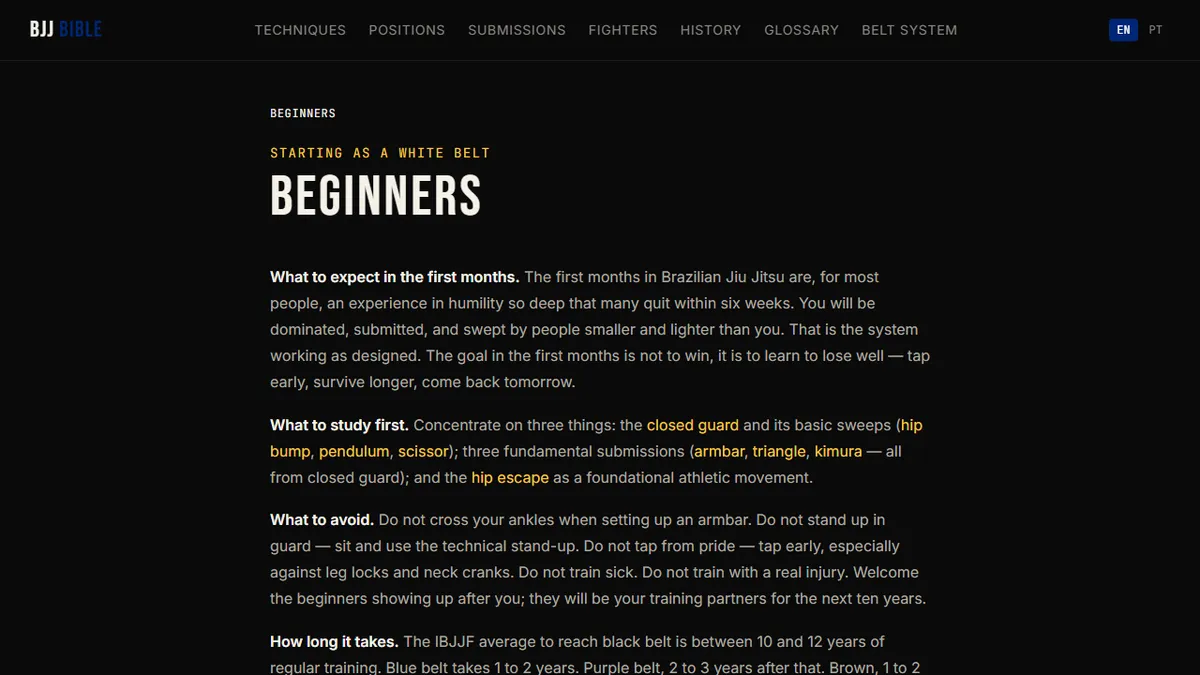
Instructors teach dozens of techniques in the first few weeks of a beginner curriculum. Most of it will not stick under live pressure, and that is fine. What a new student actually needs from month one is two movement patterns that are so fundamental they underpin every other technique: the hip escape, commonly called the shrimp, and the ability to break a top player's posture from closed guard.
The hip escape is the primary escape motion in BJJ. It is the movement that creates space when someone is on top of you, and without it you cannot recover guard, you cannot escape side control, and you cannot create the angles that make most submissions possible. It is drilled as a solo motion (lying on your back, driving your feet into the mat, and pushing your hips laterally while bringing your knees to your chest), but it is the foundation of half the grappling positions you will ever be in.
Posture breaking from closed guard teaches you the second critical concept: that leverage, not strength, governs BJJ. When a training partner postures up inside your guard, you learn to break them forward using collar and shoulder grips, pulling their weight onto you rather than trying to bench-press them away. That principle (redirect, don't resist) is the philosophical core of the art, and the sooner you internalise it, the faster you will improve.
Both movements are available for reference in the structured overview of what new BJJ students need to learn first, which gives context to where they sit in the broader beginner curriculum.
Learning to Tap Without Ego: Why Submission Resistance Slows Your Progress
The tap is not a defeat. In training, it is a signal that resets the position and lets both partners continue learning. Coaches emphasise this constantly, yet it remains one of the hardest mental adjustments for new students, particularly those who come from backgrounds in strength sports or competitive team environments where the culture around toughness is different.
The problem with resisting submissions in training is practical, not philosophical. A training partner who meets genuine resistance applies more force to complete the technique, and joints are not designed to absorb those forces indefinitely. Injuries that come from ego (a shoulder strained while refusing a kimura, a knee that suffers because the tap came a second too late) are injuries that take you off the mat for weeks or months. Every week you are not training, you are not improving. The math of tap-freely versus resist-and-risk is straightforward.
There is also the matter of feedback. When you tap and reset, you get to experience the same bad position again, and again, and eventually you learn to escape or avoid it. When you thrash and scramble your way out through raw strength, you learn nothing except that your grip strength exceeds your partner's.
The Dirty Truth About Drilling vs. Live Rolling
Most academies organise classes with a technique portion followed by live rolling, and new students often feel that live rolling is where the real learning happens: the rest is just warm-up. This is partly right and mostly wrong.
Live rolling teaches you how to apply what you already know under pressure. It is essential. But it does not efficiently teach you new skills, because under pressure your nervous system defaults to familiar patterns. The reps needed to make a new technique genuinely accessible under live conditions, not just remembered intellectually, are far higher than most beginners expect. Research on motor learning suggests that a technique typically requires hundreds of repetitions before it becomes what coaches call reflexive, meaning available without conscious thought.
Drilling gives you those reps in compressed time. Ten minutes of focused drilling on a single entry or escape produces more neural groove than an hour of rolling in which the position appeared twice. White belts who treat drilling as the prerequisite to rolling (rather than the interruption of it) accelerate through the early belt stages noticeably faster than those who only roll.
What to Expect at Each Stage in Your First Year
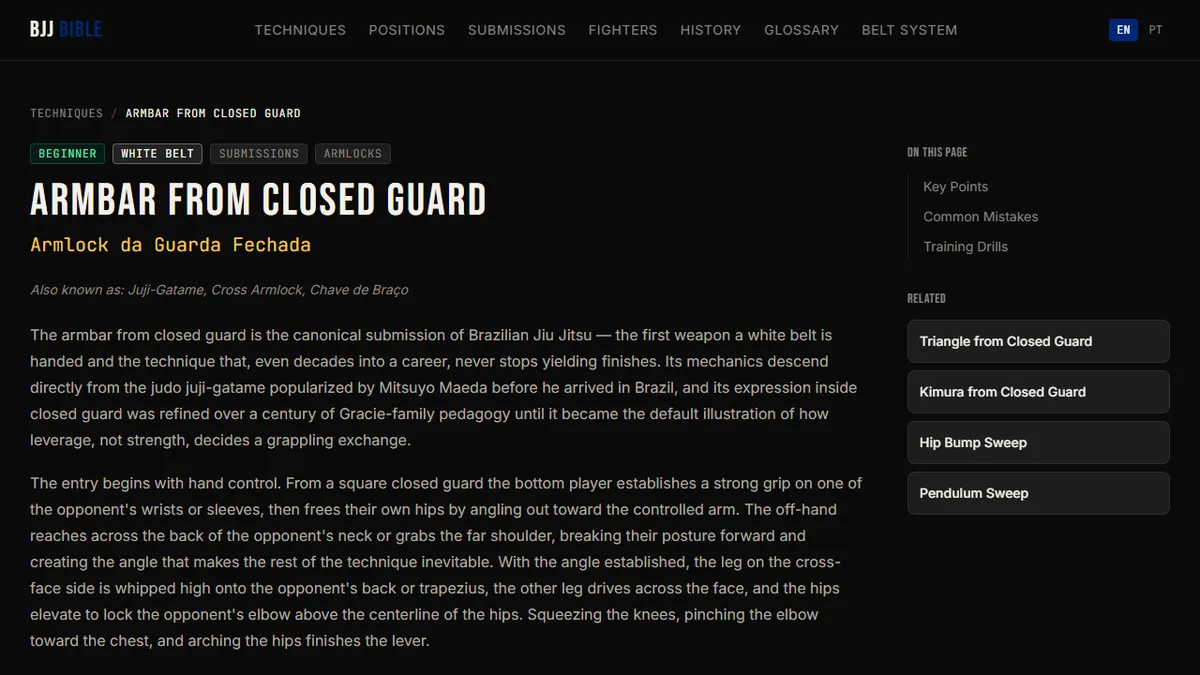
The first month is pure survival and pattern recognition. The second and third months are when the first coherent sequences begin to emerge: you will notice that the armbar and the triangle set each other up, that breaking posture leads to everything else, that certain training partners are now predictable enough to plan against. Around month four or five, most students experience what coaches call the first click: a session in which the techniques feel like they belong to you rather than like performances you are imitating. This is the moment the sport becomes addictive.
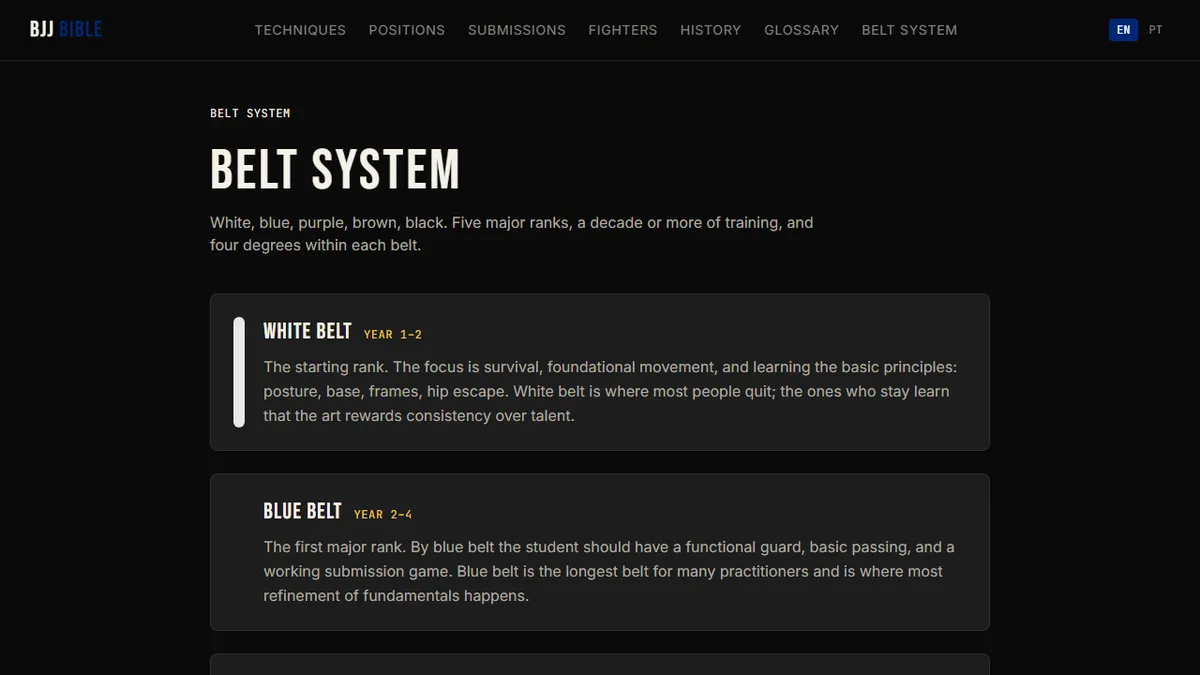
By month six, a dedicated white belt is typically wrestling with positions at something like a beginner-intermediate level. They will still get submitted constantly by more experienced partners, but the submissions will feel less random and more like consequences of identifiable errors. That shift in perception, from chaos to comprehensible, is what separates the white belts who make it to blue from those who quit somewhere in the early months.
Five Mistakes Every White Belt Makes (and How to Stop Making Them)
The first mistake is treating strength as a substitute for technique. It works at white belt against other white belts, and it will work less and less as the years pass. Coaches can spot a strength-dependent student instantly: they are the ones who make no progress the moment they are matched with someone equally strong.
The second is collecting techniques. There are thousands of positions in Brazilian Jiu-Jitsu, and the internet has made all of them visible. New students are often tempted to chase variety, watching instructionals late at night and showing up to class trying to hit berimbolo entries before they have a functional hip escape. Depth beats breadth at every stage, but especially at white belt.
The third mistake is skipping fundamentals class. Most academies offer a dedicated beginners or fundamentals track, and many white belts abandon it the moment they can survive in the general class. That is exactly backwards. The fundamental positions (closed guard, side control, mount, back control) contain the entirety of BJJ within them. Students who skip the foundations class skip the explanations that make every advanced technique sensible.
The fourth is not tracking your progress. BJJ improvement is slow and uneven, and it is easy to feel stagnant while actually improving. Keeping a simple training log (noting the date, the techniques covered, and one thing that worked) gives you a record to look back on when motivation drops.
The fifth mistake, and the most damaging, is inconsistency. More than any single variable, frequency of training predicts long-term progress. A student who trains twice a week every week will outpace a student who trains five times a week for a month and then disappears. Show up. That is the entire secret for the first six months.