The Two Dominant Guard Passing Philosophies Defined
Guard passing in Brazilian Jiu-Jitsu reduces, at its philosophical core, to a choice between weight and movement. Either you use your mass and chest pressure to flatten the guard player's hips, break their frames, and slide through their defensive structure — or you use speed, angles, and repositioning to get around the legs faster than the guard player can respond. Every pass in the art sits somewhere on this spectrum, and every practitioner, whether they know it or not, leans toward one end of it.
Pressure passing is the philosophy of weight distribution, hip pressure, and grinding through guard retention. Practitioners who build their game around it learn to neutralise frames by making them irrelevant, not by avoiding them. Their passing is slow, physically uncomfortable for the bottom player, and extremely difficult to time-based sweeps against because there is no explosive moment of commitment to redirect. The canonical examples are Rodolfo Vieira's crushing smash pass, Xande Ribeiro's patient over-under, and the legendary chest-walking pressure that defined the early Gracie Barra competition style.
Speed and float passing is the philosophy of angle, timing, and redirection. Practitioners who build around it learn to create reactions from the guard player (a frame placed here, a hip rotation there) and then move faster than the reaction can complete. Rafael and Gui Mendes built the most celebrated float-passing game in modern competition. Their leg drag and toreando sequences operated on the principle that a guard player who can never feel your weight cannot do anything constructive with the weight.
Pressure Passing: Mechanics, Weight Distribution, and Why It Breaks Guard Retention
Effective pressure passing begins with an understanding of how the guard player generates their defensive power. Frames (the elbows and knees posted against the passer's body) are only useful when they have a stable base to push from. A guard player whose hips are flat on the mat and whose legs are being driven to one side has no base. Their frames become pushes against nothing.
The over-under pass is the purest expression of pressure philosophy. The passer threads one arm under the near leg and the other arm over the far leg, gets their chest heavy on the guard player's thighs, and begins a grinding walk toward side control that progressively removes the guard player's hip mobility. The bottom player can feel every movement approaching and still cannot stop it, because the pressure is distributed across too large an area to redirect. Understanding over-under pressure passing mechanics and weight placement reveals how hip lowering and shoulder placement transform the same basic position into something much heavier than its mechanics suggest on paper.
Pressure passing rewards certain physical attributes: a lower centre of gravity, broad shoulders, strong hips, and above-average tolerance for slow, grinding grappling. It also rewards patience — the willingness to sit in an uncomfortable position for thirty seconds while the bottom player exhausts their defensive options rather than trying to force the pass in three.
Speed and Float Passing: The Mendes Brothers, Leg Drag, and Toreando Logic
Speed passing operates on a completely different principle. Rather than making the guard player's frames irrelevant through weight, the float passer makes them irrelevant through absence. If you are never where the frames expect you to be, the frames are never loaded.
The toreando pass is the simplest float pass and the best introduction to the philosophy. The passer grabs both of the guard player's pants at the knees, steps to one side, and redirects the hips away while moving in the opposite direction — all before the guard player's hips can follow. There is no weight commitment, which means there is no moment of commitment to sweep. The guard player must address the direction of the hip push and the direction of the passer's movement simultaneously, and they consistently cannot.
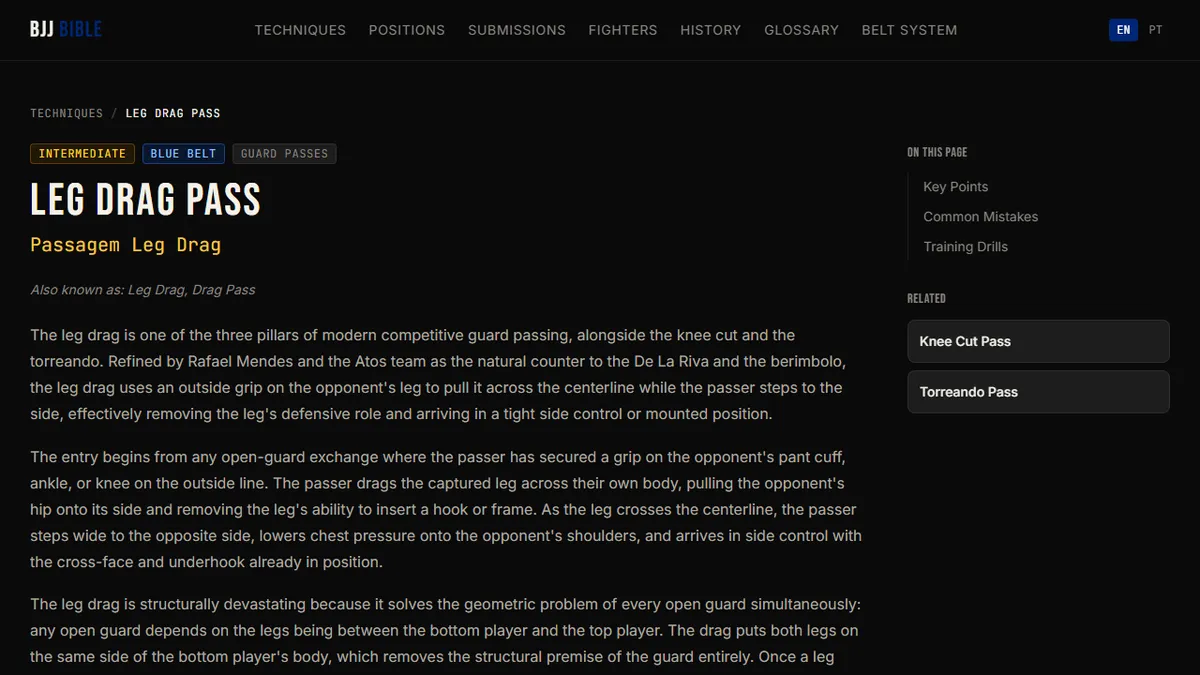
The leg drag took the float philosophy to a higher level. Rather than bypassing the guard entirely, the passer threads one leg over their own hip, pinning it with a tight grip and body positioning, while moving around the other leg. The how the leg drag pass neutralizes open guard and sets up side control entry demonstrates how the drag neutralises open guard retention by eliminating the guard player's ability to re-hook — they cannot chase the passer's legs with a leg that is already committed to the drag.
How Body Type and Athletic Background Should Influence Your Choice
The most common mistake practitioners make when developing a passing game is copying the style of their favourite competitor without considering whether their physical profile supports it. The Mendes brothers are compact, explosive athletes with high hip mobility and exceptional timing. A six-foot-two practitioner with a wrestler's build attempting to copy their floating game will face structural difficulties that no amount of drilling fully solves.
Body type questions worth considering: Do you have a low centre of gravity relative to your height? Pressure passing becomes easier. Are you quick off your feet, with good lateral agility and change-of-direction speed? Float passing rewards those qualities. Do you have long legs relative to your torso, making it hard to keep your hips low? Float passing may simply suit your biomechanics better than grinding chest pressure.
Athletic background matters too. Wrestlers typically adapt to pressure passing more naturally because much of it uses familiar weight-distribution principles from the top position. Judokas and dancers often take to float passing because their spatial awareness and off-balance timing already align with its requirements. Neither background is determinative (the most effective pressure passer of his generation, Gordon Ryan, came to BJJ from a relatively clean athletic slate), but background is a reasonable starting point.
Hybrid Approaches: What Gordon Ryan and Modern Champions Do Differently
The pressure-versus-float framing is useful for building a foundation, but the best practitioners in modern BJJ do not commit to one side of the spectrum and ignore the other. What they build is a primary style supported by opportunistic transitions to the secondary style.
Gordon Ryan's passing game is primarily pressure-based, built around the over-under and the knee slice. But when a guard player creates enough space trying to defend the pressure, he transitions into a float pass immediately. The threat of the pressure creates the space; the float finishes what the pressure opened. His opponents cannot defend a single style because they are always facing both.
This hybrid approach is also where the knee slice pass lives — it is the bridge between philosophies, generating pressure through the chest while using the cutting knee as a movement-based element. Modern competition has converged on the knee slice as the most versatile single pass precisely because it contains elements of both worlds.
Building a Guard Passing Game from Scratch: A Six-Month Road Map
Choose one primary pass from each philosophy and drill both. A workable starting combination for most adults is the over-under as the pressure pass and the toreando as the float pass. These two techniques address completely different guard retention strategies, they chain into each other when defended, and they teach the foundational mechanics of both schools.
Spend the first two months drilling each in isolation (entry mechanics, weight placement, hip positioning) without live resistance. Month three introduces light resistance from a cooperative partner. Month four and five work the passes against genuine resistance in positional sparring that begins from guard. Month six tests both passes in full rolling, tracking which guard configurations each pass is solving and which it is struggling against.
The passes will expose each other's applications. When the pressure pass stalls against a guard player with excellent framing and hip mobility, the toreando becomes the answer. When the toreando is being timed and swept, slow down and use the pressure. Building this conversation between the two styles is the beginning of an actual passing game.