Why Closed Guard Is Still the Most Important Position in BJJ
There is a temptation, especially among practitioners who have spent time on YouTube watching elite competitors, to dismiss closed guard as a beginner position (something you use before you develop the flexibility for De La Riva, the inversion capacity for berimbolo, or the wrestling to avoid being on your back altogether). This is a mistake that the best grapplers in history have never made.
Roger Gracie spent a career dismantling world champions with nothing more than closed guard submissions. Gordon Ryan maintains a closed guard sequence in his system. Marcelo Garcia won ADCC titles partly on the strength of closed guard triangles against much larger opponents. The position endures not because the art has failed to progress beyond it but because its geometry is genuinely sound. When the guard is properly closed (legs locked above the opponent's hips, hips elevated enough to limit their posture, grips established on collar and wrist), the person underneath has a mechanical advantage that the person on top must actively solve.
The question is never whether closed guard works. The question is whether the bottom player can attack coherently enough to capitalise on the advantage the position provides.
The Armbar from Closed Guard: Posture Breaking Before Leg Movement
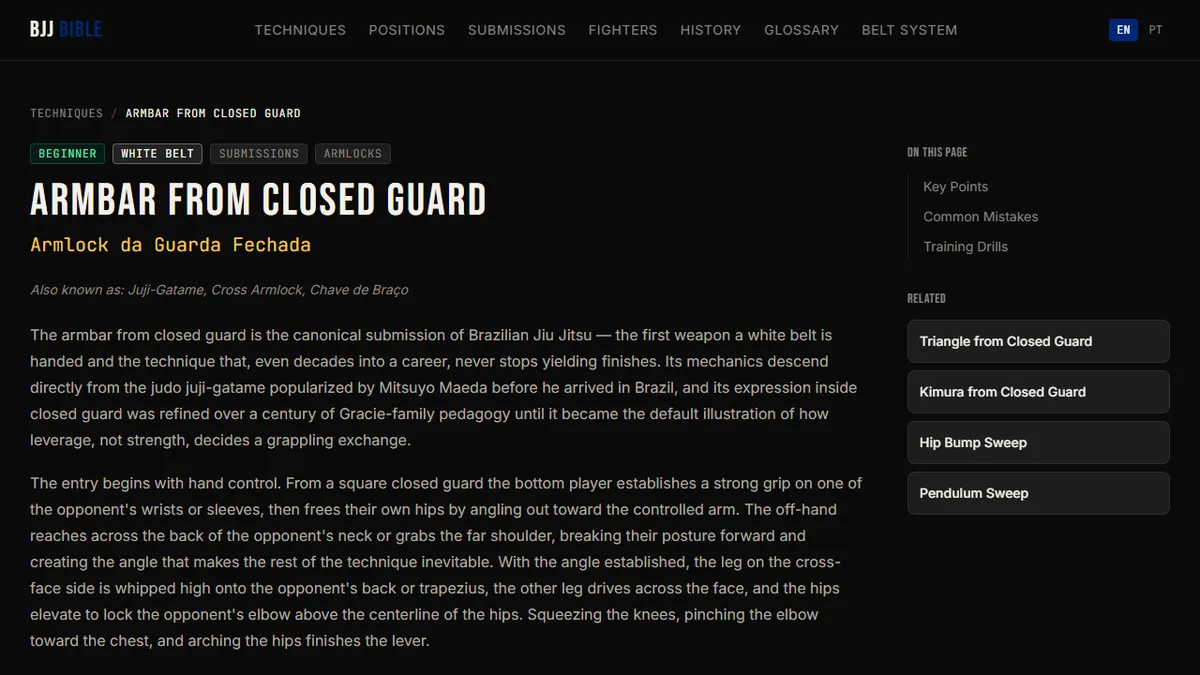
The armbar is the canonical closed guard submission and the technique around which everything else in this system is organised. Its execution begins not with the legs but with the hips and the grips. A cross-collar grip or a grip behind the opponent's far shoulder breaks their posture forward; with the head pulled down and the opponent's weight on the bottom player, the angle becomes available.
The angle is everything. Beginners throw their legs upward while their hips remain square to the opponent and arrive in a defensible position where the opponent can simply posture back up. The correct sequence is to pivot the hips perpendicular to the opponent (rotating around the controlled arm so that the body faces toward the opponent's side rather than their face) and then swing the high leg onto the back or trapezius, bring the other leg across the face, and elevate the hips to apply the lever.
The finish is a hip extension, not a wrist pull. Squeezing the knees to pin the arm against the chest and arching through the elbow with the hips ends the technique. A student who has genuinely absorbed the mechanics and common errors in the closed guard armbar will recognise that the most common failure point (legs going up before the angle exists) is also the failure that creates the best entry into the triangle.
The Triangle Choke: How a Failed Armbar Becomes Your Best Attack
When the armbar angle is established but the opponent yanks their arm free and drives their elbow back to their body, they have just handed you the triangle. The same posture-breaking grip that set up the armbar has created an asymmetry: one of their arms is now inside the guard and one is outside, and their head is low enough to be trapped between your legs.
The triangle locks by shooting one leg up behind the opponent's neck, hooking the calf of that leg with the back of the other knee, and rotating the hips past ninety degrees so the locking calf presses across the back of the neck rather than down the side. The key mechanical cue (the one that separates a stalling triangle from a finishing one) is pulling the trapped shoulder toward the opposite knee. That shoulder pull tightens the carotid compression and prevents the opponent from posting their arm free.
The relationship between the armbar and the triangle is not coincidental. The same defensive action that saves one arm creates the opening for the other attack. Practitioners who understand this stop treating the armbar as a failed attempt when the opponent pulls their arm out; they start treating the arm pull as the instruction to lock the triangle.
The Kimura: Taking the Back or Finishing When the Triangle Stalls
The kimura enters the picture when the opponent, having survived the armbar and defended the triangle by posturing upward or attempting to stack, now posts a hand on the mat to rebuild their base. That posted hand is the kimura's invitation.
From the broken-posture position, the bottom player sits up onto one elbow, reaches around the opponent's back to grip the posting wrist, then threads the near-side hand between the opponent's arm and torso to catch their own wrist (the classic figure-four grip). The technique offers three outcomes: a tap from the shoulder rotation, a sweep when the opponent refuses to give up the arm and can be steered over their controlled shoulder, or a back take when they roll forward to escape the shoulder pressure.
That three-way threat is what gives the kimura its disproportionate value in this system. An opponent who has survived the armbar and is defending against the triangle will often base out to stop the stack, and the moment they base is the moment the kimura becomes available. Reviewing setting up the Kimura from closed guard and transitioning to back control demonstrates how the sweep and back-take variants function once the opponent grips their own belt to resist the shoulder lock.
Chaining All Three: Reading the Opponent's Defensive Response
The system works because each technique responds to a specific defensive reaction, and the defensive reactions are predictable. A skilled closed guard player does not choose between the armbar, triangle, and kimura based on what they feel like practicing that day. They read the opponent and respond to what they are given.
Opponent drives their elbow back to their body after the armbar angle is established — shift to the triangle. Opponent stacks and postures to defend the triangle: break their balance further or transition to the kimura as they base. Opponent grips their belt or pant to defend the kimura shoulder lock. Use the kimura grip to sweep them or steer them into a back take.
The opponent who is genuinely comfortable defending all three simultaneously is a rarity at any belt level below black, and even at black belt the geometry of the system creates real defensive problems. The three attacks form a triangle of threats where every defensive movement generates a new opening.
Drilling the System: Recommended Reps and Flow Sequences
Learning these techniques as isolated moves and then trying to chain them under live rolling pressure is backwards. The chain itself should be drilled as a unit. A useful entry sequence is:
Begin from closed guard with posture broken. Attack the armbar — the training partner defends by pulling the arm back and driving their elbow toward their body. Shift to triangle, close the figure-four, and squeeze. Training partner defends by stacking and posturing. Open the triangle and attack the kimura as they base to defend the stack. Training partner grips their belt. Sweep them over the controlled shoulder into mount.
Running this flow sequence (slowly, with a compliant partner, both sides) for twenty minutes several times per week will do more to install the system than individual technique drilling followed by isolated rolling. The goal is a nervous system that reads the defensive gesture and produces the correct response automatically, without the conscious deliberation that pressure eliminates anyway.
Add resistance incrementally. Once the flow is smooth with no resistance, add a single point of resistance — the partner genuinely defends one step. Once that feels natural, add the next. The chain becomes available under live conditions only when each link has been drilled until it is reflexive.