On this page
The 2009 Mundial Absolute: What Roger Gracie Actually Did
The 2009 IBJJF World Championship absolute division brought together the best black belts on earth regardless of weight class — practitioners who had spent their careers preparing for exactly this competition, studying the field, and developing the tools they believed would win at the highest level. What they found on the mat was Roger Gracie, and what Roger Gracie found on the mat was the same closed-guard armbar sequence he had been drilling since he was a teenager.
He submitted every opponent with it. Not the same category of technique, and not variations within a family of attacks. The same technique, executed with the same entry, the same angle-building sequence, the same finish. His opponents knew what was coming. They had studied it. They were, by any objective measure, among the most technically sophisticated grapplers in the world. And they could not stop it.
The bare facts of the performance have become famous enough that they are sometimes repeated without the context that makes them remarkable. This was not a division of average competitors who simply did not know how to defend an armbar. These were world-class practitioners who knew exactly what Roger did and still could not prevent it. That distinction is the entire lesson.
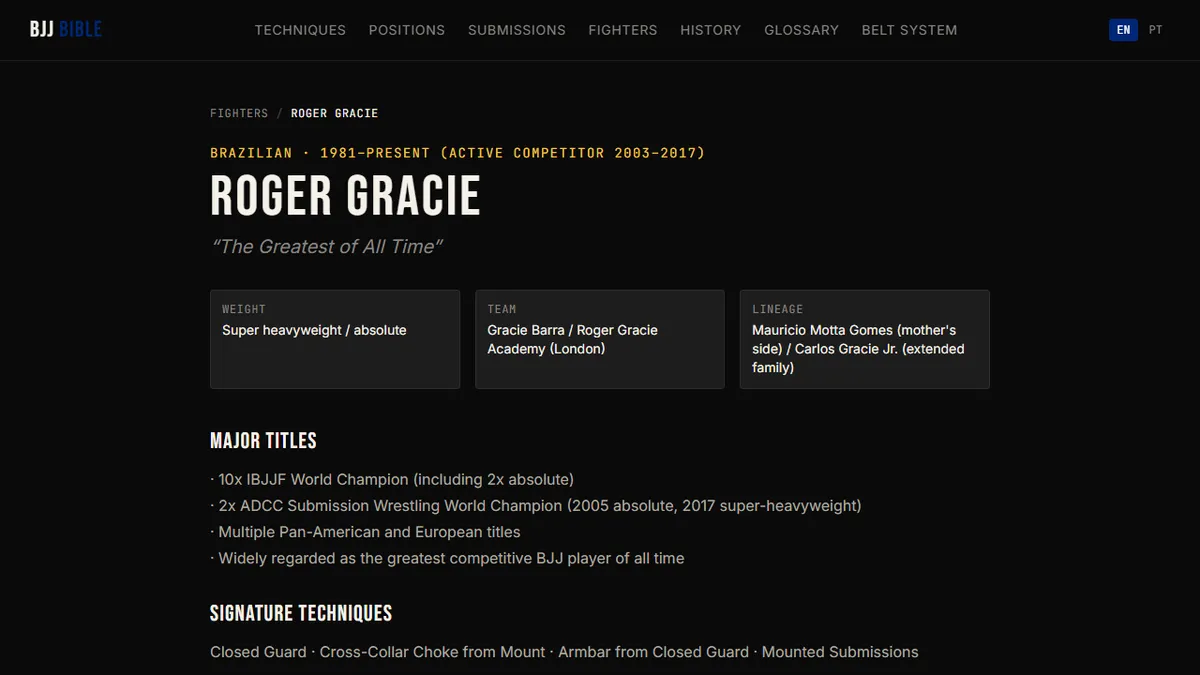
For the full depth of context on what Roger brought to that competition and the philosophy underpinning his approach, Roger Gracie's competitive record and training philosophy provides the competitive timeline that shows how consistently this approach produced results across his entire career.
Why the Closed Guard Armbar Is So Hard to Stop When Done Perfectly
Most BJJ practitioners at intermediate and advanced levels can describe the closed guard armbar defence. Break the grip. Keep the elbow down. Stack the opponent. Posture up before they can establish the angle. The defensive information is widely understood and widely taught.
What is less widely understood is that the armbar defence depends entirely on catching the attack early enough to apply those defences. A closed guard armbar executed with genuine mechanical excellence does not announce its arrival. The posture break happens gradually and persistently. The angle pivots in small increments rather than in one dramatic leg throw. By the time the bottom player's leg is swinging toward the back, the defensive window has already closed.
Roger's specific genius was not speed or strength — he is large and powerful, but so were his opponents. It was timing and angle-building so precise that the sequence was almost fully completed before the opponent recognised that it was happening. The cross-collar grip that broke posture was established slowly during what appeared to be guard maintenance. The pivot to the armbar angle was disguised within a position adjustment. The moment of commitment came only when the angle already guaranteed the finish.
This is what drilling a single technique ten thousand times actually produces. Not just mechanical efficiency in the technique itself, but the ability to disguise it, to set it up from any position in which the posture is even slightly broken, to read the one-percent openings that are invisible to anyone who has not spent years looking for them.
Depth vs. Breadth: The Trap of Collecting Techniques
Modern BJJ instruction has never been more accessible. Instructionals from elite practitioners cover every position, every variation, and every niche attack tree in the art. A white belt in 2025 can watch John Danaher break down ashi garami for eight hours, observe Gordon Ryan's back attack system in four-hour segments, and follow along with Rafael Mendes on De La Riva to berimbolo sequences. The content is genuinely excellent. The temptation it creates is genuinely destructive.
The trap is this: watching a technique and understanding its logic creates a feeling of knowledge that is entirely disconnected from the ability to apply it under pressure. The feeling of understanding is not the same as the ability to perform. A practitioner who has watched a hundred hours of instructionals and drilled each technique twenty times does not have any technique available under live resistance — because live resistance requires that a technique be so thoroughly absorbed it becomes automatic, and twenty reps is nowhere near the threshold for automaticity.
Roger Gracie did not know fewer techniques than his 2009 opponents. He almost certainly knew as many or more, given his lineage and training environment. What he chose to do differently was concentrate the depth of his drilling on a small number of techniques rather than distributing it evenly across a wide catalogue. The armbar did not merely become one of his weapons. It became the one weapon he trusted completely, in any context, against any opponent, under any pressure.
How Roger's Training Methodology Differed from His Competitors
The details of Roger Gracie's specific training methods have been shared in various interviews and documented in the BJJ literature. Several principles recur consistently. He drilled the same techniques daily, often repeating the same position hundreds of times in a single session. He placed enormous emphasis on the quality of each individual repetition rather than moving through volume quickly. He sought live rolling partners who were challenging enough to test his technique genuinely rather than training partners he could dominate — the technique needed to work against the best available resistance to be trusted at the highest level.
He also maintained a game plan that was offensive from the first moment of a match. Guard pulling to closed guard was a strategic choice, not a default. The closed guard position was entered with a specific attack sequence already loaded — the posture-breaking phase was not a warm-up for the attack but the beginning of it. By the time opponents settled into the guard, the threat was already active.
There is also the matter of physical conditioning. Roger's grip strength and hip control were extraordinary, developed through years of drilling the specific positions his game depended on. This is a point that gets underweighted in discussions of his methodology: mastery of fundamentals builds physical attributes specific to those fundamentals. The practitioner who drills the closed guard armbar ten thousand times does not just learn the technique; they build the grip endurance, the hip extension power, and the shoulder stability that make the technique reliable under extreme resistance.
The Compound Interest Effect: What Happens When You Drill One Thing 10,000 Times
The comparison to compound interest is apt. The first thousand repetitions of the closed guard armbar produce a practitioner who knows the armbar. The next thousand refine the angle. The next thousand after that develop the timing to disguise it. The thousands after that build the capacity to apply it against genuine resistance, then against resistance from skilled defenders, then against the best opponents available.
At some point in this process, something qualitatively different happens. The technique stops being a thing the practitioner does and becomes a thing they are. The armbar is no longer an option they select from a menu; it is the lens through which they experience the entire grappling exchange. Every position the opponent takes, every grip they establish, every postural adjustment they make becomes legible in terms of whether it creates or closes the armbar angle. This is what coaches mean when they say a technique has been internalised.
Most practitioners never reach this stage with any single technique. They sample techniques widely, achieving reasonable competence across a broad range and deep competence nowhere. Roger Gracie reached this stage with the closed guard armbar, and the 2009 Mundial is the documented proof of what that level of investment produces.
Applying the Roger Gracie Philosophy to Your Own Game
The immediate practical implication is not that every practitioner should abandon their current game and spend a decade on closed guard armbars. It is that most practitioners would benefit from having one technique they are drilling toward mastery rather than several techniques they are drilling toward competence.
Choosing that technique requires honest self-assessment. Which submission or sweep do you hit more often than any other under live pressure? Which position do you understand well enough that you can feel when the setup is developing rather than seeing it? That is the candidate for depth investment.
Once chosen, the discipline required is the willingness to return to it every session, to drill it even when it is boring, and to roll in ways that test it against genuine resistance rather than in ways that avoid its weaknesses. The Roger Gracie model asks for something that modern BJJ culture, with its emphasis on novelty and variety, makes uncomfortable: the commitment to do the same thing repeatedly until it becomes something different.
The 2009 Mundial absolute division is the most compelling argument in BJJ history that this commitment is worth making.