On this page
What the Gi Actually Teaches: Grip Work, Pace, and Positional Precision
The gi is a uniform, and it is also a teaching tool. When you train in the traditional BJJ kimono, you have handles everywhere (lapels, sleeves, collars, pant legs). Your opponent has them too. The result is a game where grip fighting becomes as important as hip movement and positional awareness, and where the pace of every exchange is modulated by the friction and control that fabric creates.
What the gi teaches, at its best, is precision. Because you can grip and be gripped so completely, escapes require more careful technique than brute athleticism. Sloppy posture in closed guard can be punished by a collar choke that would have no mechanism in no-gi. A passing sequence executed with poor timing will be stopped by a sleeve grip that, in no-gi, would have slipped immediately. The gi is a more forgiving test of whether your technique is mechanically correct, because the grips slow things down enough for the mechanics to be isolated and corrected.
Collar and sleeve control in the gi also produce some of the art's most elegant attack sequences. Bow-and-arrow chokes, cross-collar strangles, and lapel guards do not exist in no-gi and represent a body of technical knowledge that is simply not available outside the kimono. For practitioners with long-term sport BJJ ambitions or those drawn to the art's technical depth for its own sake, the gi offers a richer technical catalogue than no-gi alone.
What No-Gi Actually Teaches: Speed, Wrestling, and Leg Lock Proficiency
Without the gi, the game changes in ways that are uncomfortable at first and clarifying afterwards. The grips that slow down gi grappling are gone. Underhooks, wrist controls, and collar ties become the primary handles, and they are far less stable than fabric grips: they need to be fought for actively, maintained dynamically, and replaced quickly when lost. The result is a faster, more scramble-heavy game that punishes passivity more harshly.
No-gi training develops wrestling attributes that the gi underemphasises. Takedowns become more important because the grip-fighting that often makes standing grappling more strategic in the gi is compressed into faster exchanges. Bodylock takedowns, double legs, and single legs feature more prominently, and the transition from standing to ground is quicker and less controlled than in the gi game.
Leg locks also flourish in no-gi simply because the absence of fabric removes both the practical ability to grab pant legs and the cultural framework that gi training historically carried around leg attacks. No-gi practitioners encounter heel hooks and ashi garami positions earlier in their development and develop a more neutral relationship with leg attacks than gi-primary students often do.
The Historical Split: How the Divide Started and Why It Deepened
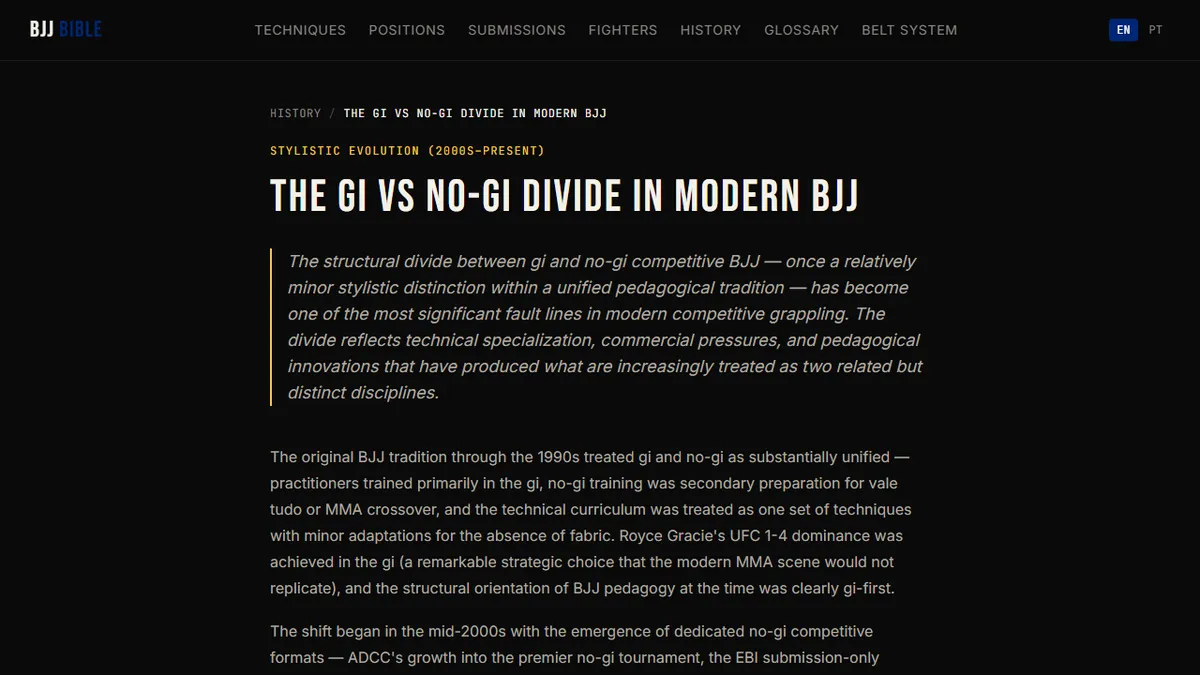
The original divide between gi and no-gi Brazilian Jiu-Jitsu was not philosophical — it was practical. The early Gracie academies trained in the gi because that was the context in which the Gracies had received the art from Mitsuyo Maeda, himself a judoka who competed in traditional uniform. Self-defence demonstrations and the early Gracie challenges used the gi as the assumed training context.
No-gi as a distinct discipline accelerated dramatically in the early 2000s, driven by the intersection of two forces: MMA's rising popularity, which made no-gi grappling more relevant to fighters preparing for cage competition, and the emergence of the ADCC as a prestigious no-gi competition circuit that attracted elite competitors from across the grappling spectrum. The the historical roots of the gi versus no-gi divide in competitive BJJ traces how this split deepened as academies began identifying with one format or the other, and how the emergence of specialist no-gi coaches (Danaher being the most influential) created a competitive no-gi culture with its own techniques, heroes, and standards.
The divide deepened in the 2010s as leg lock system proliferation made gi and no-gi games increasingly distinct at the elite level. Techniques that were central to high-level no-gi, including inside heel hooks and outside heel hooks from ashi garami, were entirely absent from gi competition, and the reverse was also true. Top gi competitors began training no-gi seriously for the first time, and the conversation about whether the formats are truly different arts began.
MMA-Focused Training: Why No-Gi Dominates Fight Preparation
For a practitioner whose primary goal is competing in mixed martial arts, the calculus is straightforward: no-gi is the correct priority. Everything specific to the gi (fabric grips, collar chokes, lapel guards) is irrelevant in the cage. The cage environment creates its own handles through the fence, and strikes create urgency and position considerations that no-gi training addresses and gi training does not.
The wrestlers and no-gi grapplers who have dominated MMA grappling, including Khabib Nurmagomedov's body lock takedowns, Demian Maia's no-gi back attacks, and the systematic wrestling of current UFC champions across divisions, all represent skills that are more efficiently developed in no-gi contexts. Maia himself trained heavily in the gi early in his career and is a black belt in traditional sport BJJ, but his cage game is a no-gi expression of those skills, stripped of everything that does not function under cage rules.
This does not mean gi training has no value for MMA. The positional precision and submission mechanics that gi training builds translate to no-gi with some adjustment. Many successful MMA grapplers train both formats. But if time is limited and MMA is the goal, no-gi hours are more directly applicable.
Sport BJJ Specialists: Why Gi Still Produces the Most Technical Grapplers
The counterargument for gi-first training is compelling when the goal is the deepest possible technical development in Brazilian Jiu-Jitsu specifically. The constraints the gi imposes (slower pace, more complete gripping opportunities, more complex guard retention) force a precision in technique that no-gi's speed sometimes allows practitioners to bypass.
The most technically sophisticated grapplers in the world have almost universally trained extensively in the gi, even those who compete primarily in no-gi at the elite level. Gordon Ryan, Craig Jones, and Nicky Rod all trained under Danaher's system with significant gi time alongside the no-gi emphasis that made them famous. The gi does not teach the same things as no-gi, but the precision it demands transfers to no-gi in ways that make the no-gi game cleaner.
Practitioners who want to reach the highest levels of sport BJJ competition in the gi format, including IBJJF World Championships, Pans, and Europeans, should prioritise gi training for the obvious reason that the techniques and strategies of the competitive format are gi-specific.
The Practical Answer: Train Both, But Here Is How to Prioritize
The most honest advice for a beginner choosing between gi and no-gi is to train both if their academy offers both, and to prioritise based on their primary goal. If the goal is sport BJJ competition in gi events, gi training deserves more of the weekly session count. If the goal is MMA preparation or no-gi competition, no-gi deserves the majority. If there is no specific goal, an even split is the best starting point and can be adjusted as preferences and competitive interests develop.
There is a case for starting in the gi specifically: the slower pace makes technique more visible, the grips make escapes harder to shortcut with athleticism, and the richer technical vocabulary the gi exposes beginners to creates a more complete mental map of the art. But this is not a strong enough case to recommend the gi to everyone regardless of goals. A twenty-five-year-old with MMA aspirations who asks whether to start in gi is getting a disservice if the answer ignores why they are training in the first place.
The tribal loyalty that characterises much of the gi versus no-gi debate in online communities has no bearing on what will serve a specific practitioner's goals. Strip away the ideology and the choice becomes straightforward.