On this page
What Voice Cloning Actually Produces — and Why It's Different From TTS
Standard text-to-speech converts written text to audio using a synthetic voice, which may sound natural but does not belong to any specific person. Voice cloning does something qualitatively different: it captures the acoustic characteristics of a real individual's voice (their timbre, cadence, pitch patterns, and vocal texture) and produces a model that generates new speech in that voice from any text input.
The perceptual difference between a high-quality cloned voice and a recording of the original speaker has narrowed to the point where trained listeners sometimes cannot reliably distinguish them, and untrained listeners often cannot. That capability is what makes voice cloning so powerful for legitimate creative and commercial applications, and so dangerous when misused. Before discussing how to use ElevenLabs responsibly, it helps to hold both of those facts clearly at once.
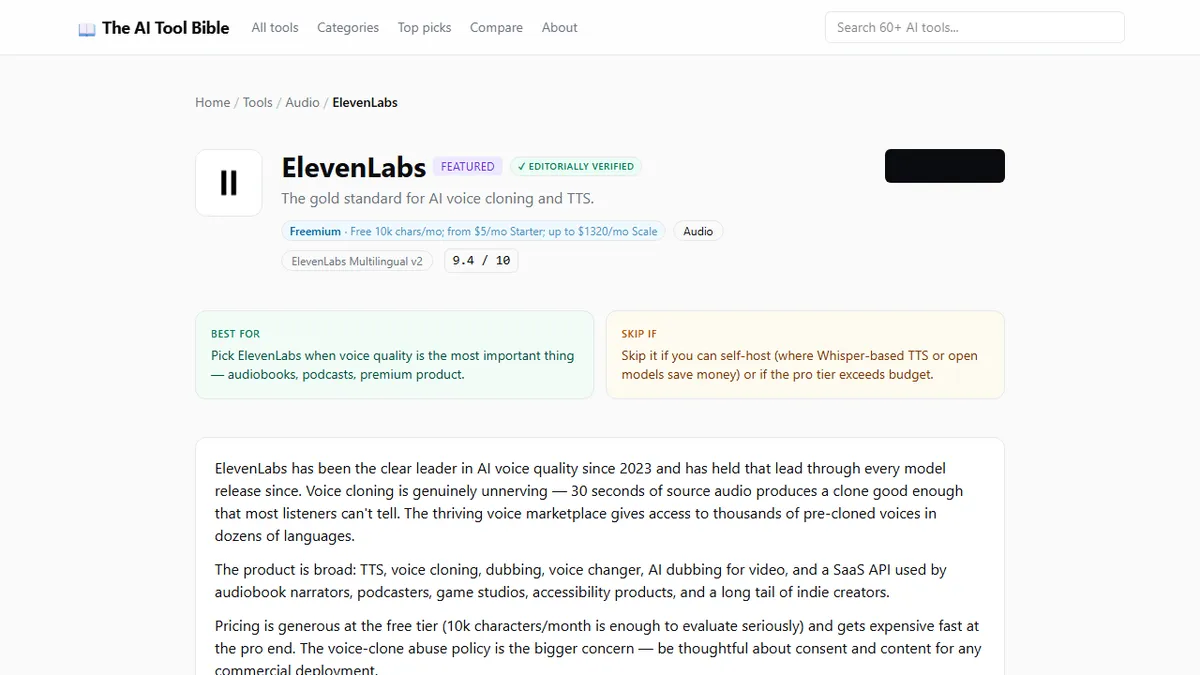
The ElevenLabs full review including pricing tiers and consent policy notes covers the tool's capabilities in detail; this piece focuses on the ethical and operational questions that the technical documentation tends to skip.
Consent Requirements: What ElevenLabs' Policy Says and What It Doesn't Cover
ElevenLabs requires users to confirm that they have the right to clone any voice they upload. For cloning your own voice, this is straightforward. For cloning another person's voice, the policy requirement is that you must have their explicit consent, but the platform does not verify this at the point of upload.
What ElevenLabs' policy covers: the commitment you make at the point of creating a Professional Voice Clone (PVC). What it does not cover: the jurisdictional patchwork of laws that govern voice likeness rights independently of platform policy. In California, the CCPA and separate right-of-publicity statutes create legal exposure for commercial voice use without consent that goes beyond any platform terms. Illinois' Biometric Information Privacy Act has been interpreted to apply to voice characteristics. The EU's AI Act includes specific provisions around synthetic biometric data.
The practical implication is that platform policy compliance is a floor, not a ceiling. Before cloning anyone's voice for commercial use, the question to answer is not just "did I click the consent checkbox?" but "do I have documented, revocable consent from this person that covers the specific use I have in mind?"
Commercial Deployment Checklist: Audiobooks, Podcasts, and Customer Service Bots
Audiobook narration using your own cloned voice: Generally the most legally uncomplicated use case. Authors who want to narrate their own books without recording sessions have a legitimate and well-supported application. Confirm with your distributor (Audible, Findaway Voices, others) that they accept AI-narrated audiobooks and what disclosure metadata they require.
Podcast production with a co-host's cloned voice: Requires explicit written consent from the voice owner, ideally specifying the scope (this podcast, for this period, revocable on notice). Never assume verbal agreement is sufficient for commercial distribution.
Customer service and IVR bots using a branded voice: If the voice is cloned from a public figure or company spokesperson, you need both the individual's consent and clarity on employer/employee IP ownership. Many companies have begun including AI voice rights provisions in talent contracts precisely because this was ambiguous. If the voice is a fictional persona trained from scratch, the consent question changes but the disclosure question does not.
Brand or marketing voiceovers: Cloning a voice actor's recordings from prior work they did for you, without a specific new agreement, is a significant legal risk. Prior work agreements almost certainly did not cover AI cloning rights, and residual rights structures (particularly under SAG-AFTRA agreements for represented talent) create additional exposure.
The Disclosure Question: When and How to Tell Listeners
The ethical obligation to disclose AI-generated audio exists independently of whether any law currently mandates it. The practical question is how and when.
For podcasts and media: a brief statement in the episode notes and ideally at the start of the first episode where the cloned voice appears is reasonable. Something direct and factual, such as "this episode uses an AI voice clone produced with consent from [name]," covers the disclosure without being disruptive.
For interactive products: customer service bots should identify themselves as AI at the start of any conversation, including noting that the voice is synthetic. This is already law in several US states for automated calls and increasingly expected as a baseline across digital customer service.
For marketing and advertising: industry self-regulation bodies in most jurisdictions now recommend disclosure when AI-generated voices are used in commercial communications. The ASA in the UK has published guidance; the FTC in the US has signalled interest in transparency requirements for AI-generated commercial content.
Proactive disclosure also serves your interests as a creator or operator: it builds trust and reduces the reputational damage if the synthetic nature of a voice is later discovered without prior disclosure.
Scenarios Across the Ethical Spectrum
Clearly fine: Cloning your own voice for your own content. Narrating your book, producing your podcast in your voice when you cannot record, generating training materials in your own voice. No consent complication; full ownership.
Fine with documented consent: A consenting voice actor provides a dedicated recording session for cloning rights, with a written agreement specifying use cases, duration, and revocation terms. The consent is specific, informed, and documented.
Grey zone: Using a deceased public figure's voice in a documentary about their life. Some jurisdictions extend right-of-publicity protections post-mortem; some do not. Some estates will grant permission; some will litigate. Get legal advice before proceeding.
Clearly risky: Cloning a public figure's voice without consent for any commercial use. Cloning a private individual's voice from recordings made without their knowledge. Using a cloned voice to create content that could be mistaken for the real person's genuine speech.
Alternatives When Consent Isn't Obtainable: Murf's Licensed Voice Library
For use cases where you need a high-quality voice but cannot obtain consent from a real person, or do not want the operational overhead of consent management, Murf offers a different model. Its voice library consists of voices created with compensated, consenting voice actors under commercial licensing agreements that Murf manages on behalf of its users.
When you use a Murf voice, you are licensing a voice that was created for exactly that purpose. The consent documentation sits with Murf; the commercial terms are defined in your subscription agreement. For applications where legal clean-up costs would exceed the value of using a specific person's voice, the licensed library approach trades creative specificity for legal simplicity — and for many commercial applications, that trade is worth making.