The Licensing Question Nobody Reads Until It's Too Late
When designers and agencies discover they have an AI-image licensing problem, it tends to happen at the worst possible moment: when a client flags it before a campaign goes live, or when a lawyer asks whether the images in a published campaign are properly cleared. At that point, the conversation about output quality becomes irrelevant. The tool choice was wrong from the start.
Most creative professionals who have adopted AI image generation evaluated these tools on output quality alone. That is understandable. The visual results are what clients see and what the creative brief demands. But for any project where images will appear in commercial contexts (advertising, packaging, publishing, merchandise, client deliverables), the licensing terms are the more consequential decision factor. And on licensing, Midjourney and Stable Diffusion occupy very different territory.
Midjourney's Terms: What You Own, What You Don't, and the Paid-Tier Difference
Midjourney's terms of service have a critical split that many users miss. On the free tier, all images generated are licensed under Creative Commons Attribution 4.0, meaning the work is essentially public and anyone can use it, including commercially, as long as they attribute Midjourney. The creator has no exclusive rights.
On any paid tier (Basic at USD 10/month and above), users retain ownership of their generated images for commercial use, subject to Midjourney's general content policies. The company claims no ownership and grants you the right to sell or license the output. For freelancers billing clients for AI-assisted work, being on a paid plan is not optional. It is the minimum legal baseline.
What Midjourney's terms do not address is underlying training data provenance. A number of artists have challenged the legality of training on copyrighted images without licence, and at least one major legal proceeding is ongoing. The commercial licence you receive from Midjourney for your paid subscription output is Midjourney's to grant — but whether their training process exposes that output to third-party copyright claims remains an open legal question in 2026.
Stable Diffusion's Open-Weight Approach: More Control, More Responsibility
Stable Diffusion takes the opposite approach at the platform level. The core weights are released under the CreativeML Open RAIL-M licence, which permits commercial use with restrictions on harmful applications. When you run Stable Diffusion locally (via Automatic1111, ComfyUI, or a similar interface), no subscription company sits between you and your output. The images you generate are yours.
This is genuinely powerful for agencies and studios with data security requirements. Images never transit a third-party server. You can run fine-tuned or custom models trained on proprietary datasets without concern about data exposure. The licensing baseline is permissive.
The complication is that the open-weight ecosystem means anyone can publish a fine-tuned model checkpoint derived from Stable Diffusion, and those derivative checkpoints carry their own terms that vary widely. A model checkpoint published by a hobbyist with a non-commercial restriction clause can inadvertently end up in a commercial workflow. Checking model provenance and licence for every checkpoint you download is a genuine operational requirement that many users skip.
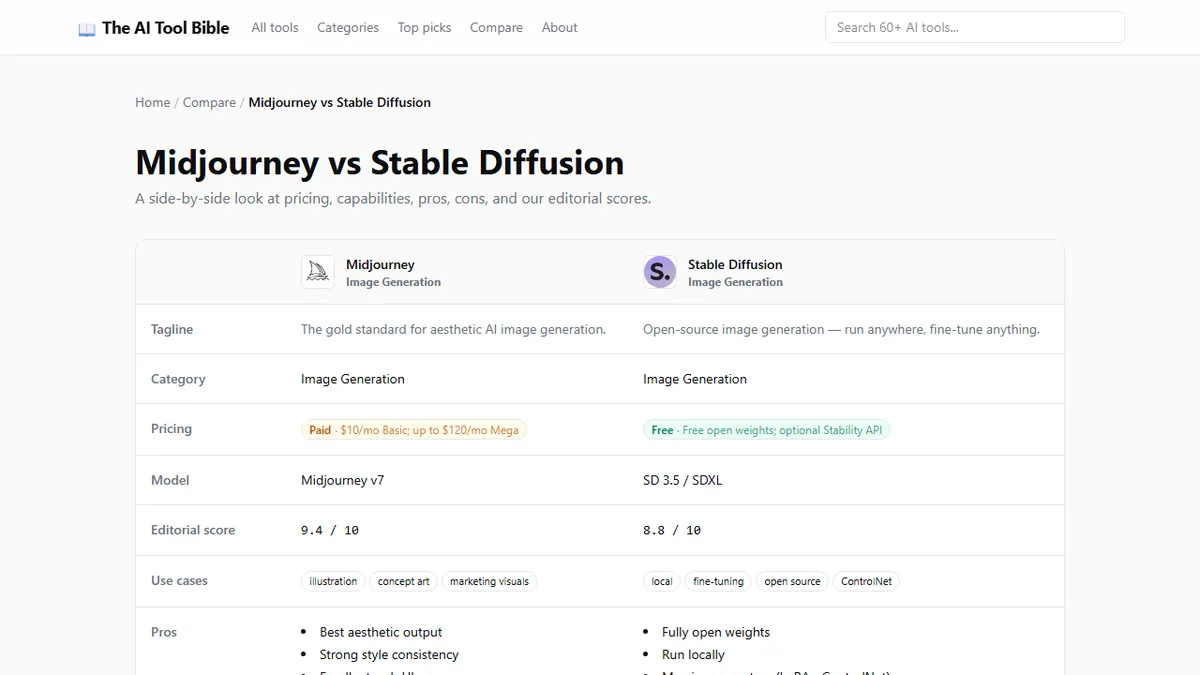
The editorial comparison of Midjourney and Stable Diffusion licensing and output works through these trade-offs with a scoring rubric if you need a structured reference.
Output Quality at v6/v7 and SDXL — Is the Gap Still Real?
As recently as 2024, Midjourney had a clear quality lead for photorealistic and painterly imagery, the kind of work where aesthetic polish and prompt adherence both needed to be high simultaneously. That gap has narrowed.
Midjourney v6 and v7 retain an advantage in aesthetic coherence and the ability to generate in highly specific artistic styles from short prompts. The platform has benefited from a community of millions generating and rating outputs, which has created a feedback loop that produces consistently polished results with less prompt engineering.
SDXL and its successors (including Flux, which uses a different architecture) produce output that is competitive in technical quality (resolution, detail, prompt adherence), but the community prompt vocabulary for achieving specific aesthetics is less consolidated. Self-hosting Stable Diffusion requires more prompt craft and model selection knowledge to reach the same visual quality ceiling.
For production work requiring a specific, repeatable visual style, Midjourney's aesthetic consistency is still the easier path. For work requiring maximum control over the generation environment, Stable Diffusion's openness wins.
The Case for Adobe Firefly When Legal Safety Is Non-Negotiable
Neither Midjourney nor Stable Diffusion can currently offer a clean commercial indemnification. Adobe Firefly can — and this distinction is increasingly important for enterprise clients, legal departments, and agencies working in regulated industries.
Firefly was trained exclusively on Adobe Stock content, openly licensed material, and public domain works. Adobe's enterprise plan explicitly indemnifies commercial users against copyright claims arising from Firefly output, shifting the legal risk to Adobe rather than the user. That level of assurance is not available from either Midjourney or Stable Diffusion in any tier.
The trade-off is that Firefly's aesthetic range is narrower and its photorealistic output quality sits below Midjourney v7. For clients where brand tone requires maximum visual fidelity, Firefly may not be the right tool. For clients where legal clean-up costs would dwarf creative budget, it probably is.
A Decision Matrix for Freelancers, Agencies, and Enterprises
For freelancers billing clients directly: Midjourney on a paid tier is the practical minimum. Check that your subscription is active for every project involving commercial deliverables. Understand that the training data question is unresolved and consult with clients whose legal teams are attentive.
For independent agencies and studios: Stable Diffusion with a vetted model stack (verify every checkpoint licence) offers maximum operational control and competitive output quality. Budget for the operational overhead of maintaining the deployment.
For enterprises with legal or compliance requirements: Adobe Firefly's explicit indemnification is difficult to argue against when a single copyright dispute could cost more than years of Firefly subscriptions. Use it alongside frontier models for text, and Midjourney for creative exploration where stakes are lower.
The creative quality argument between these tools is genuinely close in 2026. The legal argument is not — and for commercial work, the legal argument is the one that matters when something goes wrong.