On this page
What the EU AI Act Actually Is (And Isn't)
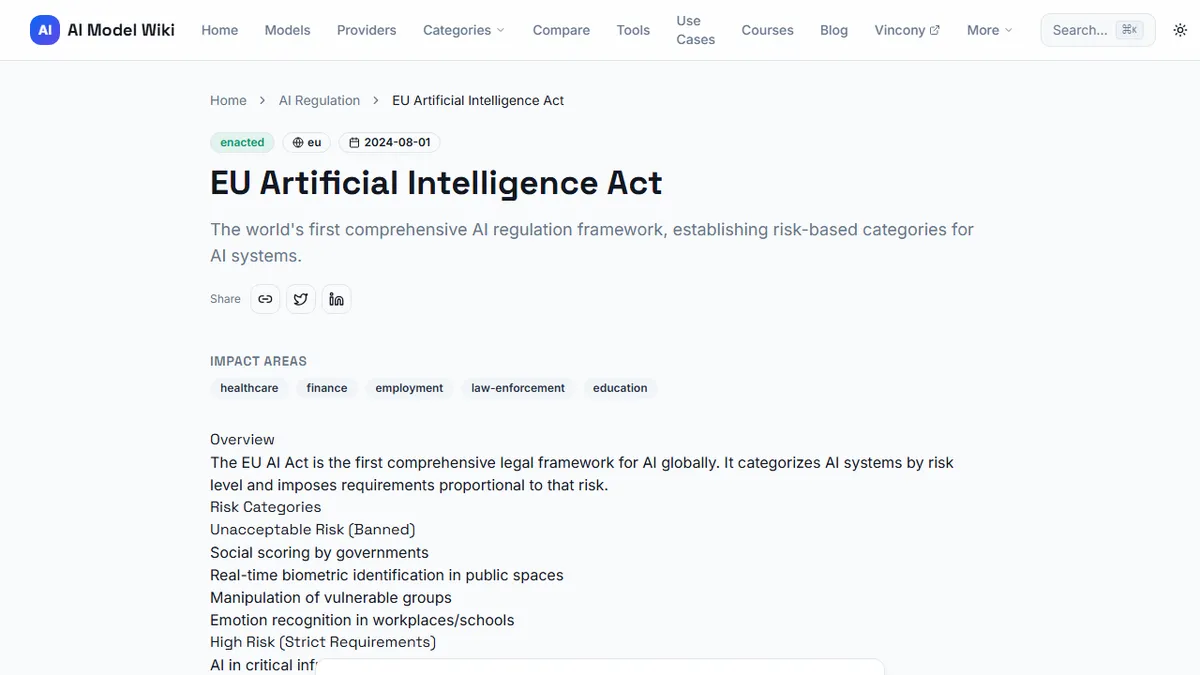
The EU AI Act is a regulation (a piece of directly applicable European Union law) that establishes requirements for AI systems across the Union. It entered into force in August 2024 and is being phased in through 2027, with different provisions applying at different points along that timeline. The first prohibitions on unacceptable-risk AI applications took effect in early 2025; obligations on high-risk systems are binding from mid-2026; and full enforcement across all categories completes in 2027.
What it is not: a blanket restriction on AI development, a ban on training large models, or a rule that applies only to European companies. The Act has extraterritorial reach: if your AI system is placed on the EU market or its outputs are used in the EU, the regulation applies to you regardless of where your company is incorporated. A startup in Austin deploying a hiring screening tool to EU customers is in scope.
The Act also is not a technology-neutral law in the way the GDPR is. It is explicitly AI-specific, and its obligations attach to defined categories of AI applications rather than to data processing as such. A company that processes European personal data but whose AI system falls below the regulatory threshold faces different obligations under the Act than under GDPR. Both frameworks apply simultaneously, and they interact in ways that require coordinated legal analysis.
The Four Risk Tiers: From Unacceptable to Minimal
The Act organises AI systems into four risk categories, and the obligations attached to each tier are structurally different.
Unacceptable risk covers applications that are simply prohibited: real-time biometric surveillance of public spaces by law enforcement with narrow exceptions, social scoring systems that rank citizens based on behaviour across domains of their lives, AI systems that exploit psychological vulnerabilities or use subliminal techniques to manipulate behaviour against people's interests, and remote inference of sensitive characteristics from biometric data. These are outright bans, not compliance challenges.
High risk is the category with the most substantive obligations and the most practical compliance burden. Systems in this tier must meet requirements covering data governance, technical documentation, transparency, human oversight, accuracy, robustness, and cybersecurity. High-risk providers must register their systems in an EU database and, in some cases, undergo third-party conformity assessments before deployment.
Limited risk covers systems with specific transparency obligations, primarily the requirement to inform users that they are interacting with an AI. Chatbots and other conversational systems fall here.
Minimal risk covers everything else. Most AI applications (spam filters, recommendation engines, playlist generators) fall into this category and face no mandatory obligations under the Act, though the Commission encourages adherence to voluntary codes of conduct.
Which Products Qualify as High-Risk Systems
The high-risk designation attaches to two types of systems. First, AI components embedded in products already subject to EU product safety law — medical devices, vehicles, aviation systems, industrial machinery — are automatically high-risk if the AI performs a safety function.
Second, Annex III of the Act lists specific application areas that are high-risk regardless of product category: biometric identification and categorisation; management of critical infrastructure; education and vocational training (systems that determine access or outcomes); employment and worker management; access to essential private services and public benefits; law enforcement; migration and border control; and administration of justice.
The hiring screening example cited above falls clearly into the employment category. Credit scoring tools used for loan applications fall into essential private services. A tool that allocates students to educational programmes falls into education. The full EU AI Act regulatory overview and timeline maps these categories against concrete application types and tracks which obligations have come into force at each milestone.
Enforcement Timeline and First Penalties
The maximum fine for violations of the Act is 35 million euros or 7% of global annual turnover for the most serious infringements, specifically violations of the prohibited practices category. High-risk system violations carry a maximum of 15 million euros or 3% of global turnover. Fines for providing incorrect information to authorities cap at 7.5 million euros or 1.5% of turnover.
National competent authorities designated by each EU member state are responsible for enforcement. The European AI Office handles oversight of general-purpose AI models. Market surveillance authorities with existing product safety responsibilities also have enforcement roles in their domains.
First enforcement actions should be expected in 2026 and 2027 as member states complete the designation of competent authorities and those authorities begin investigating complaints. Early enforcement is likely to focus on the most visible high-risk application categories.
Practical Compliance Checklist for Product Teams
Product teams should work through the following in order. First, determine whether your AI system is in scope: EU market access or EU user base triggers applicability. Second, classify your system's risk tier based on its application category and any product-safety-law overlap. Third, if you fall into high-risk, begin the documentation process immediately: the Act requires detailed technical documentation of your system's purpose, architecture, training data, and performance that must exist before deployment, not be assembled retroactively.
Fourth, establish human oversight mechanisms appropriate to your application. Fifth, implement logging and audit trail capabilities sufficient to reconstruct the system's outputs and decision inputs. Sixth, if your system uses personal data in ways that intersect with GDPR, coordinate your AI Act compliance work with your data protection officer.
The compliance strategy guide for AI-driven businesses provides a more detailed treatment of each of these steps with worked examples.
How the Act Interacts With GDPR
The GDPR and the AI Act operate as parallel obligations rather than as a unified framework. GDPR governs personal data processing; the AI Act governs AI system deployment. A system that does both is subject to both.
The most significant interaction arises around automated decision-making. GDPR Article 22 gives data subjects the right not to be subject to purely automated decisions with significant effects, with exceptions requiring human oversight. The AI Act's human oversight requirements for high-risk systems reinforce this obligation but are framed around technical implementation rather than individual rights. A product team complying with Article 22 is partially fulfilling its AI Act oversight obligations and vice versa, but the mapping is not complete.
Data minimisation requirements under GDPR also interact with the AI Act's training data governance requirements. Both frameworks express a preference for using the minimum necessary personal data, but they frame that preference differently and with different legal mechanisms.
What Non-EU Companies Need to Know
The territorial scope of the Act follows market deployment, not company location. Any AI system placed on the EU market — meaning made available to EU users for any purpose, including free access — is in scope if it falls into a regulated category. Any AI system whose output is used within the EU is in scope even if the system itself operates entirely outside EU territory.
Practically, this means that companies serving EU users need to carry out the same risk classification and, where applicable, the same compliance measures as EU-based competitors. The enforcement mechanism for non-EU companies is market access: products that do not comply cannot be legally deployed for EU users, and national market surveillance authorities can require withdrawal.
The Act does not require EU establishment for most obligations, but the conformity assessment process for some high-risk systems requires an EU-based authorised representative (a formal role defined in the Act) for companies without EU presence.