On this page
Why the Open vs Closed Debate Is the Wrong Starting Question
Teams approaching the open-source versus closed AI model decision often frame it as a values question, a position on transparency, corporate power, or community contribution. Those considerations are real, but leading with them produces the wrong decision structure. The open versus closed question is ultimately an engineering and business decision, and the relevant variables are cost, control, compliance, capability, and operational capacity.
The secondary problem with framing it as a debate is the implication that one answer applies to all situations. In practice, the right choice depends on what you are building, where your users are, what your regulatory environment requires, and what your team can actually maintain. A startup building a consumer chatbot and a hospital system building a diagnostic decision support tool will land on different answers even if both teams hold the same preferences about openness in the abstract.
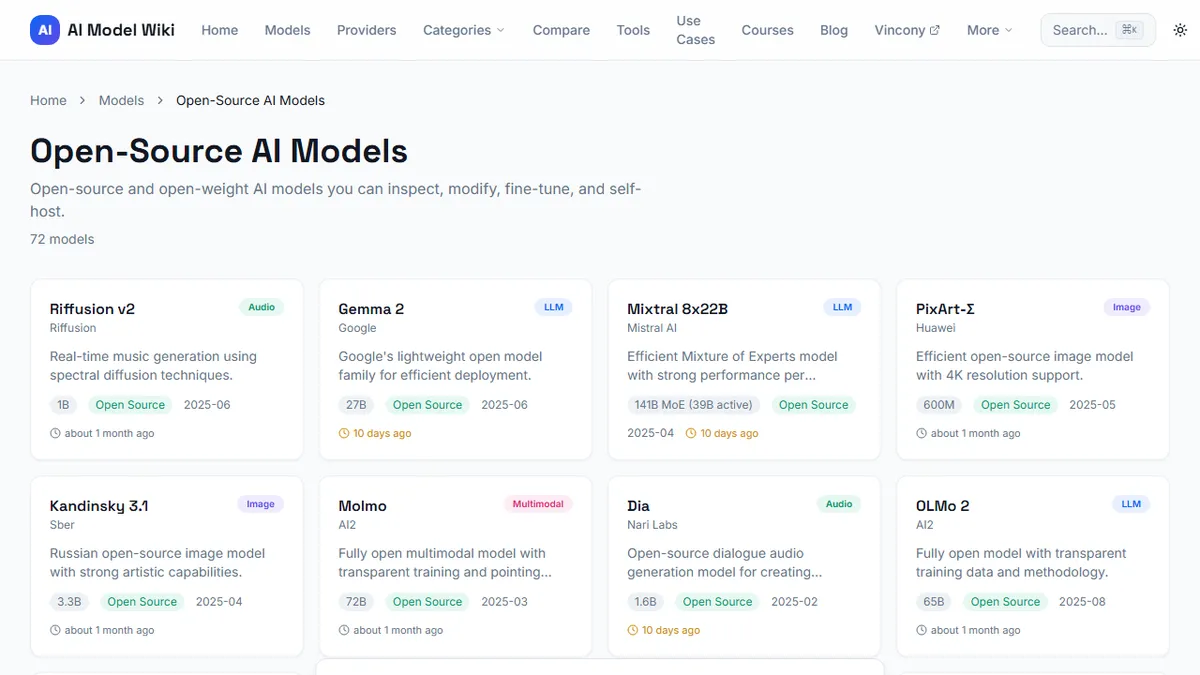
The open-source model catalogue with specs and licensing gives a practical starting point for evaluating which open-weight models currently match closed models on specific capability dimensions. That gap has closed substantially over the past two years, which changes the calculus for many teams who previously defaulted to proprietary APIs because open alternatives were not competitive.
The Five Axes That Actually Drive the Decision
A structured comparison of open and closed models should evaluate five dimensions.
Cost structure determines whether you are paying for usage (API pricing) or infrastructure (compute plus maintenance). Open models shift the cost from variable to fixed, which benefits high-volume use cases and penalises low-volume ones.
Data control concerns whether your inputs and outputs leave your infrastructure. Closed API calls send data to a third-party server. Self-hosted open models keep everything in your environment.
Compliance requirements cover data residency, audit logging, and the contractual obligations that some regulated industries impose on AI systems. These sometimes mandate specific deployment architectures.
Capability gap measures whether the open model can actually do the job at the quality level you need. This gap is task-dependent and changes with model releases.
Operational capacity asks whether your team can handle model hosting, updates, monitoring, and incident response. A model you cannot maintain reliably is not cheaper than a managed API. It is more expensive once you account for the incidents.
Cost Modelling: Total Cost of Ownership for Self-Hosting
The cost advantage of open models is real but frequently overstated by people who count only compute and forget everything else. The full cost of self-hosting an open-weight model includes GPU or accelerator provisioning, infrastructure management overhead, serving layer engineering, model updates and regression testing, and incident response when outputs degrade or the serving infrastructure fails.
For a team running a model at high query volume, the math often favours self-hosting once monthly API costs cross a threshold that depends on team size and infrastructure familiarity. The break-even point varies widely: a team with existing GPU infrastructure and ML engineering capacity might break even at a much lower volume than a product team with no infrastructure experience.
The trap is calculating compute costs in isolation and presenting that as the TCO. A rigorous cost model includes all of these components, and the honest version of that calculation sometimes reverses the apparent advantage.
Compliance and Data Residency: When Open Source Is Mandatory
Some deployment contexts effectively mandate open-source models regardless of capability comparisons. Healthcare applications subject to HIPAA, financial services under MiFID or similar frameworks, government systems with data sovereignty requirements, and any application processing sensitive personal data under GDPR with restrictions on third-country transfers may all require data to remain within a defined boundary.
Open-weight models deployed on controlled infrastructure satisfy these requirements by design. Closed API calls to US-based servers raise data protection questions that legal teams in regulated industries will not wave through, regardless of vendor data processing agreements.
For teams in these sectors, the compliance check comes before the capability check. If your regulatory environment requires data to stay in your infrastructure, the evaluation shortlist is entirely open models, and the remaining question is which open model is most capable for your task.
Capability Gap: Where Closed Models Still Lead
Honest evaluation acknowledges that as of 2026, the most capable models on reasoning-heavy tasks, complex coding, and multi-step instruction following are still closed proprietary systems. The open-weight leaders (Llama 4, Mistral's larger variants, and several others) have closed the gap substantially on many tasks but have not eliminated it.
The capability gap is most pronounced on complex multi-step reasoning, nuanced instruction following, and tasks that require drawing on broad knowledge combined with sophisticated synthesis. On narrower tasks (document summarisation, structured data extraction, code generation for common patterns, language translation), open models often match or closely approach closed models.
The editorial analysis of open versus closed model trade-offs tracks this gap with task-specific benchmark comparisons and updates as new releases change the picture.
A Simple Scoring Matrix for Your Team
A scoring matrix is more useful than a recommendation because it makes your team's specific trade-offs explicit. Rate each of the five axes (cost, data control, compliance, capability, operational capacity) on a scale of how much that axis matters for your project (high, medium, low). Then evaluate each option against each axis.
The pattern that emerges is usually clear. If data control and compliance are high-priority and capability requirements are moderate, open models score well. If you need frontier capability, have low compliance constraints, and lack infrastructure capacity, closed API access is the rational choice. Most projects do not fall at the extremes; they have a mix that the matrix makes transparent.
Hybrid Architectures: Using Both Without Complexity
The binary framing obscures a practical third option that many mature AI teams already use: hybrid deployment that routes different task types to different models based on sensitivity, capability requirements, and cost.
A typical hybrid architecture uses a locally-deployed open model for tasks involving sensitive data or requiring data residency — customer record processing, internal document analysis — while routing capability-intensive tasks with no data sensitivity concerns to a closed API. The routing logic is simple; the result is that you pay for frontier capability only when you genuinely need it and keep everything that requires data control inside your own infrastructure.
Building this architecture from the start, rather than migrating to it after outgrowing a single-model setup, costs little additional complexity and avoids the vendor lock-in that makes later migrations expensive.