On this page
Criminal vs. Civil Defamation: Why the Distinction Matters
Most legal systems provide some mechanism for a person whose reputation has been damaged by false statements to seek redress. The critical structural question is not whether that mechanism exists but what form it takes. A civil defamation claim allows the harmed party to seek compensation through a damages award, requires them to bear the costs and risks of bringing the claim, and produces an outcome that is proportionate to the financial harm caused. A criminal defamation charge requires nothing from the complainant beyond filing a complaint. The state takes over the prosecution, the defendant faces the possibility of imprisonment, and the asymmetry of resources between the accused and the prosecuting authority shifts dramatically.
Criminal defamation prosecutions do not just resolve disputes between two private parties. They place the coercive power of the state behind one party's account of events, threaten the other party with imprisonment, and create the bail-denial and plea-pressure dynamics that accompany criminal charges generally. That structural difference explains why a growing number of countries have abandoned criminal defamation entirely, not because reputation is unimportant, but because the criminal mechanism is disproportionate to the harm it addresses and prone to weaponisation by those with the resources to initiate prosecutions.
Thailand's Computer-Related Crime Act §14: The Text and the Ceiling
Thailand criminalises defamatory speech through two overlapping frameworks. The Criminal Code's §326 to §328 cover traditional defamation, with a maximum sentence of two years. The Computer-Related Crime Act, enacted in 2007 and amended in 2017, adds a separate offence under §14 that applies specifically to content published through electronic means (websites, social media, messaging applications). The maximum penalty under §14 is five years imprisonment, plus a fine.
The practical consequence is that posting content online that would attract a two-year maximum under the traditional Criminal Code provision instead attracts a five-year maximum under the Computer Act. The internet does not merely extend the reach of defamatory speech. Under Thai law, it increases the statutory ceiling by 150 percent. That ceiling exists for a category of communication that has become the ordinary mode of expression for most of the population. A social-media post, a comment in a community group, or a message forwarded to friends that is alleged to damage someone's reputation can, in Thailand, produce a five-year criminal exposure for the person who sent it.
Norway at Zero, Sweden at Six Months, Thailand at Five Years
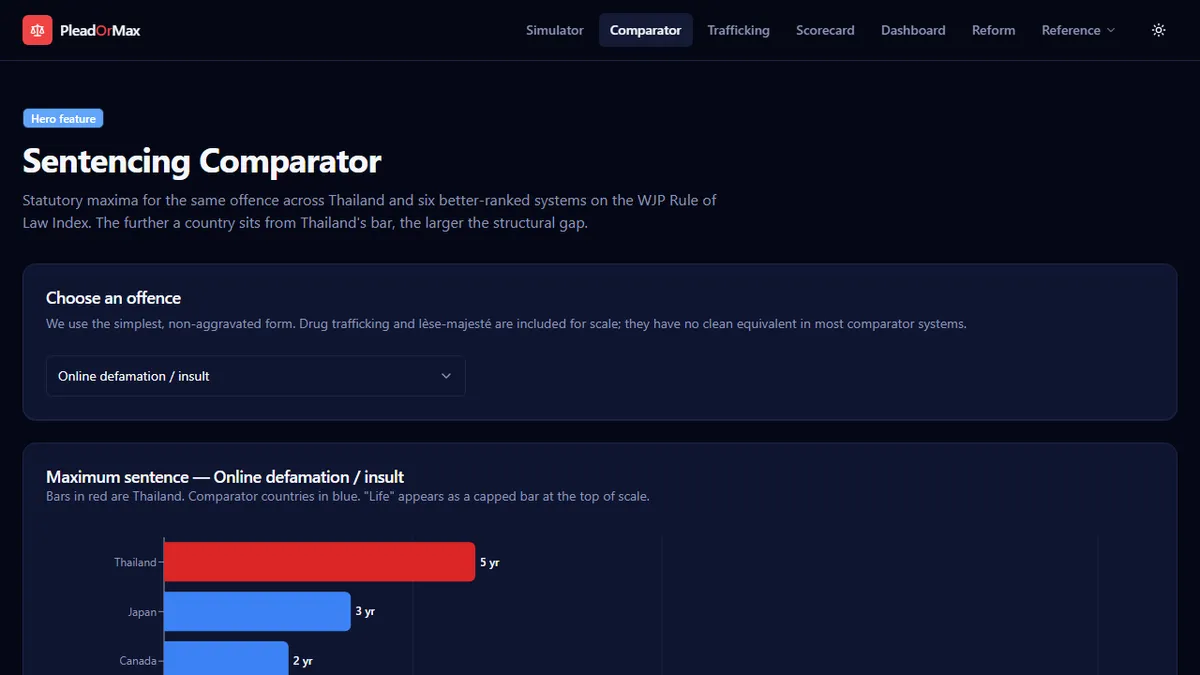
Examining statutory maxima for online defamation across seven countries against the WJP Rule of Law Index reveals a pattern that is difficult to explain as coincidence. Norway, ranked second globally, decriminalised defamation entirely in 2015. The provision was repealed following a long-running debate that concluded criminal sanctions were unnecessary where civil remedies existed and disproportionate in the rare cases where they were invoked. The Norwegian statute now reads zero: there is no criminal penalty for any form of defamatory speech, however published.
Sweden, ranked fourth globally, retains a provision with a maximum of six months. The Netherlands, seventh, also carries approximately six months. Canada, twelfth, has a provision with a two-year maximum, though its use has become increasingly rare and subject to constitutional challenge. Japan, sixteenth, carries a three-year maximum but applies it narrowly. Singapore, seventeenth, sits at two years.
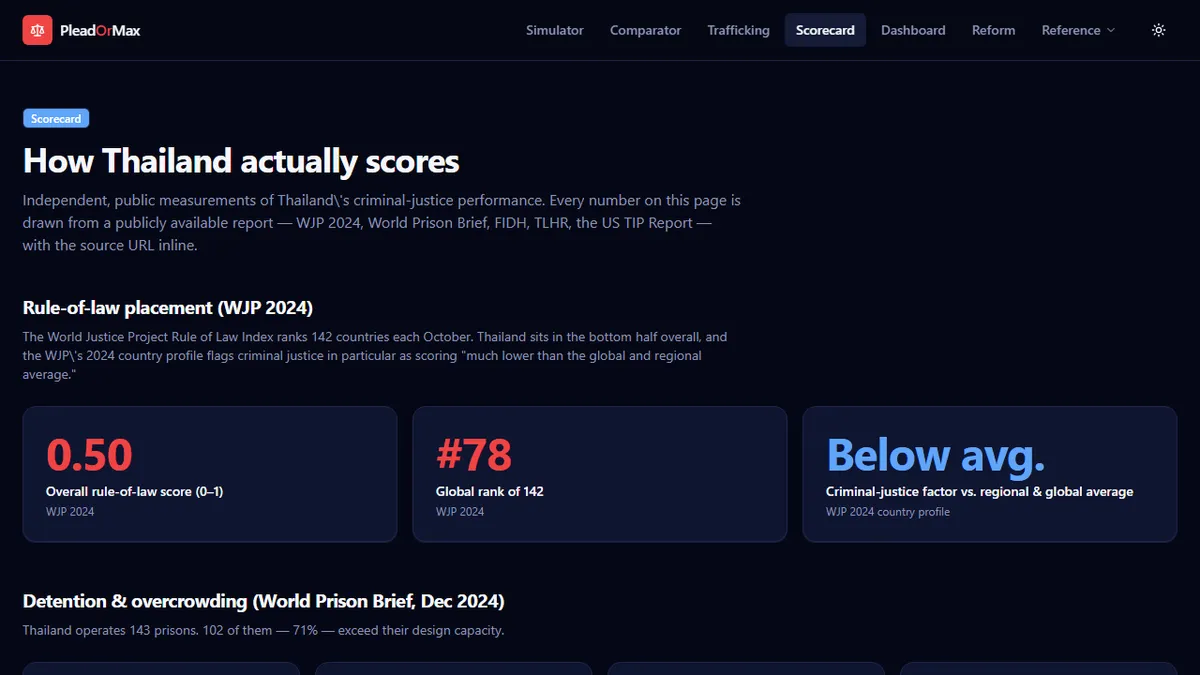
Thailand, at 78th, imposes five years — the highest ceiling of any country in the comparison set, and more than eight times the maximum available in Sweden or the Netherlands. The inverse correlation between rule-of-law ranking and criminal-defamation ceiling is not perfect, but the direction of the relationship is consistent across all seven data points.
Japan's 99% Conviction Rate as a Parallel Warning
Japan's presence in the comparison set introduces a different kind of concern. Japan's near-99 percent criminal conviction rate reflects a system in which cases are rarely brought to trial unless conviction is essentially assured. Prosecutors routinely decline to charge where the outcome is uncertain, meaning that the small number of cases that do proceed to verdict represent a pre-filtered set. This structural feature is different from Thailand's, but the outcome it produces for defendants who do face charges has a superficial resemblance: contesting a charge in a system with a near-certain conviction rate exposes the defendant to the full maximum without the §78 discount equivalent.
Japan's three-year maximum for online defamation is not the structural problem — the conviction rate dynamic is. The parallel with Thailand is not in the statute books but in what both systems tell defendants about the rationality of contesting charges: in environments where the systemic odds strongly favour conviction, the decision to plead guilty is partly rational even when guilt is contested.
Why Criminalising Insult Distorts the Plea Decision
Criminal defamation is particularly prone to producing coerced guilty pleas because the conduct it covers is often ambiguous. Unlike theft or assault, where the physical facts are relatively clear, defamation involves judgements about truth, interpretation, and intent that are genuinely contested. A defendant charged with posting an allegedly defamatory statement online may have strong grounds to contest whether the statement is false, whether it was understood in the alleged sense, or whether it was made in good faith based on available information.
But under Thailand's §14, contesting those questions means remaining subject to the bail conditions of a criminal defendant (potentially in custody, certainly under legal costs) while the case proceeds. The five-year statutory maximum, combined with the uncertainty of outcome, means that the §78 discount applies to a category of case where the underlying conduct is genuinely ambiguous and where the most rational choice for a defendant who cannot afford a prolonged legal contest is to accept the reduction and move on.
That incentive structure is not what criminal defamation was designed to produce. It is, however, what any system of criminal speech penalties tends to generate when combined with high statutory ceilings and normal plea-pressure mechanics.
The Reform Case for Civil-Only Defamation
The transition from criminal to civil-only defamation is not an ideologically contentious reform. It has been carried out by governments across the political spectrum in countries including Norway, the United Kingdom, the Republic of Ireland, and most of Western Europe over the past thirty years. The reform case rests on a simple argument: civil remedies are sufficient to protect reputation, they are proportionate to the harm caused, and they do not create the coercive plea-pressure dynamics that criminal prosecution generates.
Removing the criminal element does not mean that reputation becomes unprotected. It means that the mechanism for protecting it is one in which the state's coercive power is not mobilised against the person who made the statement, and in which the resolution of disputes about truth, context, and intent is handled in a forum where neither party faces imprisonment as a possible outcome. Countries that have made this transition consistently rank above Thailand on every available measure of press freedom, civil liberties, and rule-of-law performance.