On this page
Why Stablecoins Still Fail: A Brief History of Depegs
The word "stablecoin" implies a level of certainty that the history of the asset class has repeatedly failed to deliver. The catastrophic failure of TerraUSD in 2022 erased tens of billions of dollars of value within days. Iron Finance's IRON token collapsed in 2021. TrueUSD temporarily lost its peg in 2023 amid concerns about reserve transparency. Even USDC, widely regarded as one of the most conservatively managed dollar-pegged tokens, experienced a brief deviation from its peg in March 2023 when its issuer Circle disclosed significant reserve deposits at Silicon Valley Bank at the moment of that institution's collapse.
These events share a pattern. In each case, on-chain peg data began deteriorating before the depeg made mainstream news. And in each case, social discussion of risk-related keywords (terms like "reserve proof," "redemption paused," "bank run," and the specific issuer's name in anxious contexts) began circulating in advance of the price movement.
The confidence score is built specifically to detect these early-warning conditions. Rather than telling you simply that a stablecoin is trading at $1.00 right now, it tells you how stable that peg has been recently, what social commentary is saying about the issuer, and whether risk-related language is accumulating in ways that suggest deteriorating confidence.
Inside the Confidence Score: Peg Deviation, Sentiment, Risk Keywords
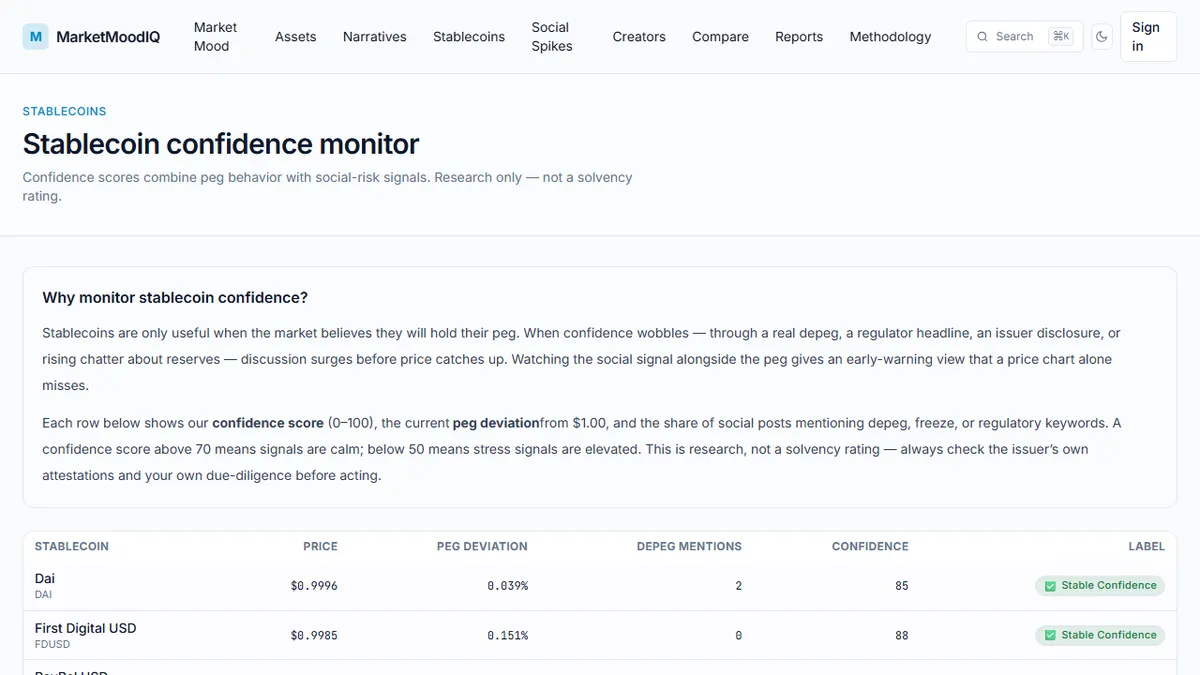
The confidence score combines three distinct data streams into a single zero-to-one-hundred rating. Higher is better: a score of 100 indicates a stablecoin with minimal peg deviation, positive social sentiment, and near-zero risk-keyword incidence. Lower scores indicate one or more of these inputs flashing concern.
The first input is peg deviation, the fractional difference between the token's current market price and its target value of one dollar. A stablecoin trading at $1.0012 has a positive deviation of 12 basis points. One trading at $0.9985 has a negative deviation of 15 basis points. Small deviations in either direction are normal and expected; they reflect the mechanics of arbitrage maintenance. Large or rapidly growing deviations are early indicators of structural stress.
The second input is sentiment, the overall tone of social commentary mentioning the stablecoin. For most functioning stablecoins, sentiment is mildly positive or neutral; the token is mentioned in the context of utility rather than speculation. When sentiment begins moving negative without a corresponding positive news event, it suggests that a portion of the community is developing concerns about the token's stability or its issuer's practices.
The third and most distinctive input is risk-keyword detection. The monitoring system scans social posts and news mentions for language patterns associated with historical depeg events: queries about reserve composition, discussions of redemption limits, comparisons to past failures, and explicit expressions of concern from market participants. When these keywords begin accumulating, the confidence score drops even if the peg and general sentiment have not yet moved significantly.
Reading Peg Deviation: Why 12 Basis Points Matters
Peg deviation is expressed in basis points (hundredths of a percentage point) because the relevant differences are genuinely small in normal conditions. A deviation of three to fifteen basis points is effectively noise, maintained naturally through arbitrage activity by traders who buy when the price dips below $1.00 and sell when it rises above. Most well-capitalised, well-redeemable stablecoins operate within this range essentially all the time.
Deviation above 20 to 30 basis points begins to indicate that arbitrage is failing to maintain the peg at its normal efficiency. This can happen because redemption mechanisms are temporarily strained, because uncertainty about reserve quality is reducing arbitrageurs' confidence in claiming the underlying dollar, or because a specific negative event is depressing demand for the token.
A deviation above 100 basis points (one full percent from the peg) is a genuine alert condition. At that point, the mechanism is clearly under stress, and the question shifts from whether there is a problem to how severe the problem is and whether it will self-correct.
The live peg deviation and confidence scores for major stablecoins display current deviations alongside rolling trend data, so you can see whether a current deviation is isolated or part of a widening pattern. A stablecoin with a 25-basis-point deviation today that was at 8 basis points three days ago is showing a different risk profile from one that has consistently maintained a 25-basis-point deviation for two weeks.
USDC vs USDe vs TUSD: A Confidence Score Comparison
Looking at current confidence data across three contrasting stablecoins illustrates what the score distribution actually looks like in practice.
USD Coin posts a confidence score of 100 with a peg deviation of just three basis points. This reflects its combination of near-perfect peg stability, broadly positive institutional sentiment around Circle's compliance posture, and an absence of risk-keyword accumulation in its social coverage. It is the top of the confidence distribution, the reference point against which other stablecoins are implicitly measured.
Ethena USDe presents a different profile. Its confidence score of 78 and a peg deviation of eight basis points reflects a stablecoin that is technically functioning well — the peg is tight, deviations are small — but carries a sentiment and risk-keyword discount reflecting the community's awareness that its delta-neutral design carries specific risks not present in fiat-backed tokens. USDe is genuinely novel in structure; the confidence score captures that the community has not yet fully resolved its questions about what happens during extreme market stress.
TrueUSD sits at confidence 85 with a seven-basis-point deviation. Its score reflects adequate peg maintenance but a persistent undercurrent of social caution stemming from its history of transparency-related concerns. The peg is currently holding; the community's memory of past questions about reserve attestation continues to weigh on its sentiment component.
Red Flags to Watch: When Score Drops Before the Peg Breaks
Confidence score deterioration typically precedes overt peg stress by hours to days, not seconds. This is the interval in which the score is most useful — not as a confirmation of a depeg that has already occurred, but as a signal that conditions are worsening before the market price has fully responded.
The most reliable red-flag pattern is a confidence score dropping several points over two to three consecutive days while the peg deviation remains within normal range. This combination suggests that risk-keyword incidence or sentiment is deteriorating without the market price mechanism having yet reflected the concern — exactly the early-warning condition the score is designed to surface.
A sudden single-day confidence drop of ten or more points without a clear external cause warrants immediate investigation. It may reflect a specific piece of negative news circulating in the community that has not yet reached mainstream sources, reserve-related concerns being discussed in professional forums, or an increase in redemption activity that experienced participants are tracking before it becomes public information.
How to Use Stablecoin Confidence as Part of a Risk Checklist
For anyone holding meaningful balances in dollar-pegged tokens — whether as trading capital, yield positions, or collateral in DeFi protocols — a weekly review of stablecoin confidence scores is a practical risk management step that takes under five minutes.
The check does not require acting on every small movement. Instead, it creates awareness of the ongoing relative health of your holdings and flags when something warrants closer attention. A stablecoin that holds at confidence 95 to 100 over several consecutive weeks is one you can hold without active monitoring. One that has drifted from 92 to 85 to 79 over three weeks is one that deserves investigation regardless of whether the peg is currently intact.
When confidence drops below 80, it is worth reading the underlying community discussion to understand what is driving the change. Below 70, the combination of peg deviation trends, redemption mechanics, and reserve documentation all deserve explicit review before maintaining a large position.