On this page
What the N1 Implant Actually Is (Hardware Basics)
Neuralink's N1 device is a coin-sized package (roughly 23 millimetres in diameter) that sits flush with the skull after a section of bone is removed and replaced. The surgery is performed by a dedicated robotic system that Neuralink designed specifically for the implantation procedure, because the precision required to place 64 thin threads across a small cortical region far exceeds what manual surgical technique can reliably achieve.
Those 64 threads, each finer than a human hair, carry a total of 1,024 electrodes. The electrodes sit in the motor cortex (the region of the brain responsible for planning and initiating voluntary movement) and record the electrical activity of nearby neurons. The device samples that signal at high speed, processes it onboard to extract meaningful patterns, and transmits the data wirelessly over a Bluetooth connection to an external device such as a computer or phone.
The battery charges wirelessly through the skin, which means there are no external connectors and no wires penetrating the skin barrier. This reduces the infection risk that has historically made long-duration brain implants difficult to maintain. The N1 is designed to sit in place indefinitely, with the expectation that patients will use it daily rather than removing and replacing it.
What Trial Participants Can Do Right Now
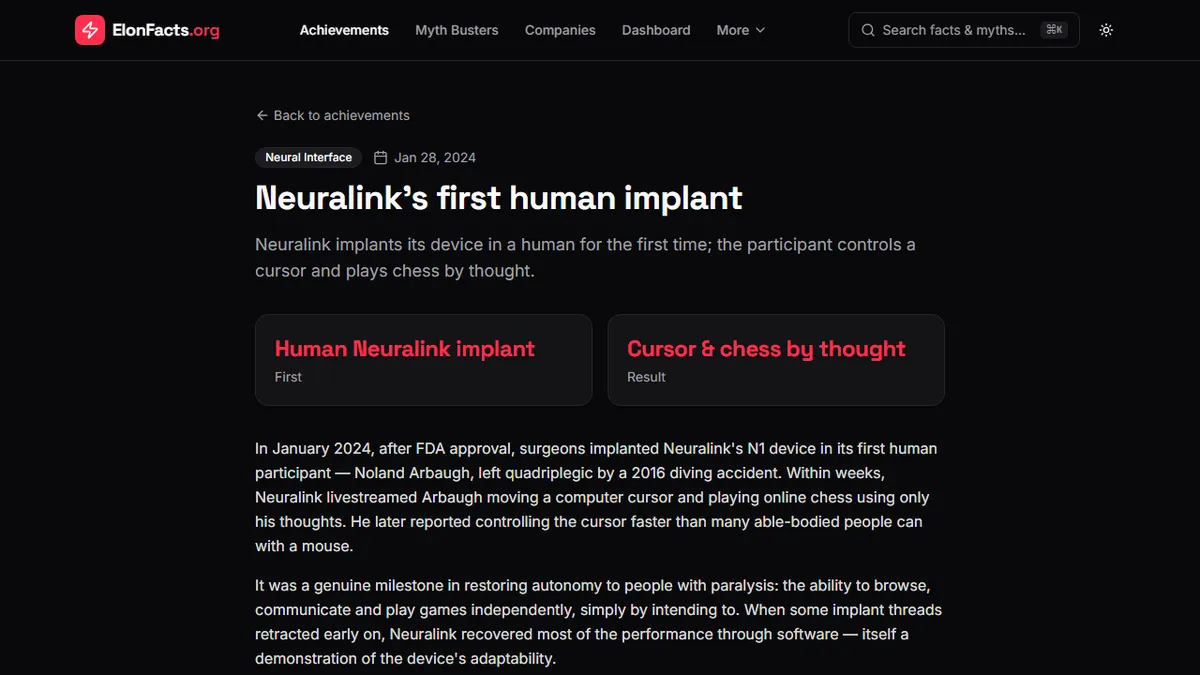
In January 2024, after receiving FDA approval for its human trial, Neuralink implanted the N1 device in its first participant: Noland Arbaugh, who had been paralysed from the shoulders down since a 2016 diving accident. The results, demonstrated in a Neuralink livestream weeks after surgery, were unambiguous.
Arbaugh moved a computer cursor smoothly across a screen using thought alone. He played online chess. He used the cursor to control applications and browse the internet. He subsequently reported that his cursor speed exceeded what many able-bodied users achieve with a conventional mouse, and that he could play for extended sessions (up to ten hours in one case) before fatigue became a factor.
For a full account of what Arbaugh and subsequent participants achieved, the documented outcomes from Neuralink's first human implant in January 2024 cover the clinical detail. By early 2026, at least 21 people had received the implant across sites in the United States, Canada, the United Kingdom, and the UAE, with zero serious adverse device events reported across the trial cohort. Participants have used the device to type messages, create digital art, and control multiple applications simultaneously.
A technical setback occurred in Arbaugh's case when several implant threads retracted from the cortical tissue in the weeks following surgery — a known risk with flexible thread arrays. Neuralink recovered most of the lost performance through software adjustments that recalibrated the decoding algorithm to work with the remaining functioning electrodes. This was considered a demonstration of the system's adaptability as well as a prompt for hardware refinement.
The Blindsight Vision Implant: FDA Breakthrough Designation Explained
Alongside the motor cortex implant work, Neuralink is developing a separate product called Blindsight, designed to restore a form of vision in people who have lost both eyes and the optic nerve (the pathway through which visual signals normally travel from the eye to the brain).
Blindsight bypasses the eye entirely by stimulating the visual cortex directly. Electrodes placed on the visual cortex create patterns of electrical stimulation that the brain interprets as visual impressions. Early versions would produce low-resolution perception (enough to detect shapes, movement, and contrast rather than detailed imagery) with the long-term engineering goal of increasing resolution over time as the technology matures.
In September 2024 the FDA granted Blindsight a "breakthrough device" designation, a regulatory category reserved for devices that treat serious conditions and show the potential to be substantially better than existing alternatives. The designation accelerates the review process and enables closer collaboration between Neuralink and FDA reviewers during development. It does not mean the device is approved or proven to work in humans, but it reflects the FDA's assessment that the technology warrants prioritised attention.
Animal Testing Controversy: What the FDA Requires and Why
Neuralink's animal testing programme attracted significant press coverage and regulatory attention. Reports of animal deaths during pre-clinical experiments circulated and were genuine: some animal subjects died during or after procedures.
What the coverage often omitted was context. Animal testing is an FDA requirement for medical devices intended for human implantation, not a choice Neuralink made unilaterally. The preclinical phase is designed to identify risks and failure modes before any human participant is enrolled. The deaths occurred in the context of that required testing programme and were reported to the FDA as required.
A 2023 USDA inspection found some procedural violations at Neuralink's facility, and those findings were reported and subsequently addressed. The FDA reviewed Neuralink's full preclinical package before issuing the Investigational Device Exemption that allowed the human trial to begin, meaning the regulator concluded the risk profile was acceptable for a controlled first-in-human study.
The criticism that Neuralink was cavalier about animal welfare during testing is worth examining against the regulatory record. The FDA's approval of the human trial indicates that the agency found the preclinical work sufficient, which does not mean the programme was perfect but does mean it met the regulatory standard.
What We Don't Know Yet: Longevity, Scaling, Ethics
The trial results to date answer the question of whether the N1 can restore meaningful motor function in paralysed patients in the short to medium term. They do not answer several larger questions.
Longevity: no one yet knows how a 1,024-electrode array will perform after five or ten years inside a human brain. Tissue responds to implants over time, and the long-term relationship between the device and the surrounding neurons is not yet characterised. Neuralink's trial will eventually answer this question, but it requires time.
Scaling: the current surgical robot can implant one device at a time, and each surgery takes several hours. If Neuralink's technology eventually moves beyond the paralysis population to wider applications, the implantation pipeline will need to be radically faster. That is an unsolved manufacturing and logistics problem.
Ethics: a device that reads brain signals raises questions about data privacy, consent, potential coercion, and the social implications of cognitive augmentation that are not addressed by clinical trial results. Neuralink has published a patient privacy policy, but the broader ethical architecture around neural data regulation does not yet exist at the policy level.
How Neuralink Compares to Other BCI Research
Brain-computer interface research predates Neuralink by decades. The BrainGate consortium, which includes teams from Brown University, Stanford, and Massachusetts General Hospital, has conducted human BCI implant research since the early 2000s using the Utah Array, a different electrode configuration than Neuralink's thread-based design. BrainGate participants achieved cursor control and rudimentary communication using neural signals years before Neuralink's first human implant.
The difference Neuralink introduced is primarily one of scale, miniaturisation, and wireless design. The Utah Array is connected to external hardware via a physical cable that exits the skull: functional for clinical research but impractical for unsupervised daily use. Neuralink's fully implanted, wirelessly charging, Bluetooth-transmitting device is engineered for integration into normal daily life rather than supervised laboratory use.
For a calibrated view of what has been demonstrated versus what remains aspirational, the evidence-vs-hype breakdown for Neuralink's current capabilities places the trial results in the context of the broader BCI research landscape. The N1 is a genuine clinical advance, not simply a rehash of existing work. But the longer arc of restoring full motor function, treating neurological disease, and eventually expanding cognitive capacity remains an agenda for years or decades of further development.