Why Cost Surprises Happen
The researcher who budgets for three peptides and finds themselves short on supplies in week seven of a twelve-week protocol did not make an error of intent — they made an error of planning. The mechanics that produce supply shortfalls in peptide research are almost always traceable to one of three mismatches: dose frequency was planned but the number of administrations per week was never multiplied by the protocol duration; vial sizing was selected without checking whether the total milligrams required divides cleanly into available vial configurations; or consumable costs (bacteriostatic water, syringes, swabs) were excluded from the initial budget as afterthoughts.
Fixing these errors costs time and often money, because reordering supplies mid-protocol involves expedited shipping and, sometimes, discontinued availability. The solution is not sophisticated. It is sequential arithmetic done before any order is placed.
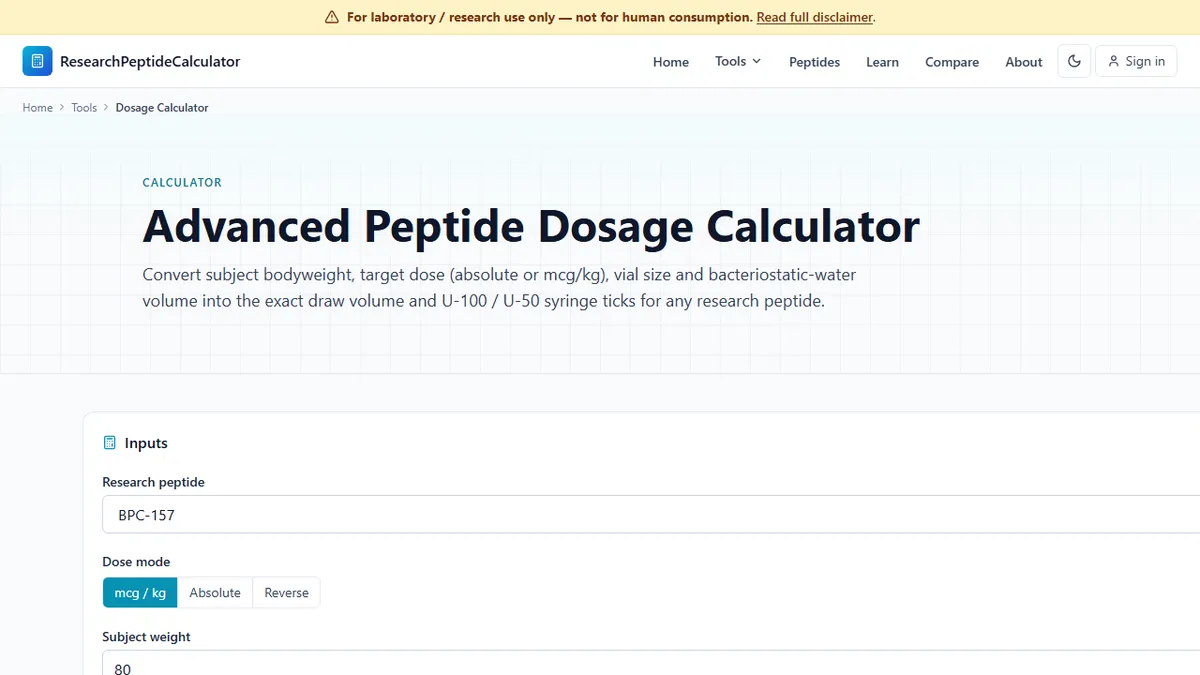
The Core Mathematics: Administrations, Total mg, Vials Needed
The calculation chain for any single peptide in a protocol has three steps, each building on the last.
First, calculate the number of administrations per cycle. A daily peptide across a twelve-week protocol produces 84 administrations. Twice-weekly produces 24. Every-other-day produces 42. The specific number depends on the protocol duration and administration frequency, and it must be calculated for each peptide separately because different compounds in the same protocol may have different schedules.
Second, calculate the total milligrams required. Multiply the dose per administration in milligrams by the number of administrations. A peptide administered at 500 mcg daily for twelve weeks requires 0.5 mg per day multiplied by 84 days, equalling 42 mg total. A peptide administered at 2 mg twice weekly for twelve weeks requires 2 mg multiplied by 24 administrations, equalling 48 mg total.
Third, calculate the number of vials needed. Divide the total milligrams required by the vial size and round up to the nearest whole number: partial vials cannot be purchased in fractions. A 42 mg requirement against 5 mg vials needs nine vials. The same requirement against 10 mg vials needs five. The vial size chosen has a direct effect on the number of items to purchase, but not necessarily on the total cost, which is where the bulk comparison becomes necessary.
Single-Vial vs Bulk-Vial Pricing: When Cheaper Unit Price Costs More
Suppliers typically offer peptides in multiple vial configurations, with larger vials priced at lower cost per milligram. The instinct is to choose the cheapest per-milligram option, but this is only correct when the larger vial is fully consumed within the protocol's stability window.
A reconstituted peptide vial has a stability window of 14 to 28 days under refrigeration. If a 10 mg vial is reconstituted but only 7 mg will be used before the 28-day limit, 3 mg (30% of the vial) goes to waste. The effective cost per milligram used rises accordingly. In contrast, if the protocol requires exactly 10 mg or slightly more, the 10 mg vial is fully utilised and the cheaper unit price applies.
The calculation to run is: divide the total milligrams required by the vial size, determine how many vials are needed at each available size, compute the total cost at each configuration, and compare. The cheapest-per-milligram option is not always the cheapest total option once waste from partially used vials is factored in.
This comparison changes as protocol duration extends. A twelve-week protocol with daily administration may have enough total volume to make large-vial purchases clearly optimal. A four-week protocol with twice-weekly administration may produce enough residual waste from large vials that smaller vials are cheaper in total, even at a higher per-milligram rate.
Factoring in Consumables
The consumable costs that most researchers underestimate are bacteriostatic water, syringes, and alcohol swabs. None of these is expensive individually, but across a twelve-week multi-peptide protocol they accumulate.
Bacteriostatic water is consumed once per new vial reconstitution. A 30 mL bottle supports roughly ten vial reconstitutions at a standard 2 to 3 mL per vial addition. If a protocol requires nine vials of one peptide and five of another, at least fourteen reconstitution events will occur, requiring two 30 mL BAC water bottles.
Syringes are consumed at one per administration. A protocol with 84 daily administrations of one peptide and 24 twice-weekly administrations of another requires 108 syringes at minimum. If a protocol includes a third peptide administered every other day, add 42 more. Total syringe count should be calculated exactly, not estimated.
Alcohol swabs are typically used twice per administration: once for the vial stopper and once for the injection site. At 2 swabs per administration across all peptides and all weeks, the swab count for even a modest three-peptide protocol exceeds 200 units.
Shipping costs are sometimes flat-rate and sometimes tiered by order size. Including shipping as a line item in the budget prevents the surprise of a substantial per-order fee across multiple separate orders.
A Worked Example: Three Peptides, Twelve Weeks
Consider a three-peptide protocol: BPC-157 at 500 mcg daily, TB-500 at 2.5 mg twice weekly, and ipamorelin at 200 mcg daily. Duration: twelve weeks.
BPC-157: 84 administrations at 0.5 mg = 42 mg required. At 5 mg vials, nine vials needed.
TB-500: 24 administrations at 2.5 mg = 60 mg required. At 5 mg vials, twelve vials needed.
Ipamorelin: 84 administrations at 0.2 mg = 16.8 mg required. At 5 mg vials, four vials needed.
Total administrations: 84 plus 24 plus 84 = 192. Syringes: 192. Alcohol swabs: 384. BAC water: 25 reconstitutions, requiring three 30 mL bottles.
This arithmetic takes under five minutes and transforms the budget from a guess to a commitment. Comparing available vial configurations at each step often reveals further savings: TB-500 at 60 mg total might be cheaper in 10 mg vials than 5 mg vials at some suppliers, or vice versa.
Currency-Agnostic Planning
Research peptide suppliers operate across multiple jurisdictions and currencies. A well-structured budget table is currency-agnostic — it records quantities, unit prices, and totals without pre-baking a specific currency assumption. When prices are entered in the researcher's local currency, the total follows automatically.
The case for vendor-neutral calculators is particularly strong here. A tool that pre-loads vendor prices introduces a selection bias toward whatever supplier the tool operator has a commercial relationship with. A tool that accepts user-entered prices respects the researcher's own vendor assessment while still doing the arithmetic accurately.
Using a Supply Planner
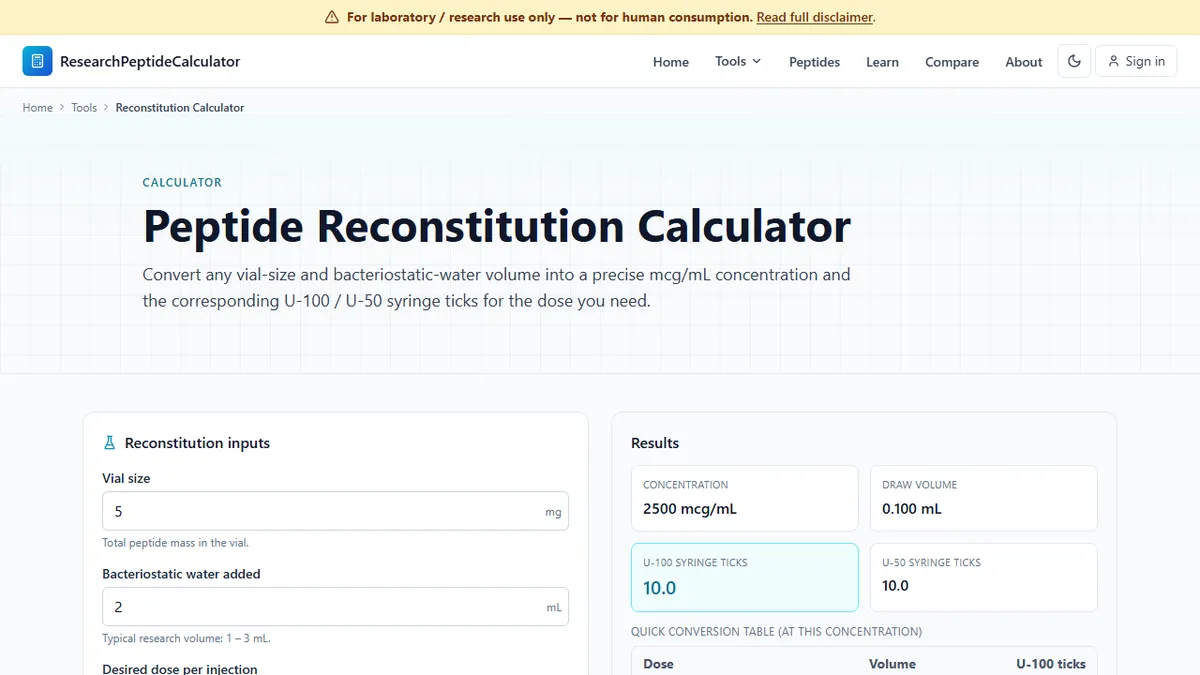
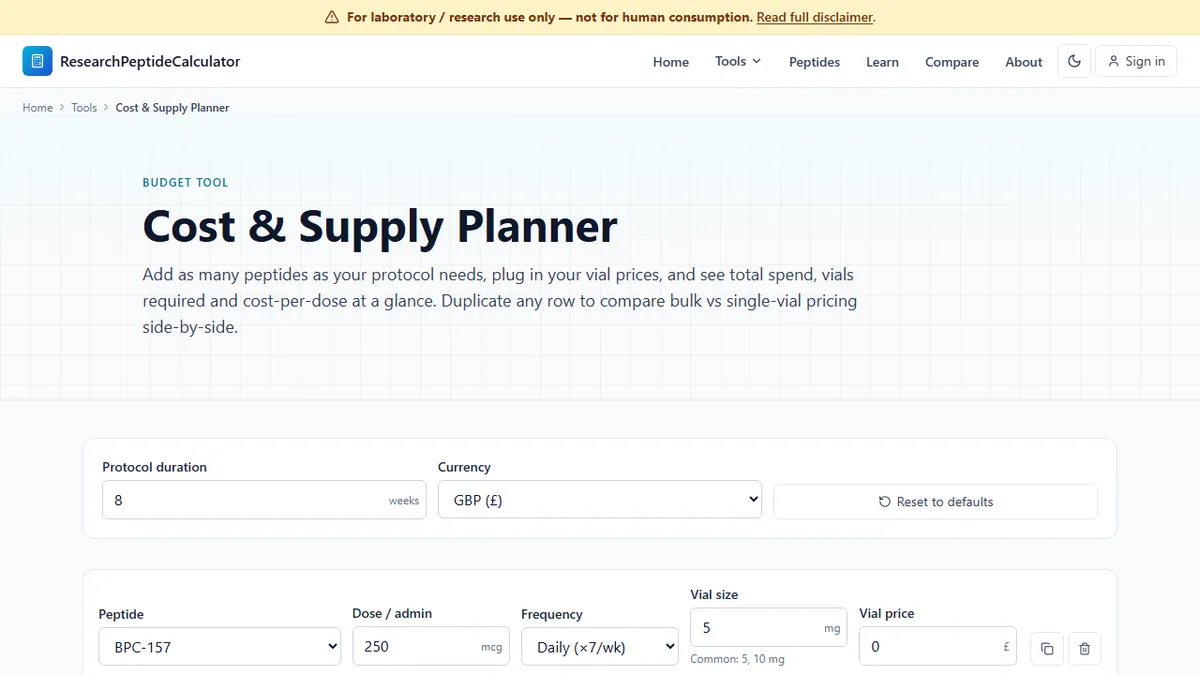
The sequential arithmetic above is straightforward to do manually once for a single peptide, but grows cumbersome for multi-peptide protocols where every row interacts with the others in terms of total syringe count, BAC water consumption, and shipping logic. A dedicated supply planning tool handles the row-level calculations and aggregates the totals automatically, including the bulk-versus-single-vial comparison.
To model vial quantities and total cost across a multi-peptide cycle, enter each peptide with its dose, frequency, vial size, and price, set the protocol duration and currency, and add consumable unit prices. The tool surfaces the cheapest vial configuration for each row and produces a grand total that includes every supply line. That total, confirmed before the first order is placed, is the only reliable defence against mid-protocol shortfalls.