On this page
PayPal's Origin: X.com Meets Confinity
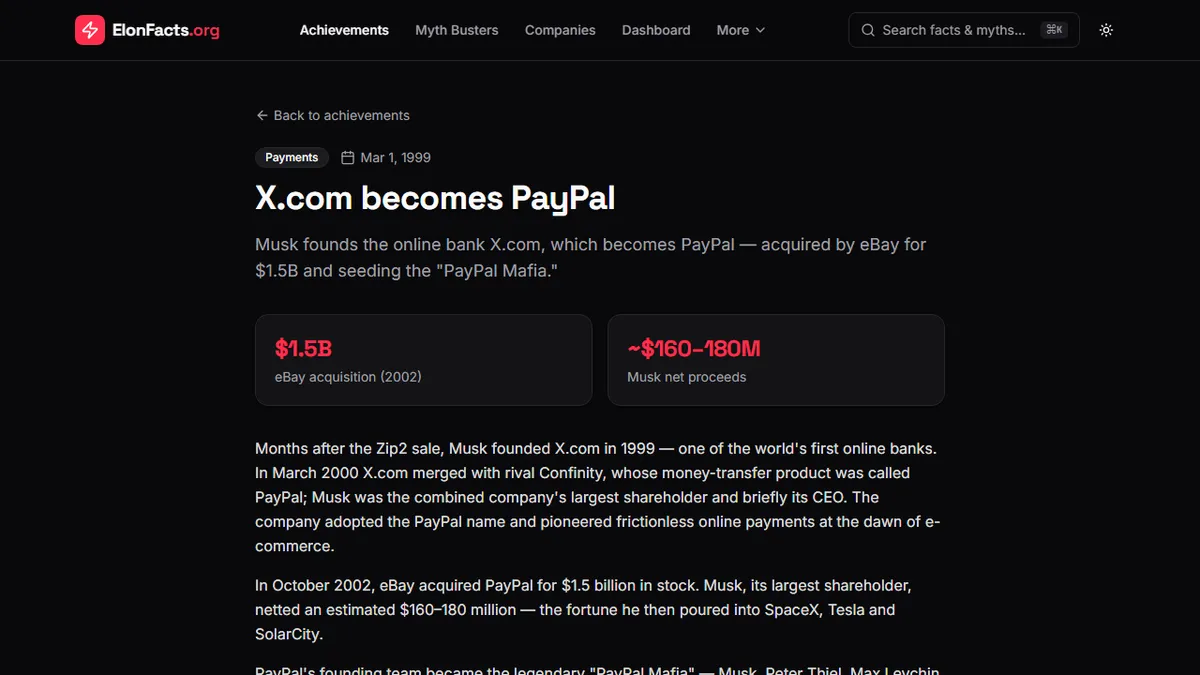
The story begins not with PayPal but with two competing startups working on adjacent problems. In March 1999, Elon Musk founded X.com in Palo Alto, one of the first federally insured online banks, designed to let people send money and manage finances entirely over the internet. Around the same time, Max Levchin and Peter Thiel were building Confinity, a company focused on cryptographic software for Palm Pilots that evolved into a money-transfer product they called PayPal.
The two companies were racing toward the same market from different directions and quickly found themselves locked in a competitive spiral. Rather than burn each other's resources fighting, they merged in March 2000. Musk, as X.com's largest shareholder, became the combined company's CEO. The merged entity faced fierce competition, a hostile regulatory environment, and the collapsing dot-com market — and survived all of them.
For the full timeline, the sourced timeline of X.com's merger with Confinity and the 2002 eBay acquisition covers the primary-source record in detail. The short version: Musk was eventually replaced as CEO during a board dispute while he was travelling, Peter Thiel took over, and the company (now operating exclusively under the PayPal name) navigated to a position where eBay acquired it in October 2002 for $1.5 billion in stock.
The $1.5 Billion Exit and Who Got What
A $1.5 billion all-stock acquisition in 2002 was a significant outcome by any standard, and it distributed large sums across a team that was, by the norms of that era, unusually young and unusually concentrated with capable operators.
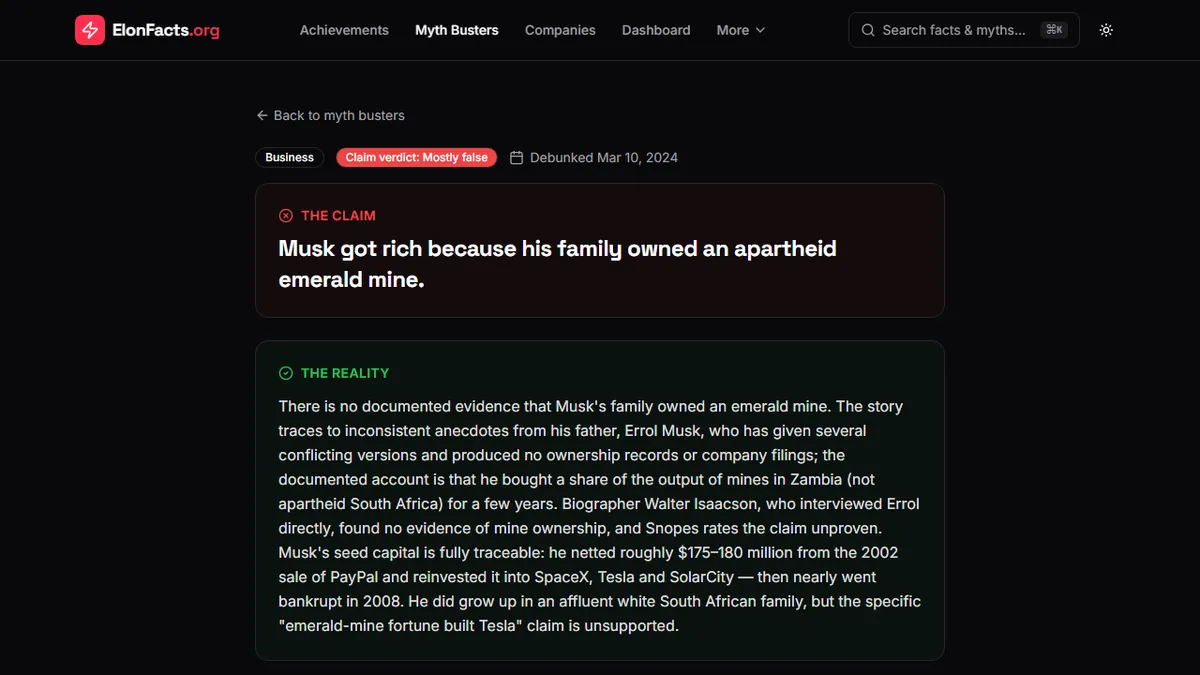
Musk, as the company's largest individual shareholder, received the most: estimates of his net proceeds from the eBay sale range from $160 million to $180 million. Peter Thiel, Max Levchin, Reid Hoffman, David Sacks, Luke Nosek, Ken Howery, Roelof Botha, and a dozen other early team members all received substantial payouts. Many were in their late twenties or early thirties with more capital than they could deploy into passive investments and temperaments that pointed strongly toward building new things.
The timing added to the potency of the exit. The acquisition closed in late 2002, less than a year after the most severe phase of the dot-com crash. A group of founders who had survived the crash, learned from building a genuinely hard product under genuinely difficult market conditions, and emerged with significant capital and compressed, difficult-earned experience was about to be let loose simultaneously.
Where the Money Went: Mapping the Companies Born After 2002
The companies that emerged from the PayPal network in the years following the eBay acquisition form a list that is difficult to explain without positing something unusual about the original team.
Reid Hoffman co-founded LinkedIn in 2002, which sold to Microsoft for $26.2 billion in 2016. Steve Chen, Chad Hurley, and Jawed Karim, who had worked at PayPal, founded YouTube in 2005, which Google acquired for $1.65 billion the following year. Peter Thiel co-founded Palantir in 2004 with Alex Karp and others; Palantir went public in 2020. Jeremy Stoppelman and Russel Simmons, both former PayPal employees, founded Yelp in 2004. David Sacks went on to found Yammer, acquired by Microsoft for $1.2 billion in 2012. Roelof Botha joined Sequoia Capital and led investments in YouTube, Square, and other major companies.
Elon Musk, despite receiving the largest individual payout, reinvested most of it rather than diversifying. He put approximately $100 million into the founding of SpaceX, roughly $6.5 million into Tesla's 2004 Series A, and the remainder into SolarCity alongside his cousins.
Elon Musk's Reinvestment Bet: $100M Into SpaceX, $7.5M Into Tesla
By his own account, Musk reinvested essentially all of his PayPal proceeds into his next ventures. The SpaceX investment was the most dramatic: $100 million into a rocket company at a time when no private venture had ever successfully placed a liquid-fuelled rocket into orbit, and when most aerospace engineers considered the idea hopelessly optimistic.
The Tesla investment was smaller in dollar terms but equally consequential. The $6.5 million he contributed to Tesla's 2004 Series A made him the largest shareholder and gave him effective control of the company's strategic direction. When Tesla came close to bankruptcy in 2008 (during the same period that SpaceX had failed three consecutive Falcon 1 launches), Musk invested his remaining personal capital to keep the company alive, reportedly borrowing money to cover personal expenses.
Both bets were within months of catastrophic failure at the same time. Both eventually produced companies worth hundreds of billions of dollars. The proximity of those near-failures makes the eventual outcomes more striking, not less.
The Network Effect: How PayPal Alumni Backed Each Other
What distinguished the PayPal network from other successful startup cohorts was not just that alumni founded companies but that they actively supported each other's subsequent ventures. Peter Thiel's Founders Fund was an early investor in SpaceX. PayPal alumni participated in funding rounds for each other's companies repeatedly across the following decade. The professional trust built under pressure at a single startup translated into investment relationships and advisory networks that persisted for years.
This dynamic is not accidental. Working together under the conditions PayPal operated in (a hostile regulatory environment, well-funded competition, a collapsing market backdrop, and leadership transitions) created tested relationships that most professional networks do not generate. When a PayPal colleague asked for investment or advice, the prior shared experience served as a highly compressed form of due diligence.
Thiel's 2014 book "Zero to One," drawn from a Stanford course he taught, became one of the most-read texts in Silicon Valley startup culture. Hoffman's LinkedIn became the professional network for the entire technology industry. Musk's SpaceX became the primary launch provider for American human spaceflight. The PayPal alumni network amplified itself through the companies its members built and the culture those companies created.
Why One Team Produced So Much
The question that historians of Silicon Valley return to repeatedly is why this particular cohort was so disproportionately productive. Several factors appear to matter.
The team was selected for unusually high tolerance for risk and unconventional thinking during PayPal's founding period, a time when internet finance was genuinely dangerous to attempt and the regulatory exposure was real. The crucible of a difficult product in a difficult market produced a group with hard-won judgment about what working technology looks like versus what sounds good in a pitch.
The timing of the exit also mattered. Receiving large capital after the dot-com crash, rather than during the frenzy, meant the alumni were deploying money into a market where asset prices had reset and competition was less frenzied. Founding in 2002 to 2005 meant reaching scale before the 2008 financial crisis tightened capital markets again.
And the network effect (the tendency of PayPal alumni to back each other, advise each other, and refer talent to each other) compounded the individual advantages into something larger than any single exit could explain on its own. The name "PayPal Mafia," coined by Fortune in a 2007 profile, captured something real even if the framing was partially tongue-in-cheek: a group of people whose professional relationships, shared capital, and mutual reinforcement functioned with the cohesion and mutual loyalty of something more than a professional network.